IN Brief:
- Northwood has closed a $375m Series C round to expand antenna manufacturing and satellite ground-network infrastructure.
- Portal phased arrays support simultaneous spacecraft contacts, while Prism dishes provide high-data-rate RF links.
- Six multi-orbit-capable sites are deployed; 100Gbps-plus capacity in selected regions remains a target for late 2027.
Northwood Space has closed a $375m Series C funding round to expand satellite ground-station manufacturing and its shared communications network. Andreessen Horowitz and DFJ Growth co-led the financing, which the California company will use to develop its Portal phased-array antenna production, Prism high-throughput dishes, and new network sites. A separate multi-year credit facility from HSBC Innovation Banking will support working capital and the buildout of ground infrastructure.
Northwood has deployed six multi-orbit-capable sites across two continents since its earlier financing round, according to its latest operating update. It also opened a 185,000-square-foot headquarters and factory in Torrance in September, increasing its manufacturing footprint more than fivefold. At full production, the facility is intended to produce hundreds of antennas annually. The November financing will expand established antenna production lines and the network locations they serve.
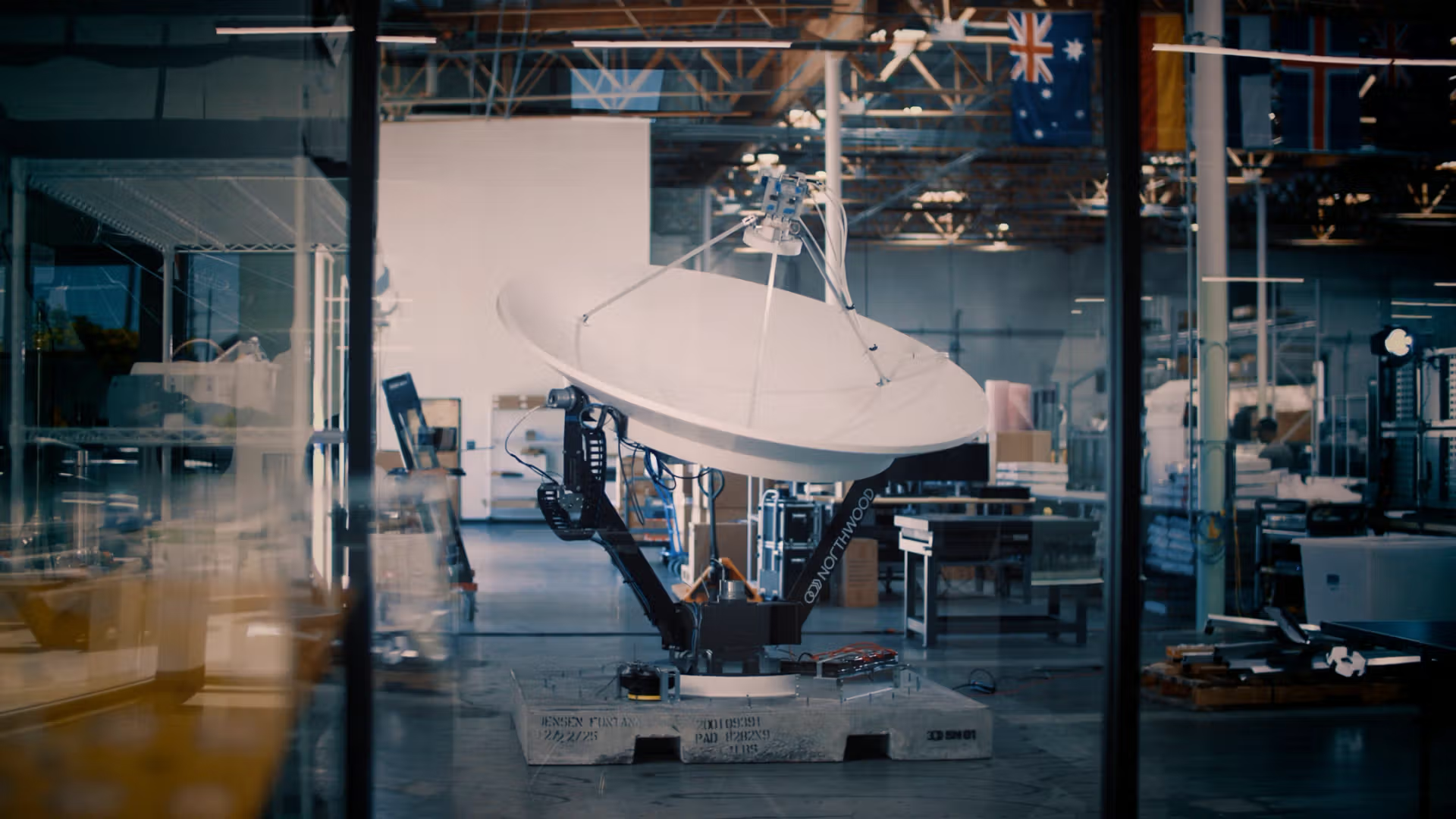
The company’s two principal antenna families serve overlapping but different communications requirements. Portal is a multi-beam phased array designed for simultaneous satellite contacts and precise command links. Prism uses a parabolic structure to provide high-data-rate RF communications, including payload downlinks, telemetry, tracking, and command. These functions impose different requirements on antenna gain, beam direction, operating frequency, and the time available for a contact as spacecraft move through the visible sky.
Portal’s phased-array architecture steers radio beams electronically by controlling the relative signals across multiple radiating elements. Its ability to maintain simultaneous contacts can make ground capacity available to more than one spacecraft during an overlapping pass. The number and quality of links depend on the radio front ends, waveform, spacecraft geometry, and total system resources. Operators must also coordinate their scheduled contacts with the ground hardware and terrestrial links that carry data beyond the antenna site.
Prism is designed for higher-throughput space communications using parabolic antennas. Northwood describes delivery across S-, X-, and Ka-band frequencies, with different missions using different links for spacecraft control or bulk sensor-data transfer. Antenna gain, the satellite signal, coding and modulation, weather, and terrestrial backhaul affect the data that can be transferred during a pass. Although Prism is associated with large payload downlinks, the company also specifies telemetry, tracking, and command among its applications.
Northwood reports that combining ten Portal antennas achieved receive performance comparable to a 20-foot dish, using its own arraying methods. The company has also demonstrated a full-duplex link to a government satellite in geostationary orbit from a Portal site, extending work already completed with low Earth orbit spacecraft. Both milestones describe tested configurations: reproducing comparable results for another spacecraft depends on the frequencies, link budget, and operating conditions of that mission.
Each antenna is designed for shipment by conventional freight and installation at a site equipped with suitable ground, electrical supply, and fibre connectivity. Northwood says its standardised deployment approach can bring an antenna from truck delivery to a live link in three to four hours, while a new site can take around three months. Those stated intervals describe the company’s deployment model and rely on site readiness. Local permissions, civil work, security, and the availability of communications backhaul remain practical considerations.
Ground communications also require software that allocates time on antennas and manages multiple customers. Northwood’s system allows operators to search, reserve, modify, and cancel scheduled satellite passes through an interface, connecting spacecraft contact planning with shared network capacity. A constellation needs access to stations at the right time and location; adding antennas without coordinating their bookings or supporting data routes would leave some capacity unusable. The hardware and scheduling layers are therefore developed as a combined service.
Northwood plans for selected high-demand regions to support site-level capacity above 100Gbps by the end of 2027, a future network target rather than a measured speed for one antenna. It expects further site announcements in the first half of 2027 and intends to add 400 jobs over three years in engineering, manufacturing, software, and operations. The new financing will back those production and network expansions as the company moves from a small number of multi-orbit sites towards a broader shared ground infrastructure.