IN Brief:
- Single-pair Ethernet is moving from point-to-point links into multi-drop edge topologies.
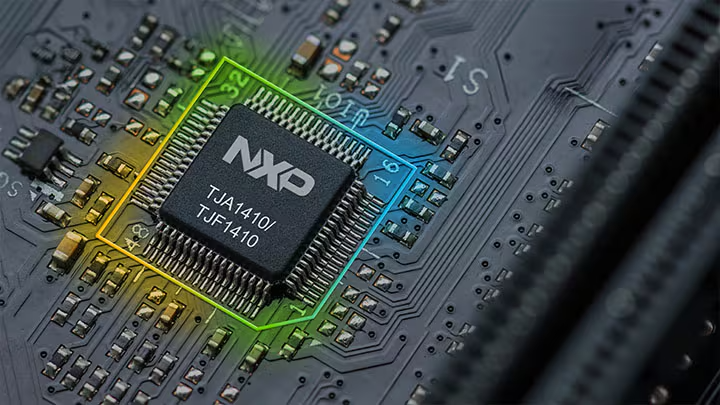
- NXP’s TJA1410 and TJF1410 provide the PMD portion of 10BASE-T1S over an Open Alliance TC14 3-pin interface.
- The parts target low-cost deployment, diagnostics, and wake features across vehicle and industrial networks.
NXP Semiconductors has announced what it describes as the first production-released 10BASE-T1S Physical Medium Dependent (PMD) transceivers, introducing the TJA1410 for automotive use and the TJF1410 for industrial and building automation. The devices are designed to push Ethernet connectivity closer to end nodes in multi-drop networks, using single-pair cabling and a partitioned PHY model intended to reduce system cost and integration complexity.
The PMD approach splits a traditional Ethernet PHY into two parts: a digital portion integrated into the host microcontroller or switch, and an external PMD transceiver that handles the analogue transmit and receive functions on the physical medium. Both the TJA1410 and TJF1410 communicate with the host over the Open Alliance TC14 standardised 3-pin interface, with the host required to implement the 10BASE-T1S digital PHY.
For industrial and building automation, the TJF1410 is a compact PMD device in a 3 mm x 3 mm HVSON8 package. The company lists compliance with IEEE 802.3cg and Open Alliance TC14 specifications, alongside low quiescent current, robust EMC performance, and support for topology discovery diagnostics defined by TC14. The part also supports wake signalling across Open Alliance TC10 through TC14, is compatible with power-over-data-line implementations, and is specified for bus connections up to 32 nodes with cabling lengths up to 100 metres.
The automotive-focused TJA1410 carries additional qualification and safety hooks, with NXP listing ISO 26262 ASIL B alignment and AEC-Q100 Grade 1 qualification, alongside strong EMC performance and remote wake support over the Ethernet data line. The device can also operate with lower cost CAN FD common mode chokes, positioning that as another lever to bring down 10BASE-T1S bill-of-material cost in vehicle networks.
Ritesh Saraf, VP and GM Ethernet, NXP Semiconductors, said: “10BASE-T1S is a foundational technology that finally makes Ethernet viable all the way to the end-node – in automotive, industrial, and building systems. With our new PMD transceivers, we remove cost and complexity barriers and give our partners a scalable path to extend Ethernet all the way to the edge of their networks. With this launch, we set a new benchmark for cost-effective and safety-capable Ethernet connectivity in next-generation software-defined architectures.”
NXP is also positioning the PMD devices within a wider roadmap that includes automotive MCUs and switches integrating MACsec-secured 10BASE-T1S ports, naming its S32K5, S32N7, and S32J100 families as part of that ecosystem. On the industrial side, the product supports migration away from legacy field buses such as Modbus or RS-485, with the idea being that multi-drop Ethernet at the edge can reduce gateways, simplify cabling, and standardise edge connectivity under an Ethernet backbone.
The key shift is less about raw data rate — 10 Mbps is deliberate — and more about cost, topology, and manageability. Production PMD parts remove a common barrier to deployment: getting single-pair, multi-drop Ethernet physically onto the wire with a small, low-pin-count device that still carries diagnostics and power management features.