
IN Brief:
- AI-driven rack density is pushing overhead power distribution towards higher currents and faster reconfiguration.
- Vertiv’s double-stack PowerBar Track extends its open-track busbar concept to higher-capacity layouts.
- Live tap-off relocation, metering options, and global compliance are being positioned as default expectations.
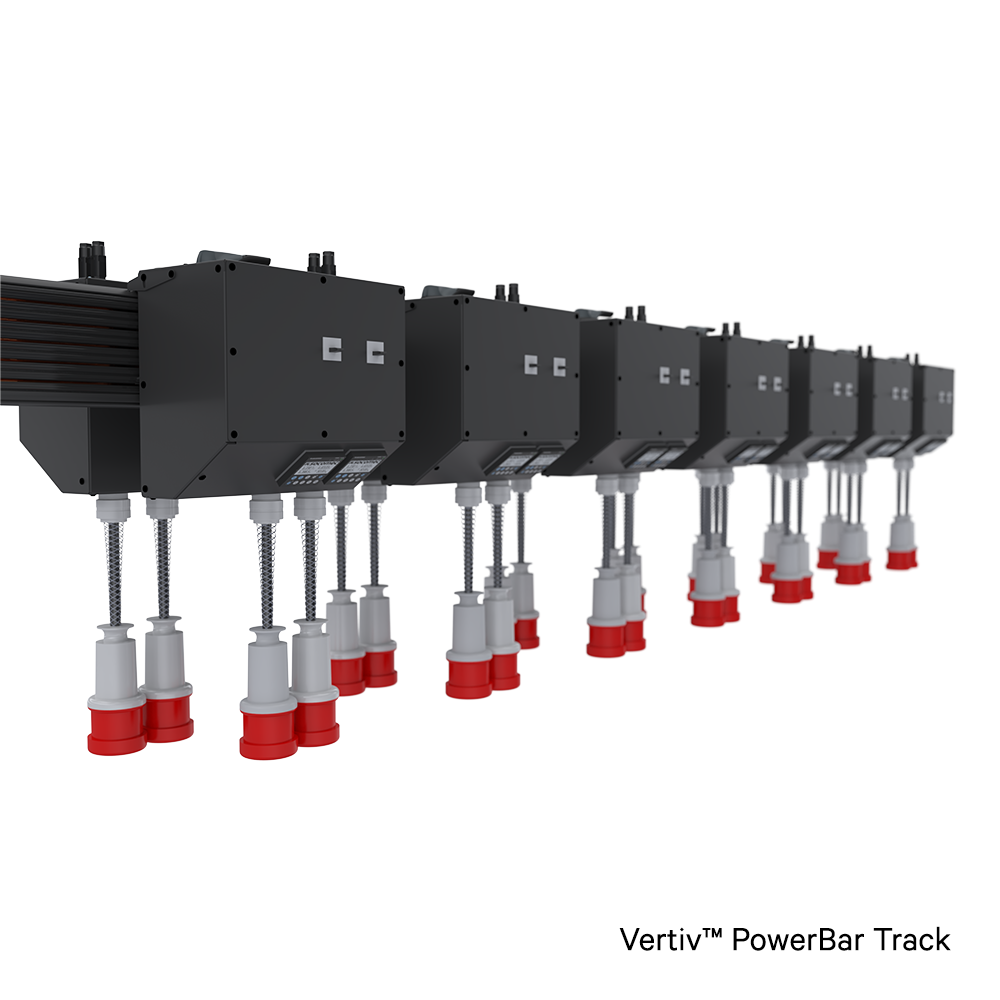
Vertiv has expanded its PowerBar Track busway family with a compact double-stack configuration designed to increase overhead power distribution capacity while reducing the floor-space penalty of traditional layouts in high-density data halls. The system targets colocation and hyperscale sites where AI workloads are driving higher rack power, tighter overhead congestion, and more frequent change-outs of infrastructure.
The new configuration is built around an open-track architecture that supports live changes without taking the busway offline, allowing tap-off boxes to be installed or moved along the track while loads remain energised. Vertiv is positioning the approach as a practical response to short refresh cycles in AI clusters, where power maps can change faster than the surrounding building services.
The double-stack format is intended to raise the number of available connection points and the supported load per run, while also enabling vertical scaling for dense rows. Configurations are available up to 2,000 A under UL 857, and up to 2,500 A under IEC 61439-6, with copper and aluminium conductor variants aligned to regional preferences and compliance requirements. Operator safety is handled via mechanical and electrical interlocks at each connection point, with an earth-first, break-last approach used to reduce exposure during installation and relocation.
“Power distribution must keep pace with the scale and density of modern AI and high-performance computing environments,” said Kyle Keeper, senior vice president of the power business unit at Vertiv. “As customers navigate increasing power demands, tighter space constraints, and rapidly evolving infrastructure requirements, they need solutions that provide flexibility. Vertiv PowerBar Track double stack is designed to address these challenges by enabling compact yet scalable expansion, supporting live changes, and delivering the reliability required in mission-critical data centre environments.”
Vertiv’s documentation for the PowerBar Track platform emphasises modular build-out and plug-and-play operation through hot-swappable tap-off boxes, with optional metering aimed at tighter capacity planning and energy management. The platform supports RJ45 Ethernet plug-in connections for metering integrations, and track sections are supplied in standard lengths to simplify overhead routing. Short-circuit protection expectations are also being pulled closer to the point of use, with tap-off designs rated for high interrupt capacity as busway systems become a more common alternative to cable-heavy overhead whips.
The PowerBar Track double-stack is designed to integrate with Vertiv’s wider power train, including switchgear, UPS systems, and rack infrastructure, as well as prefabricated and modular overhead approaches used to accelerate build schedules. That integration pitch reflects a broader shift in data centre electrical design, where time-to-deploy and repeatable architectures now sit alongside efficiency and compliance as primary constraints.

