IN Brief:
- SolidRun’s new COM Express Type 6 modules combine AMD Ryzen AI Embedded P100 processors with up to 59 TOPS of AI performance.
- The platform pairs x86 embedded compute with LP-CAMM2 memory to improve serviceability and lifecycle flexibility.
- For edge systems in harsh environments, the challenge is shifting from adding AI to packaging it within workable thermal and maintenance limits.
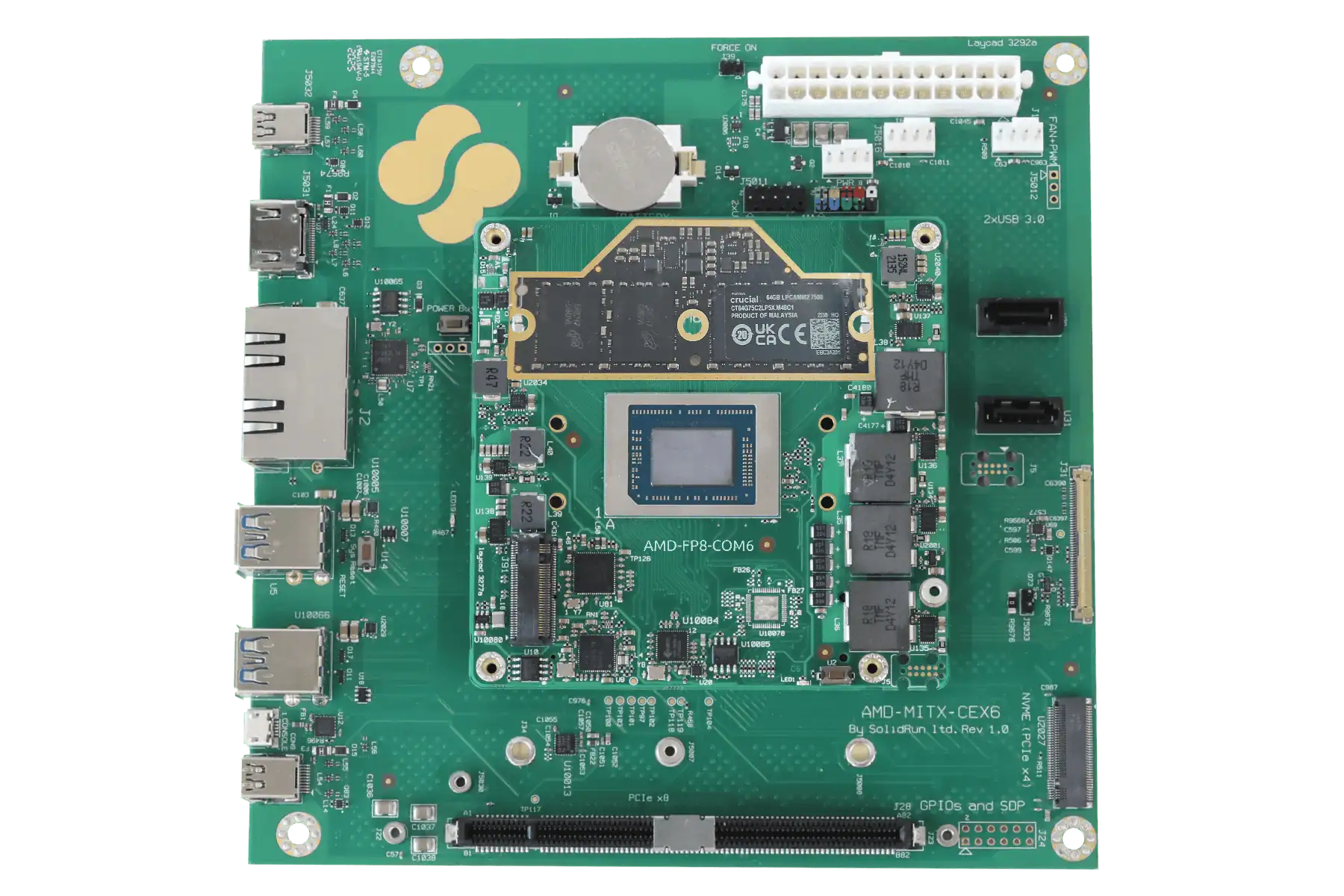
SolidRun has introduced a new COM Express Type 6 family built around AMD’s Ryzen AI Embedded P100 processors, bringing higher AI throughput, serviceable LP-CAMM2 memory, and a compact x86 form factor into edge systems designed for harsh and mission-critical environments.
The new P100 modules are aimed at applications where ruggedisation, thermal control, and long-life embedded deployment still have to coexist with a much heavier local inference workload than previous generations were expected to handle. SolidRun says the platform can deliver up to 59 TOPS of total AI performance, positioning it for use in real-time analytics, machine vision, autonomous control, and other edge workloads that increasingly need dedicated AI acceleration without giving up industrial PC-class compatibility.
Using COM Express Type 6 keeps the proposition familiar for system designers building around established carrier-board ecosystems, while the move to AMD’s Ryzen AI Embedded P100 family adds a more contemporary compute mix of CPU, GPU, and NPU resources. That matters because many edge deployments are now expected to support a blend of conventional control, graphics, and AI tasks in the same box, rather than treating inference as a separate subsystem.
One of the more practical design choices is the use of LP-CAMM2 memory. In the laptop market, CAMM has largely been discussed as a space-saving alternative to conventional SO-DIMMs, but in embedded modules the serviceability angle is arguably just as important. Memory that can be replaced or upgraded more easily in the field gives OEMs and integrators another option when balancing lifecycle support, maintenance access, and platform reuse across product generations.
The appeal of that combination is strongest in sectors where compute platforms are deployed away from controlled IT environments — transport, industrial automation, defence-adjacent systems, outdoor infrastructure, and mobile equipment among them. In those settings, the question is no longer whether embedded edge hardware will need AI capability, but how much AI capability can be delivered without pushing power, thermals, and field support beyond what the enclosure and operating profile can tolerate.
SolidRun’s launch points to where the COM market is heading. Standardised embedded form factors remain valuable because they reduce integration friction, but the differentiator is shifting toward how effectively vendors can package AI acceleration, memory architecture, and rugged deployment characteristics into those established standards. That gives the P100 family relevance beyond a routine module refresh.
As edge AI deployments move from pilot programmes into installed infrastructure, products like this will be judged less on peak TOPS figures alone and more on whether they make inference-heavy systems easier to build, service, and keep running in the field. That is where embedded AI hardware is now being tested properly.