
IN Brief:
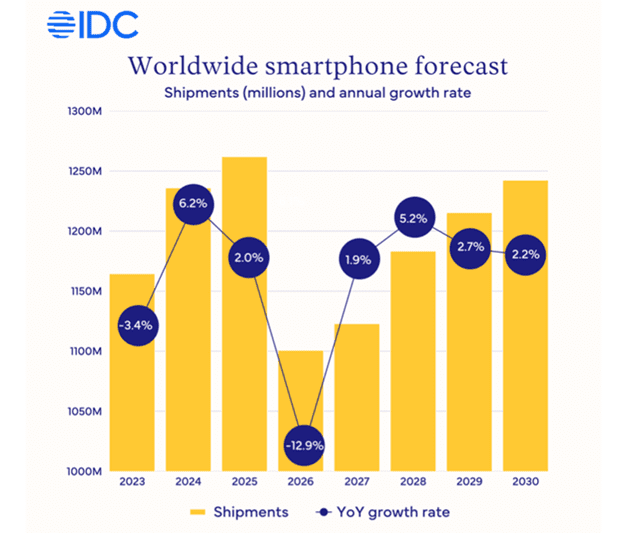
- IDC now expects 2026 smartphone shipments to fall 12.9% to 1.12 billion units, or roughly 160 million fewer devices year on year.
- Average selling prices are set to rise to a record US$523 as DRAM and NAND shortages squeeze lower-cost Android portfolios first.
- The shortage is expected to persist through 2026 and into mid-2027, reshaping product mix, memory configurations, and competitive positioning.
IDC has cut its 2026 smartphone outlook sharply, warning that the ongoing memory shortage will drag global shipments down to 1.12 billion units this year, a 12.9% decline that would remove roughly 160 million devices from the market and deepen the industry’s retreat from mass-volume growth.
The revised forecast points to a market in which DRAM and NAND have become both expensive and difficult to secure in the right volumes. IDC expects average selling prices to rise 14% to a record US$523 in 2026, while the pressure falls hardest on vendors concentrated at the lower end of Android. In those segments, memory occupies too large a share of the bill of materials to absorb cleanly. Either specifications are trimmed, prices rise, or margins narrow to the point that some product tiers stop making sense altogether.
The firm now sees the sub-US$100 smartphone segment, worth about 171 million devices, becoming effectively uneconomic even after pricing stabilises. That is a significant shift for a part of the market that has depended on relentless cost-down, steady improvements in integration, and enough cheap memory to keep headline specifications moving in the right direction. Once those assumptions break, portfolio strategy changes quickly. Vendors begin pruning ranges, reducing configuration choices, and steering product planning toward higher-value tiers that can better absorb cost volatility.
That pressure is not merely commercial. It feeds directly into design decisions. Memory choice affects PCB layout, package selection, power budget, software headroom, imaging pipelines, and the scope of local AI features that can realistically be supported across a platform’s life. A handset designed around abundant RAM and storage behaves differently from one built under tight memory constraints, particularly where software support periods are lengthening and user expectations around camera performance, multitasking, and on-device models continue to rise.
IDC expects some vendors to compensate by shipping new devices with lower DRAM and storage configurations than buyers have recently come to expect at a given price point. In practice, that means fewer generous memory allocations in the mid-range and more aggressive segmentation between entry, mid-tier, and premium models. Larger manufacturers with greater purchasing power and tighter supplier relationships are likely to ride that out more effectively than smaller brands that rely on opportunistic buying and thinner margins.
The more troubling part of the forecast is its duration. IDC now expects supply pressure to persist through 2026 and into mid-2027, with prices unlikely to return to 2025 conditions within the current horizon. The underlying cause is structural rather than cyclical. AI infrastructure build-outs are competing with consumer devices for the same DRAM and NAND capacity, while suppliers continue to favour higher-margin server and HBM products. Mobile memory remains essential in enormous volume, but it is no longer automatically the most attractive destination for incremental capacity.
That has consequences beyond smartphones. The same supply dynamics are already bearing on tablets, PCs, wearables, XR devices, and other connected hardware. Across the board, designers are being forced to treat memory less as a low-cost entitlement and more as a constrained resource that shapes system architecture. Products which were once expected to add RAM and storage with each annual refresh may instead stand still or step back, even as software workloads continue to grow heavier.
The smartphone market now faces a more selective phase of competition. Premium brands with scale and a strong ecosystem can defend pricing more easily. Value brands have less room to manoeuvre, particularly in regions where low-cost handsets dominate shipment mix. IDC expects the steepest declines in the Middle East and Africa, Asia Pacific excluding Japan and China, and China itself, reflecting how exposed those regions are when memory costs rise faster than purchasing power.
The industry will recover in volume eventually, but the old assumption that better specifications can always be delivered at lower prices is weakening. Memory inflation is not just disrupting quarterly planning. It is changing the boundaries of what product categories remain commercially sustainable, and it is forcing manufacturers to rework the balance between performance, capacity, and price much earlier in the design cycle.

