IN Brief:
- Toshiba Electronics Europe has launched the TLX9920 photovoltaic-output photocoupler for solid-state relay designs.
- The device provides isolated gate-drive voltage for high-side and back-to-back MOSFET configurations without a secondary-side power supply.
- Applications include BMS, onboard chargers, inverters, energy storage systems, and industrial power control equipment.
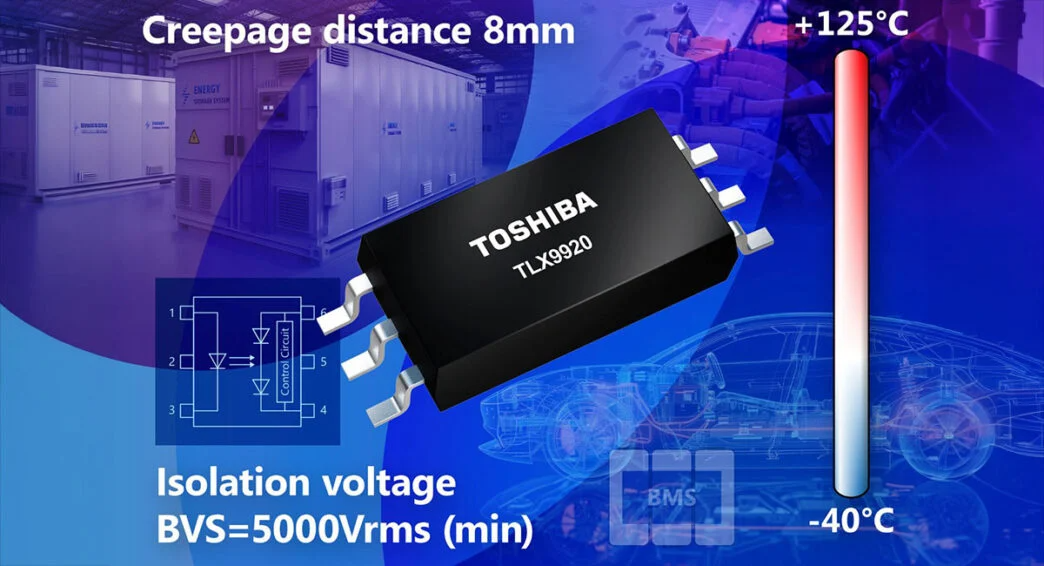
Toshiba Electronics Europe has launched the TLX9920, a photovoltaic-output photocoupler designed to provide isolated gate-drive voltage for power MOSFETs used in solid-state relays.
The device is intended for high-side and back-to-back MOSFET configurations, generating the required gate-drive voltage from its photovoltaic output. This removes the need for a secondary-side isolated power supply in solid-state relay circuits, reducing the number of components required in automotive and industrial switching designs.
Target applications include automotive battery management systems, onboard chargers, inverters, high-voltage vehicle subsystems, energy storage systems, and industrial power control equipment. The TLX9920 is qualified to the AEC-Q101 automotive reliability standard, supporting use in vehicle electronics and other systems requiring enhanced component assurance.
The photocoupler is housed in a thin SO6L package measuring 3.84mm × 10.0mm × 2.1mm. It provides a minimum creepage distance of 8mm and a minimum isolation voltage rating of 5000Vrms. The package and isolation performance support reinforced insulation requirements in higher-voltage systems.
Electrical characteristics include a minimum open-circuit voltage of 13.5V and a minimum short-circuit current of 8µA at a forward current of 10mA. An integrated discharge circuit is included to support reliable MOSFET turn-off behaviour and reduce the amount of external circuitry required around the switching stage.
Automotive and industrial power systems are replacing mechanical relays with semiconductor-based switching in applications where lifetime, switching frequency, acoustic noise, and maintenance access are under pressure. Mechanical contacts remain familiar and widely used, but they introduce wear, bounce, arcing, and service-life limits that become harder to manage in high-duty-cycle systems.
Solid-state relays remove the mechanical contact, but they add design work around MOSFET drive, isolation, leakage, thermal behaviour, and fault handling. High-side and back-to-back configurations are common in battery and power-control systems, yet they require a gate-drive solution that can maintain isolation while keeping the circuit compact and predictable.
A photovoltaic-output photocoupler addresses that design point by converting optical input energy into an isolated electrical output for the MOSFET gate. In practice, this can simplify the relay structure and reduce the need for additional isolated bias power on the secondary side. The integrated discharge circuit further supports controlled turn-off, which is critical in power paths where uncontrolled gate discharge can affect safety and switching behaviour.
Battery systems, onboard chargers, inverters, and energy storage equipment place strict requirements on isolation, creepage, clearance, and long-term reliability. Component choices in the isolation path influence not only electrical performance, but also certification, layout, and fault-mode behaviour.
The TLX9920 sits in the part of the power-design chain where small components can have a large effect on system architecture. As vehicle electrification, distributed energy storage, and industrial power control continue to adopt semiconductor switching, isolated gate-drive devices will remain central to building compact and reliable high-voltage systems.