
IN Brief:
- Valeo and Infineon have shown a ground projection module using laser beam scanning and 2D MEMS technology.
- The module is designed for daytime-visible, short-distance projection around vehicles.
- Automotive lighting is moving into a wider role that combines optics, sensing, control electronics, and software-defined vehicle functions.
Valeo and Infineon Technologies are collaborating on a short-distance ground projection module that integrates laser beam scanning and 2D MEMS mirror technology for vehicle exterior communication.
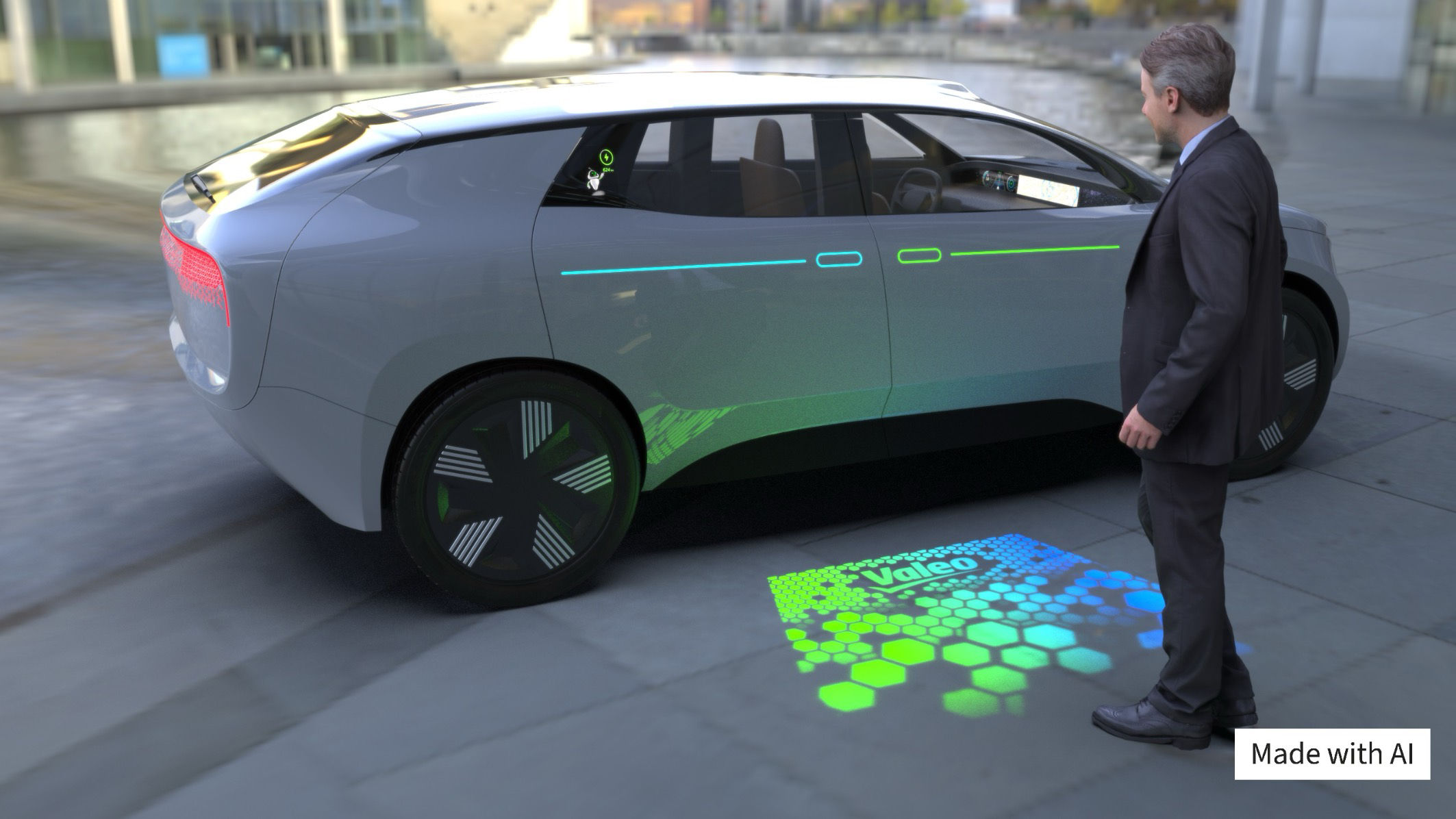
The first product from the collaboration has been shown at Auto China 2026 in Beijing. The module combines Valeo’s high-definition ground projection system with Infineon’s 2D micro-electromechanical systems mirror and controller. It is designed to deliver higher brightness, contrast, and resolution for short-distance projection while meeting eye-safety requirements.
The first-generation system provides bi-colour output, with future versions planned to move towards full-colour capability. The module supports vehicle-to-everything communication, exterior personalisation, and safety functions by projecting dynamic information onto the ground near the vehicle.
Use cases include welcome and goodbye lighting signatures, tailored exterior messages, braking warnings, pedestrian crossing cues, and lane-change intent signals. The system creates a visible physical layer for information that would otherwise remain inside a digital V2X stack, dashboard display, or driver-assistance interface.
The electronics centre on the combination of automotive lighting and MEMS beam steering. Ground projection has already appeared in vehicle lighting concepts, but daylight visibility, image stability, optical efficiency, eye safety, package size, thermal control, and automotive qualification remain difficult constraints. A scanning MEMS architecture offers a route to high-definition patterns without relying only on static optics or large projection assemblies.
Automotive lighting is expanding beyond illumination into communication and interface functions. Matrix headlights, animated rear lamps, illuminated front panels, and projected symbols are turning the vehicle exterior into a more active signalling surface. That shift brings lighting electronics closer to body-domain control, sensing, and software-defined vehicle architectures.
Regulation remains a major constraint for dynamic exterior projection. Vehicle signalling has historically developed around fixed lamp functions such as braking, reversing, and turn indication. Projected road messages and pedestrian cues require predictable meaning, consistent visibility, regional approval, and robust safeguards against distraction or misuse.
System integration will depend on inputs from the wider vehicle platform. A projection module may need to respond to vehicle speed, braking, steering, door status, proximity sensors, lighting conditions, ADAS data, and software logic. That moves the subsystem beyond decorative lighting and into the domain of controlled safety communication.
Infineon’s role brings MEMS and semiconductor control into the module, while Valeo contributes lighting-system integration and vehicle-level packaging experience. A production implementation will need optical performance, electronics reliability, thermal management, software control, and regulatory compliance to work as a single automotive system.
The collaboration places MEMS technology inside a broader change in vehicle electronics, where sensors, lighting, processors, and exterior communication functions increasingly overlap. Projected information around the vehicle will only gain ground if it can be made bright, durable, readable, and legally consistent across markets.

