
IN Brief:
- ASRock Industrial will show secure and open edge AI systems at COMPUTEX 2026.
- The demonstrations include autonomous robotics, on-premises medical AI, compliance appliances, secure OpenClaw agents, and IEC 61499 automation.
- Industrial edge AI is moving toward local inference, runtime security, open automation, and deployable embedded platforms.
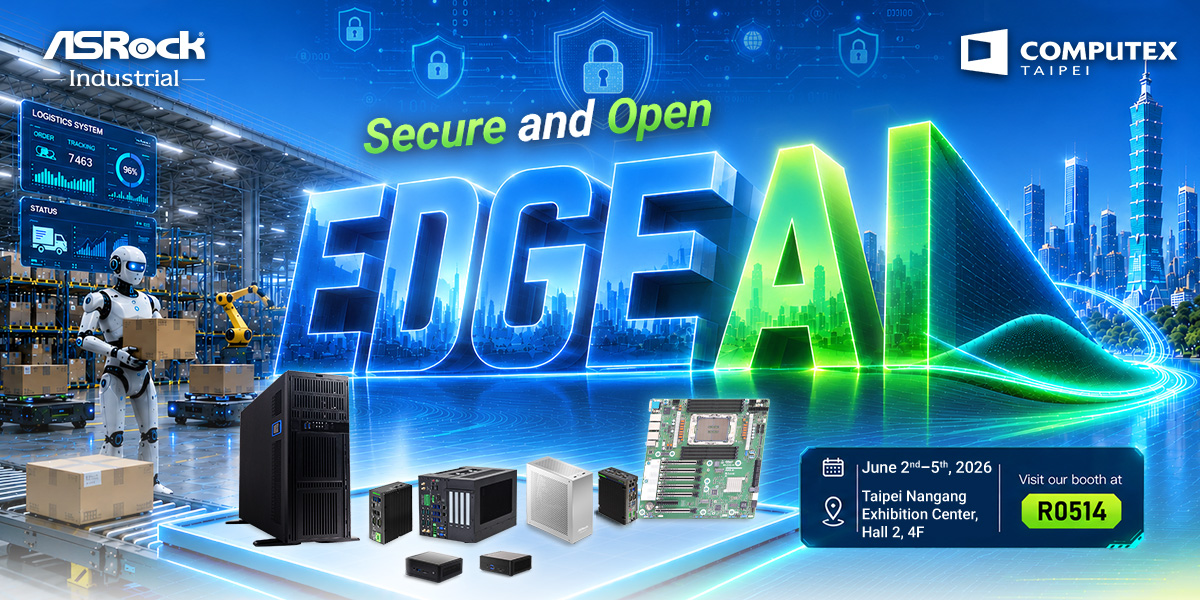
ASRock Industrial will use COMPUTEX 2026 to present edge AI systems spanning autonomous robotics, medical AI, AI compliance, secure agentic workloads, open automation, and industrial embedded computing.
The company’s showcase is built around secure and open edge AI. Its Agentic Robot101 demonstration uses the NUC-358H to run local multimodal robotics workloads with real-time vision perception, voice interaction, reasoning, and physical action execution without cloud dependency.
ASRock Industrial will also show the AI BOX-A395 mini AI workstation in three enterprise AI demonstrations. One combines the platform with Taiwan AI Cloud’s AFS AI Hub for an on-premises Medication Safety AI Agent designed for hospital networks. The system uses the Formosa Foundation Model to provide real-time drug interaction analysis with explainable clinical outputs.
A second AI BOX-A395 demonstration, developed with III ASTRA, is an AI compliance appliance for automated on-device governance validation. It is aligned with the EU AI Act, OWASP LLM Top 10, and the NIST AI Risk Management Framework. A third demonstration integrates Phison aiDAPTIV to expand memory capacity for local AI workloads by using aiDAPTIV Cache Memory as a third-tier dynamic memory pool.
The showcase also includes OpenClaw AI agents secured by AiSafeguard with Exein Runtime, adding policy-based device control, sandbox isolation, runtime behaviour monitoring, threat detection, and centralised security visibility. ASRock Industrial’s AiUAC Copilot will demonstrate AI-assisted engineering for IEC 61499-based automation applications running on industrial IoT controllers.
The hardware path behind edge AI is becoming more demanding as local workloads move from basic inference into robotics, regulated workflows, and automation. AMD’s compact Versal Prime Gen 2 devices for embedded systems reflect the same push toward higher local processing capability in constrained footprints.
Industrial edge AI is now being shaped by more than model acceleration. Local systems need security controls, runtime monitoring, memory strategies, regulatory alignment, industrial I/O, and deterministic links into automation environments. The AI workload has to sit inside a deployable platform that can be powered, cooled, managed, updated, and trusted over a long service life.
Robotics brings those requirements together sharply. A robot operating at the edge is interpreting sensor data, deciding on physical action, and interacting with equipment, people, or goods in real time. Safety envelopes, auditability, cyber protection, compute reliability, and controlled behaviour all become part of the embedded system design.
Medical and compliance demonstrations add a further layer. Sensitive data, governance checks, and regulated workflows favour on-premises deployment where information can remain inside controlled networks. That shifts responsibility onto embedded platforms with enough performance, memory capacity, software support, and lifecycle security to run models reliably outside a data-centre environment.
Open automation is becoming equally important as manufacturers look beyond isolated AI demonstrations. IEC 61499 support points to AI-assisted engineering connected to reusable function-block control models. Industrial users need AI systems that can be deployed, maintained, and audited as part of automation infrastructure, rather than left as experiments running beside the production line.

