
IN Brief:
- MSI IPC will present edge AI and industrial computing systems at COMPUTEX 2026.
- The portfolio covers machine vision, semiconductor AOI, robotics, driver monitoring, panel PCs, and local agentic AI.
- Industrial AI deployments are moving from standalone inference boxes toward complete embedded computing architectures.
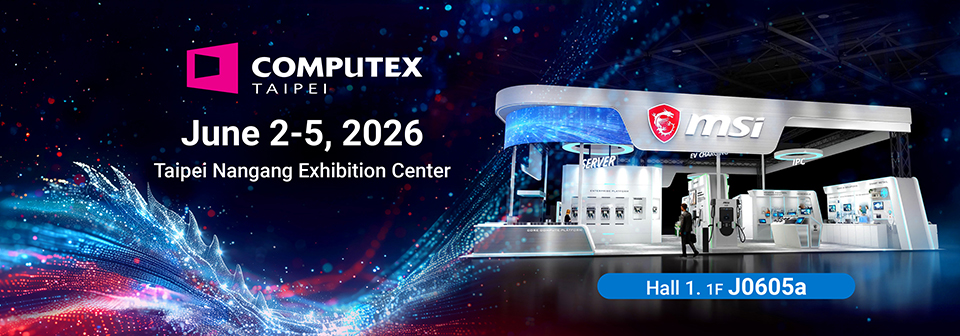
MSI IPC will use COMPUTEX 2026 to present an edge AI and industrial computing portfolio aimed at smart manufacturing, semiconductor inspection, robotics, transportation, healthcare, and local agentic workloads.
The industrial demonstrations include the Edge AI Box MS-C910E with Memorence AI for real-time machine vision, adaptive workflows, and high-precision quality control. For semiconductor manufacturing, MSI IPC will show an automated optical inspection system developed with Qiming Tech, using the Edge AI Box MS-C939 for real-time defect detection and production-yield optimisation.
Other demonstrations include a real-time voice AI translation system running on the Slim Box MS-C926, a voice AI ordering system using the Embedded Box MS-C927, and driver fatigue detection running on the In-vehicle Box MS-C932.
MSI IPC will also introduce EdgeXpert, an AI supercomputer at the edge built on NVIDIA’s DGX Spark platform. Demonstrations will include AI robot interaction with Reachy Mini, a smart campus patrol vehicle at National Chung Hsing University, OpenClaw and Hermes agents running locally, an EU Cyber Resilience Act-compliant agentic AI demonstration with Galene Elettra, and a legal AI suite for enterprise legal and IP governance.
The company will also show industrial panel PCs for smart healthcare, manufacturing, and locker systems, alongside high-reliability platforms based on Intel Wildcat Lake, NXP, NVIDIA Jetson Thor, and 4U rackmount systems for smart cities, manufacturing, and transportation.
Industrial edge computing is moving across several layers at once. At the controller and networking layer, NXP’s RT1180 industrial-control MCUs with TSN and embedded security show how deterministic communication and device-level security are being pulled into embedded hardware decisions. MSI IPC’s portfolio sits higher in the compute stack, where vision, robotics, inspection, and local AI workloads require more capable industrial platforms.
Machine vision and AOI depend on more than processor acceleration. High-quality image capture, low-latency processing, trained models, stable lighting, mechanical repeatability, and integration with production data systems all shape performance. In semiconductor inspection, defect detection speed and false-positive rates influence yield, rework, and production economics.
Robotics and patrol systems add mobility, sensor fusion, environmental variation, and safety constraints. Local processing reduces reliance on cloud connectivity, but it also places more responsibility on the embedded platform. Compute performance has to be balanced against power draw, ruggedisation, thermal design, service access, and software update processes.
The agentic AI demonstrations show where the market is heading next. AI systems are moving beyond single-purpose inference into workflows that can coordinate tools, data, and actions. In industrial settings, that pushes requirements for auditability, execution boundaries, cyber resilience, and predictable integration with physical equipment.
MSI IPC’s COMPUTEX portfolio reflects a broader transition from AI appliances to industrial compute infrastructure. The practical test will be how these systems integrate into long-life environments where uptime, maintainability, safety, and lifecycle support are as important as model performance.

