IN Brief:
- Microchip has introduced dsPIC33CK Value Line digital signal controllers for cost-sensitive real-time control.
- The devices combine up to 100MHz deterministic processing, high-resolution PWM, 12-bit ADCs, and communication peripherals.
- Motor control, touch, sensing, industrial, automotive, and medical systems are pushing more control functions into compact embedded devices.
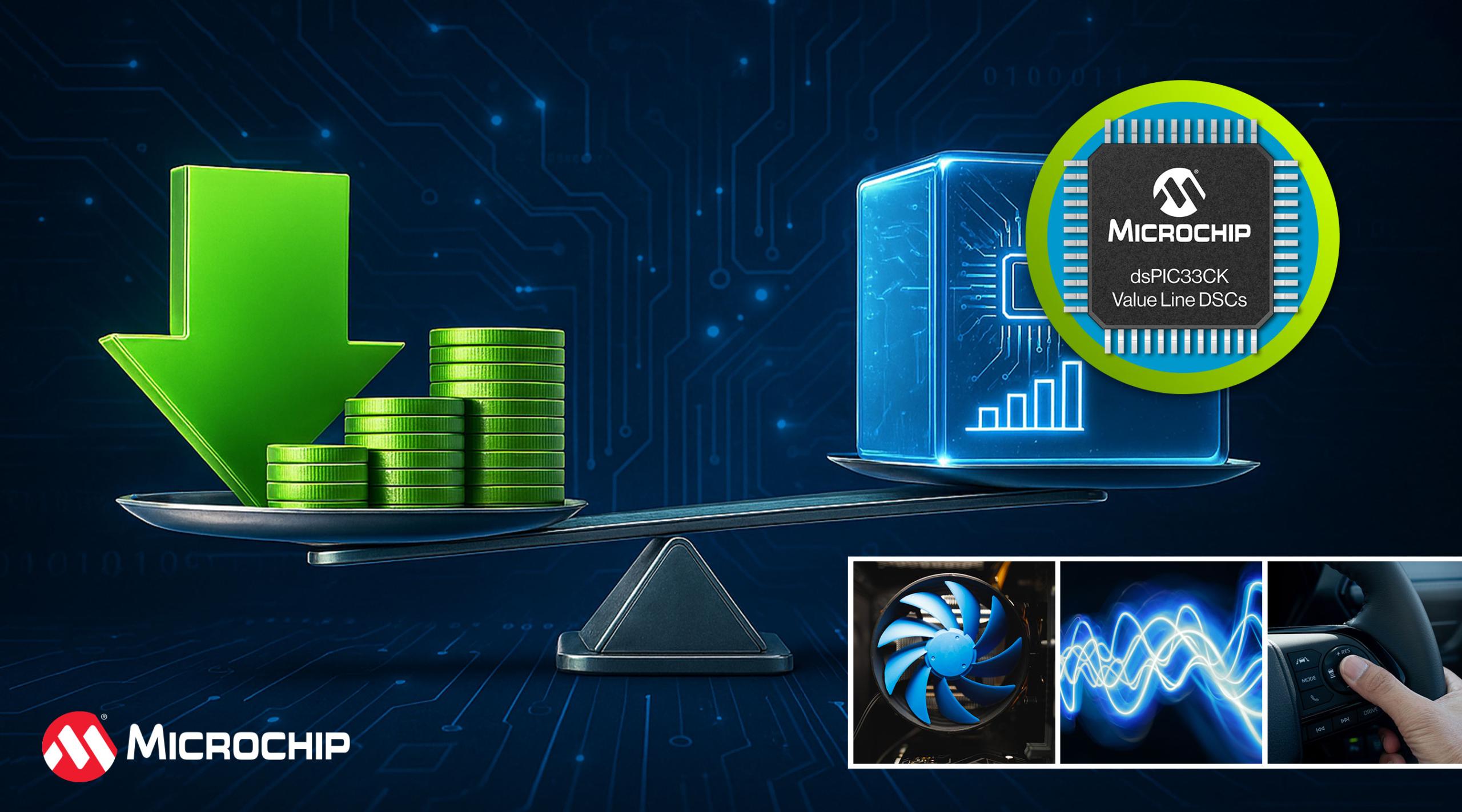
Microchip Technology has introduced the dsPIC33CK Value Line family of digital signal controllers for cost-sensitive real-time control applications that need deterministic processing, analogue integration, and peripheral support without higher-end feature overhead.
The devices combine up to 100MHz deterministic processing, high-resolution pulse-width modulation, and a 12-bit analogue-to-digital converter. Target applications include motor field-oriented control, touch interfaces, precision sensing, industrial systems, automotive electronics, consumer products, and medical equipment.
The dsPIC33CK Value Line devices are intended to consolidate multiple system functions onto a single controller, reducing external component count, PCB footprint, and bill-of-materials cost. Flash memory options scale from 32KB to 256KB, with compatibility across the wider dsPIC33CK family to support migration as product requirements change.
Joe Thomsen, corporate vice president of Microchip’s digital signal controller business unit, said: “Not every real-time control design needs a high-end solution, many just need dependable performance at the right cost. The dsPIC33CK Value Line delivers the essentials designers rely on most while eliminating complexity and helping provide a straightforward path to building capable, reliable systems without paying for features they don’t need.”
The family is designed to offer up to 2ns PWM resolution across eight channels, a 12-bit ADC supporting up to 2MSPS, on-chip analogue comparators with a 12-bit DAC, and communication peripherals including CAN FD, LIN, SENT, UART, SPI, and I²C.
Automotive-grade reliability includes AEC-Q100 Grade 1 qualification, while built-in security functions support secure boot and secure firmware updates. Development support includes a low-cost dsPIC33CK Value Line Curiosity Nano evaluation kit with onboard debugger, plus compatibility with Microchip’s Curiosity Nano base for Click Boards, Curiosity Nano touch adapter board, Motor Control Dual Inline Module, and MPLAB development ecosystem.
The same embedded design pressure is visible across timing, control, and sensing components. Microchip’s EX-423 low-power oscillator for critical timing applications sits in a different part of the system, but both launches reflect the need for compact components that support reliability, accuracy, power control, and long service lives.
Real-time control platforms are being asked to do more inside smaller, cheaper, and more constrained systems. Motor drives, pumps, fans, actuators, touch interfaces, battery-powered products, and sensing nodes all benefit when control loops, analogue measurement, communications, and security can be integrated without adding multiple devices around the board.
Cost sensitivity does not reduce the engineering burden. A lower-cost controller still has to meet deterministic timing, PWM precision, analogue accuracy, communication requirements, firmware integrity, and lifecycle expectations. In motor-control applications, control-loop latency and PWM resolution affect torque ripple, acoustic behaviour, efficiency, and thermal load. In touch and sensing systems, analogue stability and noise behaviour can determine whether an interface works reliably outside the lab.
Consistent pricing across order volumes also affects early-stage product planning. Component decisions made during evaluation often carry through to production, and price breaks that depend heavily on scale can distort architecture choices. A predictable entry point helps smaller programmes, industrial variants, and lower-volume medical or specialist systems build around a controller without assuming consumer-scale purchasing power.
Value Line DSCs are available now starting at $0.51 each. The strongest fit is likely to be designs where dependable real-time control, analogue integration, secure update capability, and a straightforward development path carry more weight than maximum headline performance.