IN Brief:
- The WPME-CDI2C family supports bidirectional I²C communication at data rates up to 2MHz.
- The SOIC-8NB isolators provide 3750VRMS isolation and high common-mode transient immunity.
- Isolated serial interfaces are becoming more important as low-voltage control electronics move closer to noisy power and sensing environments.
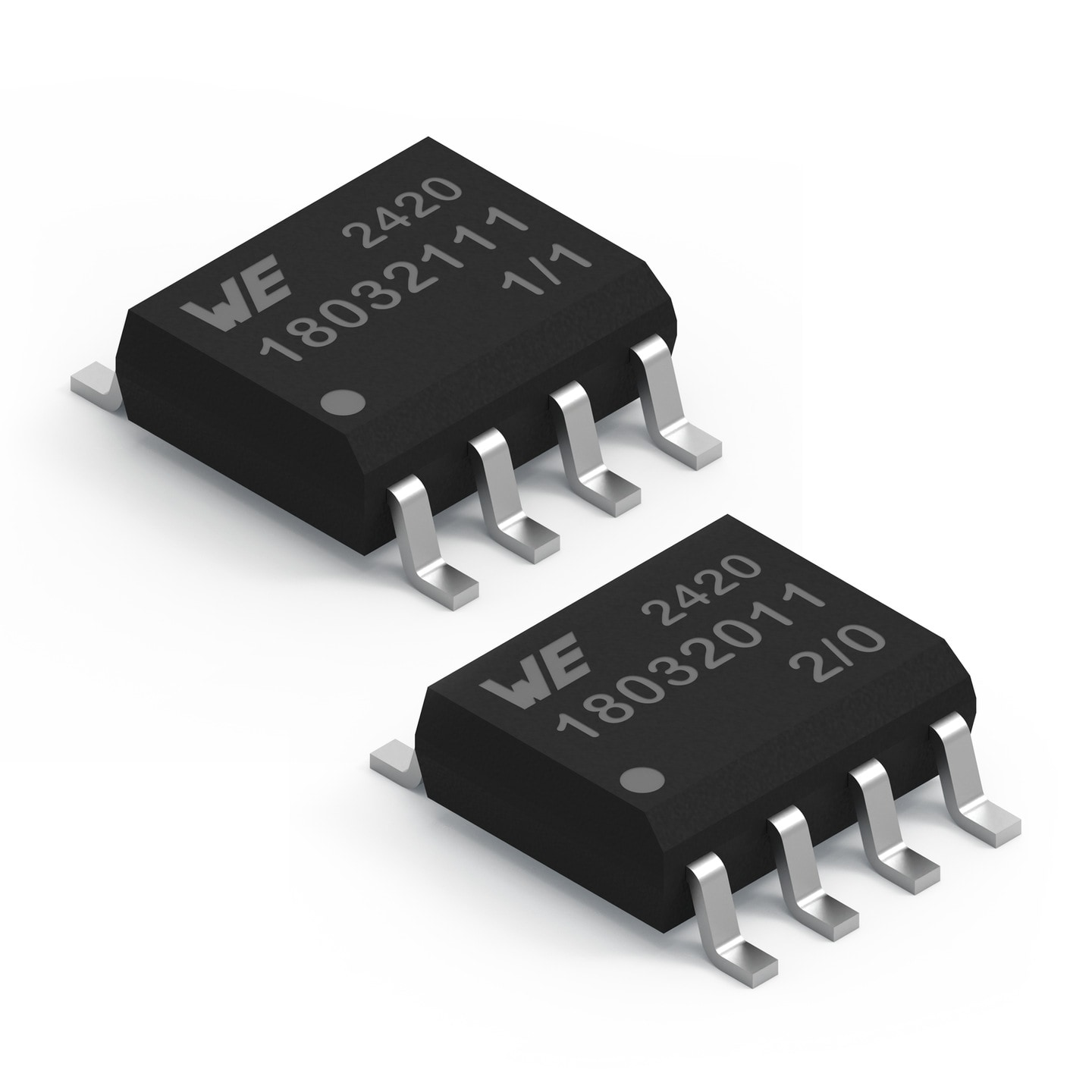
Würth Elektronik has expanded its digital isolator portfolio with the WPME-CDI2C family, adding bidirectional I²C isolation for embedded and industrial systems that need robust serial communication across electrically separated circuit domains.
The new two-channel devices support I²C data rates up to 2MHz and are supplied in SOIC-8NB packages. They provide isolation up to 3750VRMS and common-mode transient immunity of ±150kV/µs, giving designers a compact option for protecting digital links from ground shifts, noise, and fault conditions.
Two variants are available. One provides bidirectional isolation on both SDA and SCL lines, while the other combines bidirectional SDA with unidirectional SCL operation. That split gives engineers flexibility across conventional I²C systems and designs where the clock direction is fixed by a defined master device.
The family is aimed at isolated I²C, SMBus, and PMBus interfaces, as well as battery-management systems, motor control, power supplies, instrumentation, isolated ADC and DAC links, and sensor interfaces. The package is pin-compatible with common I²C isolators, which should reduce redesign effort where isolation is being added to an existing board architecture.
Although I²C remains attractive because of its low pin count and familiar design flow, many of its newer use cases are far removed from the short, low-noise board-level links for which simple serial buses were first adopted. Industrial sensors, battery sections, displays, low-voltage processors, motor drives, and power supplies are now often packed into the same equipment, leaving small digital interfaces exposed to ground offsets and switching noise.
In battery and motor-control systems, isolation also creates cleaner fault boundaries. A low-voltage controller can communicate with a sensing or power section without allowing a failure in one domain to propagate unchecked through the rest of the electronics. For modular industrial systems, that separation also supports easier replacement of subassemblies and clearer diagnostic behaviour during service.
The same pressure can be seen in interface-heavy designs such as transparent HMI film combining force and touch sensing, where sensing layers, display electronics, and processing hardware have to coexist in thinner, denser assemblies. As systems add more inputs and local intelligence, the physical-layer details around apparently simple data connections become harder to ignore.
Würth Elektronik’s WPME-CDI2C devices sit in a component category that rarely dominates design discussions, but isolated interfaces are increasingly important to the reliability of mixed-signal and mixed-voltage systems. The surrounding electronics are becoming faster, denser, and more power-rich; the I²C bus may still be simple, but its operating environment is not.