
IN Brief:
- Samsung has begun shipping 12-layer HBM4E samples to major global customers.
- The initial device offers 48GB capacity, stable 14Gbps pin speed, and up to 3.6TB/s bandwidth per stack.
- HBM development is increasingly shaped by packaging, thermals, power efficiency, and AI accelerator bandwidth.
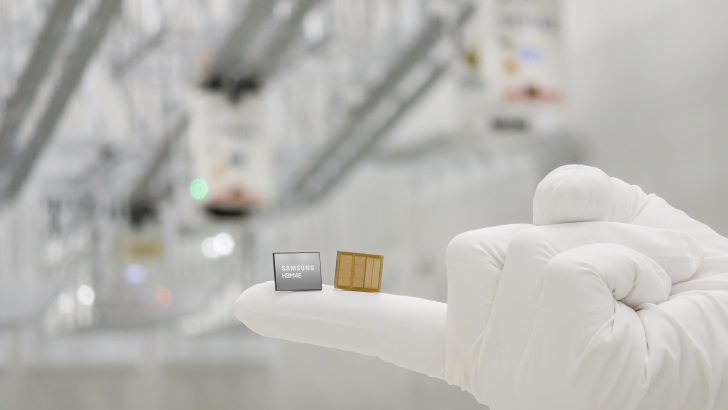
Samsung Electronics has begun shipping 12-layer HBM4E samples to major global customers, extending its high-bandwidth memory roadmap for AI accelerators, high-performance computing, and hyperscale data-centre systems.
The initial 12-layer device provides 48GB capacity and stable operation at 14Gbps pin speed, with scalability to 16Gbps. At that level, the stack delivers up to 3.6TB/s of memory bandwidth, representing a performance increase of more than 20% over Samsung’s HBM4 generation.
Samsung is also preparing 32GB and 64GB configurations, covering 8-layer, 12-layer, and 16-layer options. The HBM4E device uses Samsung’s sixth-generation 10nm-class 1c DRAM process and a 4nm logic base die, combining memory and logic technologies within a package architecture built for high-bandwidth AI workloads.
Energy efficiency and thermal resistance have also been improved, with Samsung reporting a 16% gain in power efficiency and more than 14% better thermal resistance compared with the previous generation. Those metrics are becoming increasingly central as stack capacity and interface speed continue to rise.
HBM design is no longer a simple bandwidth race. AI accelerators need dense, fast memory placed close to the compute engine, but every increase in stack height, pin speed, and capacity adds pressure to the substrate, base die, interconnect, power delivery, and cooling design. A memory stack can unlock accelerator performance only if the surrounding package can keep it fed, stable, and thermally controlled.
That package-level challenge is already shaping the next phase of AI hardware. Glass-core substrates moving toward AI packaging point to the same underlying constraint: processors, memory, and advanced interconnect are becoming inseparable at system level. HBM4E pushes the memory side forward, while substrate and packaging technologies determine how far that performance can be used in production systems.
Memory energy consumption is also gaining importance as AI infrastructure scales. Data movement can account for a substantial portion of system power, and higher bandwidth is valuable only when it does not create a disproportionate thermal or energy penalty. Improvements in energy per bit, heat dissipation, and reliability are therefore becoming just as relevant as headline throughput.
Customer sampling gives processor and system developers a route to validate performance, package integration, thermals, and manufacturability before mass production. HBM is tightly linked to accelerator development cycles, so early samples are needed long before platforms reach commercial deployment.
Samsung plans to move HBM4E into mass production in line with customer schedules. As AI hardware becomes more memory-bound, the HBM stack is becoming one of the defining components in accelerator design, sitting at the intersection of DRAM process, logic base die, advanced packaging, and data-centre thermal management.

