IN Brief:
- The Astra Machina SL2600 kit combines Synaptics’ Torq platform with Google’s Coral Open NPU.
- The board supports embedded AI prototyping across vision, industrial IoT, healthcare, robotics, and test systems.
- Edge-AI development is moving toward production-oriented toolchains, interfaces, and low-power deployment constraints.
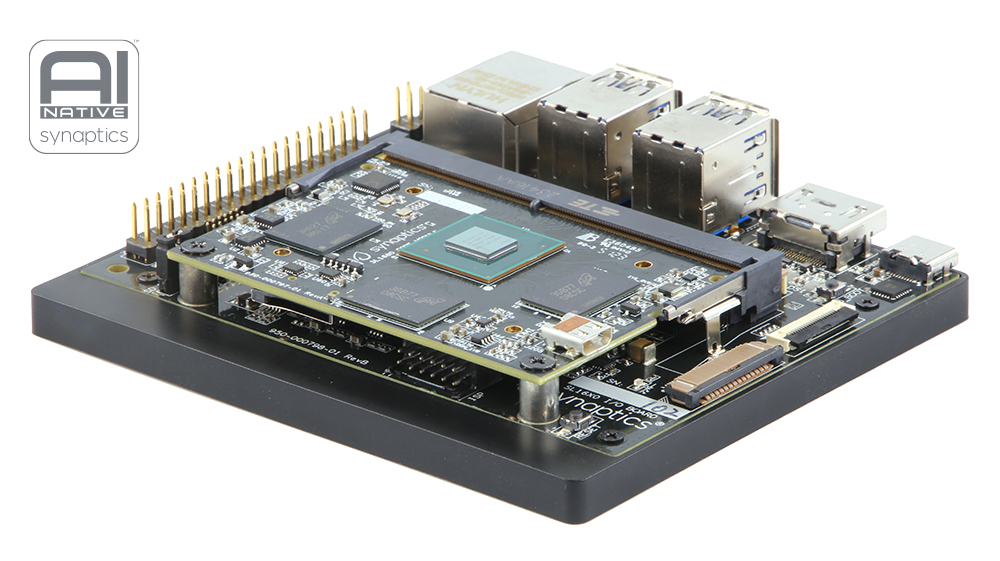
Synaptics has expanded access to its Astra Machina SL2600 development kit through Mouser, giving embedded developers a modular platform for multimodal edge-AI prototyping across industrial, healthcare, robotics, IoT, and test applications.
The kit is built around Synaptics’ Torq Edge AI platform and integrates Google’s RISC-V-based Coral Open NPU. It supports Yocto Linux, IREE, and MLIR tooling, with hardware interfaces including MIPI DSI, MIPI CSI-2, JTAG, GPIO, PoE+, USB, and expansion connectivity.
The board is designed to help engineers move from model development into embedded hardware evaluation, particularly where local inference has to be tested with camera input, display output, networking, and production-oriented software tools. Target applications include machine vision, factory sorting, medical imaging peripherals, patient monitoring, industrial IoT gateways, and robotics.
Edge AI is shifting from simple wake-word engines and sensor classification into visual perception, multimodal processing, and local decision-making. That evolution makes the development environment more important. Model accuracy alone does not produce a deployable product; engineers still have to manage memory, acceleration, latency, thermal limits, camera performance, power consumption, and software update paths.
Hardware development platforms are therefore being judged less by isolated benchmark numbers and more by how well they represent the constraints of the final product. Camera and display interfaces, PoE support, embedded Linux, model-compilation tools, and accessible expansion headers all shorten the path between a trained network and a working embedded prototype.
The same deployment pressure is visible in Alif’s edge-AI microcontrollers for Hardware Pioneers Max and MSI IPC’s edge-AI platform for manufacturing. Edge AI is moving away from cloud-tethered demonstrations and toward hardware that can run inference locally, securely, and within the power envelope available in machines, instruments, and connected devices.
Industrial and medical systems strengthen that requirement. A machine-vision product may need to respond in real time without relying on a network connection. A medical peripheral may need to keep sensitive image or patient data local. A factory gateway may have to continue operating during connectivity loss while still supporting secure updates and long-term maintenance.
Toolchain consistency is another recurring barrier. Developers can train models in familiar frameworks, but deployment onto target silicon often requires optimisation, conversion, profiling, and runtime integration. By combining an NPU, embedded Linux, open tooling, and board-level I/O in one kit, Synaptics is addressing the practical handover between AI development and embedded engineering.
The Astra Machina SL2600 kit gives design teams a route to test that handover earlier. As edge AI becomes a product feature rather than a laboratory exercise, development hardware has to reflect the real-world mix of compute, sensing, connectivity, power, and software maintenance that determines whether local inference can survive outside a demo environment.