IN Brief:
- ByteSnap Design will show a live edge-AI vision system at two UK engineering events in June.
- The demonstration runs object detection and identification on embedded hardware without cloud processing.
- Edge AI is moving toward application-level embedded demonstrations involving cameras, firmware, security, RF, and compliance work.
ByteSnap Design will showcase a live edge-AI vision system at Design Engineering Expo and Hardware Pioneers Max in June, demonstrating real-time object detection and identification running entirely on embedded hardware without cloud processing.
The embedded systems consultancy will exhibit at Design Engineering Expo, part of Smart Manufacturing Week at the NEC Birmingham on 3–4 June, in Hall 5, Stand H96. It will also exhibit at Hardware Pioneers Max at ExCeL London on 10–11 June, on Stand C2.
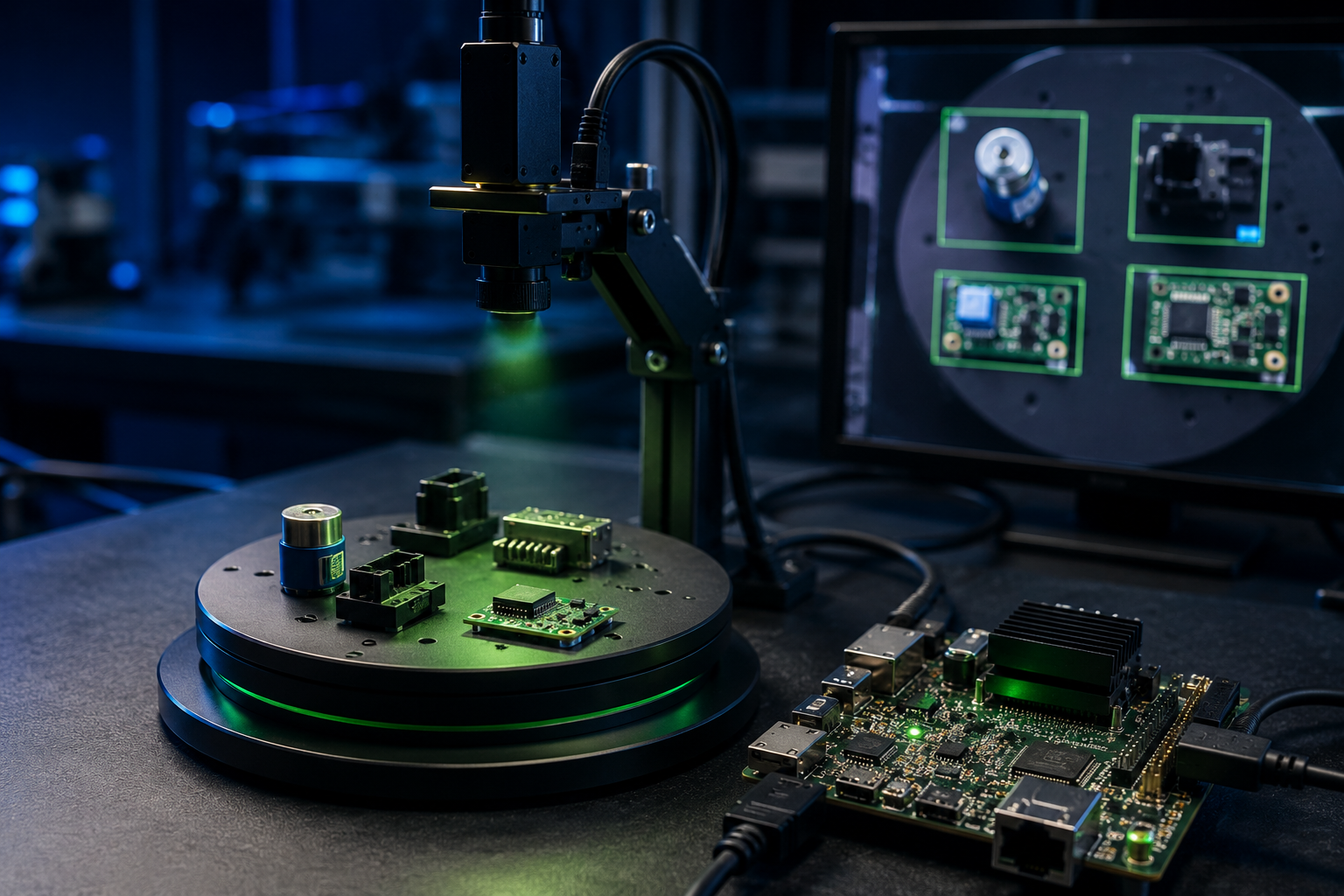
The demonstration is powered by an Infineon PSOC Edge device and uses an embedded camera system with a rotating turntable to detect and identify objects in real time. Results are displayed instantly on screen, showing how computer vision and on-device machine-learning inference can be integrated into low-power embedded systems.
“Interest in edge AI has accelerated rapidly over the last 12 months, particularly from manufacturers looking at machine vision and intelligent embedded systems,” said Dunstan Power, co-founder and director at ByteSnap Design.
“What we’re demonstrating at the shows is real-time AI inference running directly on embedded hardware, without relying on cloud processing. For many applications, that fundamentally changes what’s possible in a deployed product.”
ByteSnap’s embedded AI development work includes computer vision, machine-learning model optimisation, and firmware integration across platforms including NVIDIA Jetson, Infineon PSOC Edge, NXP i.MX, and STM32. The company will also discuss cellular migration projects, including antenna redesign, firmware updates, RF optimisation, and certification management for manufacturers moving products from legacy 2G and 3G networks to 4G LTE and 5G.
Embedded security and firmware support will also feature, including targeted security patching, vulnerability management, and audit-ready reporting for CRA, MDR, and IEC 62443 compliance across embedded Linux, RTOS, and bare-metal platforms.
Edge AI is moving from processor capability claims into application-level engineering. Local inference can reduce latency, lower bandwidth use, and support operation without a cloud connection, but it also forces the AI model to fit the constraints of the hardware, memory, camera interface, firmware architecture, thermal design, and power budget.
Products such as Alif’s edge-AI microcontrollers for Hardware Pioneers Max show how rapidly local AI hardware is expanding. ByteSnap’s demonstration adds the application layer around that trend, where camera input, object handling, firmware behaviour, and real-time display all have to work together.
Compliance is also becoming more difficult to separate from embedded development. The EU Cyber Resilience Act, medical device regulation, and IEC 62443 all increase pressure on software maintenance, vulnerability tracking, secure updates, and documented development processes. An embedded vision product that performs well at launch still needs a credible route through security patching and long-term support.
Cellular migration adds another practical constraint. Many deployed industrial and connected products still depend on legacy mobile networks, and moving them to 4G LTE or 5G affects antenna design, RF certification, firmware, enclosure behaviour, and cloud interfaces. ByteSnap’s show focus brings those issues into the same conversation as edge AI, reflecting the reality of modern embedded products: intelligence, connectivity, security, and compliance now arrive together.