IN Brief:
- Longsys has introduced AIDIMM and AILPBGA products for edge AI inference.
- AIDIMM delivers up to 128GB capacity and 307.2GB/s bandwidth.
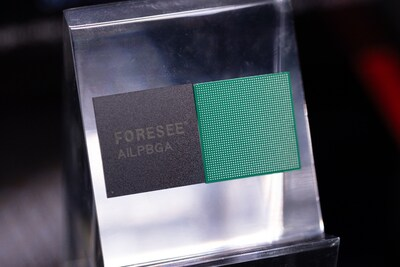
- AILPBGA targets compact embedded AI systems with LPDDR compatibility and a 22mm x 22mm package.
Longsys has introduced AIDIMM and AILPBGA memory products for edge AI inference, targeting systems that need local large-language-model execution without moving every workload to cloud infrastructure.
The AIDIMM module delivers up to 128GB capacity, a 256-bit bus, and 307.2GB/s bandwidth in a compact form factor. It supports dynamic voltage scaling from 0.9V to 1.05V and FDVFS power tuning, giving system designers a route to balance performance and power consumption in edge AI hosts.
A single AIDIMM module can run edge large language models with more than 70 billion parameters, placing it in the growing class of memory products designed around local AI agents, compact workstations, robotics controllers, and embedded systems that cannot depend entirely on remote inference.
The AILPBGA device is aimed at smaller embedded AI platforms. It provides 24GB to 64GB capacity, 307GB/s bandwidth, native LPDDR compatibility, and a 22mm x 22mm package. By improving memory bandwidth without requiring a full SoC redesign, the device is intended to reduce the integration burden for compact AI inference hardware.
Longsys is also showing storage-processing and software elements around the hardware. Its SPU storage processing unit and iSA intelligence storage agent integrate HLCache to reduce DRAM usage and hardware cost, while the scheduling engine uses expert offloading, cache management, and predictive prefetching to support mixture-of-experts LLM workloads.
At COMPUTEX 2026, the company demonstrated an AMD Ryzen AI Max+ 395 system running a 397-billion-parameter LLM with 128GB DRAM. Systems with 64GB configurations were shown running 80-billion and 122-billion-parameter models. Longsys also displayed Gen4 and Gen5 mSSD products using wafer-level SiP, with the Gen5 mSSD delivering up to 11GB/s sequential read, 10GB/s sequential write, 2.2 million read IOPS, 1.8 million write IOPS, and capacities up to 8TB.
Memory has become one of the defining limits in local AI hardware. Samsung’s 12-layer HBM4E samples address the high-performance end of the market, where accelerator bandwidth is a central constraint. Longsys is working at a different layer, where edge systems need more bandwidth and capacity without adopting the cost, power, and packaging assumptions of data-centre HBM.
Edge AI systems must fit a more awkward design envelope than cloud infrastructure. They need useful model capacity, acceptable latency, manageable heat, serviceable cost, and physical integration into products that may have limited board area or sealed enclosures. Memory architecture affects model size, context length, batching, and prefetch behaviour, all of which shape how responsive a local AI system feels in use.
The AILPBGA approach is particularly relevant where embedded system designers need a higher-bandwidth memory option while retaining compatibility with existing LPDDR-oriented platforms. That could support AI-enabled industrial devices, smart imaging systems, robotics, and local inference appliances where power, package area, and redesign cost are tightly constrained.
AI hardware is broadening beyond accelerators. Processors, memory, storage, power delivery, and software scheduling all determine whether a local model runs smoothly. Longsys’ AIDIMM and AILPBGA products address that system-level problem, where edge AI performance increasingly depends on how efficiently data can be stored, moved, and reused inside compact platforms.