IN Brief:
- Marktech has expanded transfer-moulded photodetector and LED packaging capabilities.
- The platform supports COTS and custom optoelectronic designs for defence and aerospace applications.
- Transfer moulding improves package robustness, optical control, and repeatability in compact SMT designs.
Marktech Optoelectronics has expanded its COTS and custom photodetector and LED capabilities with a transfer-moulded packaging platform for defence and aerospace sensing, targeting, and optical alignment systems.
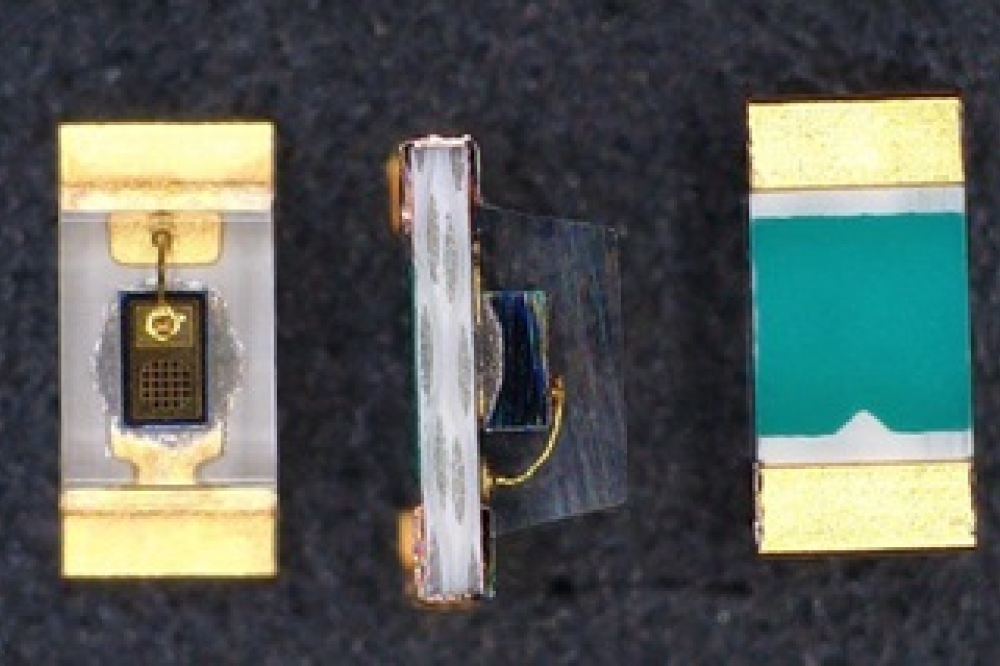
The platform enables compact SMT packages for photodetectors and LEDs, with package structures designed to improve reliability, optical beam control, environmental robustness, and stray-light performance. Marktech is applying the technology to both standard and custom optoelectronic designs, giving OEMs more room to match package geometry, optical behaviour, and mechanical constraints to demanding applications.
Transfer moulding forms the optical and mechanical package structure directly around the die. The process can protect the die and wire bonds from shock, vibration, thermomechanical fatigue, and moisture ingress, while improving part-to-part consistency. It can also reduce package footprint by integrating lenses, light shields, and housing features into the moulded body rather than adding separate plastic assemblies.
Defence and aerospace systems place unusually high demands on optical sensing and alignment hardware. Components may be exposed to vibration, thermal cycling, humidity, mechanical shock, and long service lives, while still being expected to hold calibration and optical performance. Packages that vary in geometry or degrade under environmental stress can introduce signal loss, calibration drift, and inconsistent field behaviour.
The same design pressures are increasingly present in industrial and instrumentation systems. Dense optical arrays, compact targeting modules, spectral sensing, position detection, and alignment systems all benefit from repeatable emitter and detector placement. SMT-compatible optoelectronics also support automated placement and denser PCB layouts, helping optical functions fit more naturally into electronics assemblies.
Marktech’s wider portfolio covers UV, visible, near-infrared, and short-wave infrared emitters and photodiode detectors, alongside custom die, wafers, and assemblies. The transfer-moulded platform extends that capability into package architecture, where optics, mechanics, and electronics meet.
Optical sensing is being pulled into smaller, harsher, and more integrated environments. Autonomous systems, defence electronics, factory automation, inspection equipment, and medical instruments increasingly require compact photonic functions with controlled geometry and predictable long-term behaviour. Packaging is therefore becoming a performance variable, not a passive enclosure.
The defence electronics chain is also placing renewed emphasis on ruggedised component supply and repeatable production. CSG’s European electronic fuze contracts showed how demand for qualified electronic subsystems is feeding into procurement across the sector. Optoelectronic packaging sits in a different part of that chain, but it shares the same requirements around reliability, qualification, availability, and stable performance under harsh conditions.
Transfer moulding also supports higher integration. Instead of relying on separate lens caps, housings, reflectors, and shields, more functionality can be formed into the package. That reduces mechanical complexity and can improve alignment between emitter, detector, and optical axis, particularly in small packages where tolerance stack-up can dominate performance.
For OEMs designing optical sensing or alignment systems, the expanded platform gives another option between fully bespoke assemblies and standard packages that may not meet environmental or optical requirements. As defence, aerospace, and industrial sensing platforms become more compact and software-defined, the components feeding those systems still need physical robustness and repeatable optical behaviour at package level.