IN Brief:
- Toshiba has introduced three 40V N-channel MOSFETs for automotive power designs.
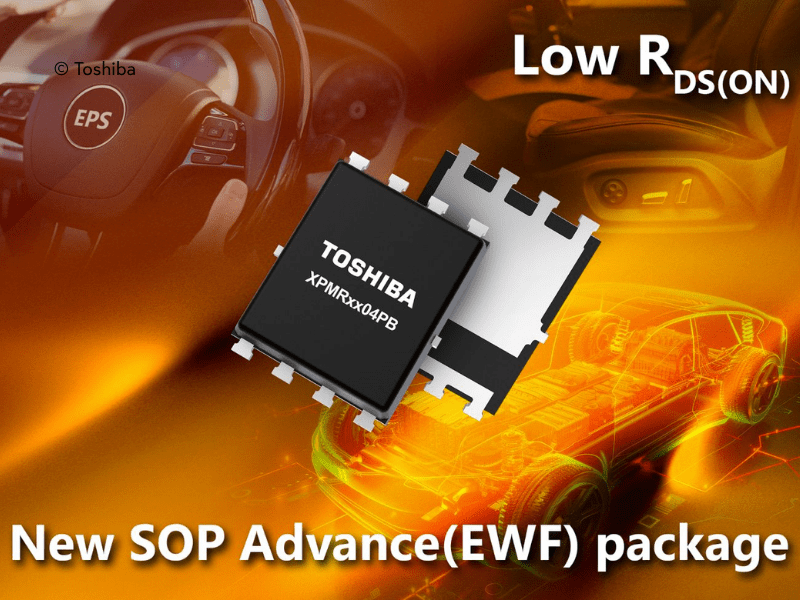
- The XPMR5904PB uses SOP Advance(EWF) packaging to improve current capability and thermal performance.
- Automotive power electronics are placing more design pressure on package resistance, inspectability, and compact thermal paths.
Toshiba Electronics Europe has introduced three 40V N-channel power MOSFETs for automotive power designs, using SOP Advance(EWF) packaging to improve current capability and thermal performance in compact layouts.
The first device, XPMR5904PB, is available now, with XPMR7404PB and XPMR8504PB scheduled to follow. The MOSFETs are intended for inverters, semiconductor relays, load switches, and motor drives, where current handling, conduction losses, thermal resistance, and board area all sit in close competition.
Inside the XPMR5904PB, a post-less structure connects the chip and outer lead through a copper clip rather than internal posts. That shortens the current path, reduces resistance, and allows a larger mountable chip area inside the package. A source-coupled structure connects source terminals on the reverse side of the package, increasing the contact area with the PCB land pattern.
The device is rated for a 180A drain current, which is 1.2 times higher than Toshiba’s existing products using comparable SOP Advance(WF) packaging. Compared with Toshiba’s XPHR7904PS, the new part reduces drain-source on-resistance by around 25% and lowers channel-to-case thermal impedance by around 38%.
Automotive electronics continue to force power-device design down into the details of package construction. As more vehicle functions become electrically actuated, the MOSFET package is no longer a mechanical afterthought added after silicon selection. Package resistance, solder joint quality, parasitic behaviour, thermal path, and inspection access all influence system efficiency and manufacturing yield.
The SOP Advance(EWF) package includes a wettable flank structure to support automated optical inspection of solder fillets. That is valuable in high-volume vehicle production, where power devices are used in systems exposed to thermal cycling, vibration, and long service lives. The devices are designed to meet AEC-Q101 requirements for automotive electronic components.
Low-voltage silicon devices remain central to vehicle power systems even as wide-bandgap components take on higher-voltage roles. ROHM’s SiC MOSFET adoption in AI server backup power illustrates the movement of silicon carbide into high-voltage conversion, but vehicle body electronics, auxiliary drives, relay replacement, and low-voltage switching still rely heavily on silicon MOSFETs optimised for cost, packaging, and reliability.
Those design pressures are becoming more visible as vehicles absorb electric pumps, thermal-management equipment, comfort systems, braking auxiliaries, and power-distribution functions. The distributed low-voltage network is densely populated with MOSFET switching stages, and small improvements in package resistance or heat transfer can reduce local temperature rise, free board space, and improve lifetime margins.
Toshiba’s latest package approach addresses that less visible layer of automotive electronics, where compact switching devices must carry higher currents while remaining inspectable, manufacturable, and thermally predictable.