
IN Brief:
- Vox Power has added PMBus-compatible digital output modules to its NEVO+ AC-DC power platform.
- The modules support monitoring, output adjustment, sequencing, fault visibility, and non-volatile configuration.
- Digitally managed power rails are becoming increasingly important in compact industrial, medical, test, and embedded systems.
Vox Power has added digital output modules to its NEVO+ configurable AC-DC power series, bringing PMBus 1.2-compatible monitoring and control to the output stage of the platform.
The new modules are designed for the NEVO+600 and NEVO+1200 platforms and retain compatibility with existing output module slots. Engineers can select a digital “D” output module instead of an analogue version, adding I²C-based access to voltage, current, power, temperature, status, output-voltage adjustment, current-limit adjustment, and settings stored in non-volatile memory.
The NEVO+600 uses a 600W 5in by 3in by 1.61in chassis weighing around 600g, while NEVO+1200 uses a 1200W 6in by 6in by 1.61in chassis weighing around 1.2kg. The platform supports multiple output voltages and power configurations, with up to 16 isolated outputs available depending on system requirements. Outputs can be connected in series or parallel where higher voltage or power is required.
The digital modules are available in several voltage classes. OP1D supports 0V to 7.5V at 25A and 125W, OP2D supports 0V to 15V at 15A and 150W, OP3D supports 0V to 30V at 7.5A and 150W, and OP4D supports 0V to 58V at 3.75A and 150W. Higher-power OPA2D and OPA3D options support 0V to 15V at 25A and 300W, and 0V to 30V at 15A and 300W respectively.
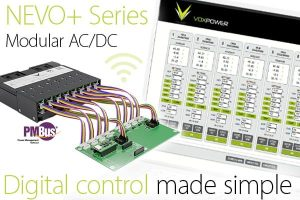
Vox Power has also released an open-source development kit based on the ESP32 microcontroller to simplify work with PMBus. The kit supports communication over USB, WiFi, TCP/IP, and websocket, and includes a browser-based virtual instrument and data logger, a VISA-compatible SCPI interpreter for automated test programming, direct PMBus access, and control of up to eight digital modules from a single controller PCB.
Power-system design is moving steadily from fixed analogue rails to digitally supervised architectures. In complex industrial, medical, laboratory, and embedded systems, the ability to sequence rails, group modules on a bus, read fault registers, and store repeatable configurations can reduce commissioning time and improve service diagnostics. It also gives engineers a cleaner path from prototype configuration into repeat builds and factory programming.
At the high-voltage end of the power chain, ROHM’s SiC MOSFET adoption in AI server backup power reflects the shift towards more efficient conversion in demanding infrastructure. Vox Power’s NEVO+ update addresses the equipment-level rail architecture beneath that wider power trend, where configurable outputs increasingly need monitoring, sequencing, and communication rather than simple fixed-voltage delivery.
The development kit includes a hardware expansion interface compatible with auxiliary connectivity options such as MikroE Click boards, allowing system designers to implement preferred protocols where required, including CAN bus, Modbus, DALI, and DMX. That gives the digital module approach a route into equipment where the power system needs to communicate with wider machine control, lighting, building, or test infrastructure.
Digital output modules for NEVO+600 and NEVO+1200 are available for new configurations through Vox Power and authorised distribution partners, with samples available in Q3 2026. Existing customers moving from analogue to digital modules can update configurations and part numbers through Vox Power support.

