
IN Brief:
- ODU has supplied ODU-MAC Black-Line mass interconnects for DEIF converter testing.
- The connectors support automated end-of-line testing using robotic test pallets.
- Power converter production is increasing demand for repeatable, high-current, automated test interfaces.
ODU has supplied ODU-MAC Black-Line mass interconnect hardware to support automated end-of-line testing for DEIF power converter production.
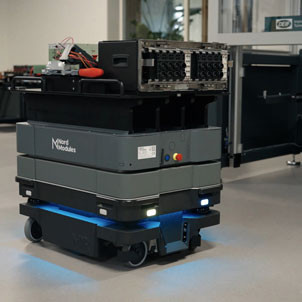
DEIF, a Danish supplier of power controls for decentralised power generation on land and at sea, is automating production of its power converter range. The company commissioned Grau Engineering to provide autonomous robotic test pallets, with ODU supplying customised interconnect technology for stable and repeatable high-power test connections.
The ODU-MAC Black-Line system provides modular power and signal transmission within an automated test interface. In this application, the connector system must deliver reliable mating, high contact density, robust mechanical alignment, and consistent electrical performance as converter units move through production validation.
End-of-line testing is becoming more demanding as power converters move into higher-power industrial, energy, marine, and hybrid AC/DC systems. A converter test station may need to verify power handling, control behaviour, signal paths, safety functions, fault responses, data capture, and traceability without slowing the production line or introducing operator-dependent variation.
Automation changes the role of the connector. In a manual bench environment, selection may focus on rating and ruggedness. In an automated line, the interface becomes part of the machine process, with mating force, cycle life, tolerance compensation, alignment, serviceability, and safety all affecting uptime and test repeatability.
DEIF’s iE Convert range uses silicon carbide technology and modular scalability for modern energy systems, placing strong demands on manufacturing consistency. As converter platforms scale into higher power and broader deployment, production validation has to become more repeatable, more data-driven, and less dependent on manual handling.
The same manufacturing pressure is visible in EV battery and ECU test systems, where modular validation hardware is being adapted for more complex electrified platforms. Converter production faces a similar challenge because higher voltage and higher power make late-stage faults more costly and harder to isolate.
Mass interconnect systems help consolidate multiple power, signal, RF, pneumatic, and data paths into a controlled test interface. That reduces wiring variation, improves changeover repeatability, and gives production teams a more stable route for connecting devices under test to automated equipment.
Wide-bandgap devices, digital control, and modular power architectures often draw the most attention in converter design, but manufacturing scale depends heavily on test infrastructure. The ODU, DEIF, and Grau Engineering project shows how automated test interfaces are becoming a practical requirement for bringing advanced power electronics into repeatable production.

