IN Brief:
- Imec has developed a 22nm narrowband receiver for the upcoming IEEE 802.15.4ab UWB standard.
- The receiver improves blocker resilience while supporting longer-range positioning in dense wireless environments.
- Robotics, AR, automotive, and industrial IoT systems could benefit from more robust low-power localisation.
Imec extends UWB range with narrowband receiver
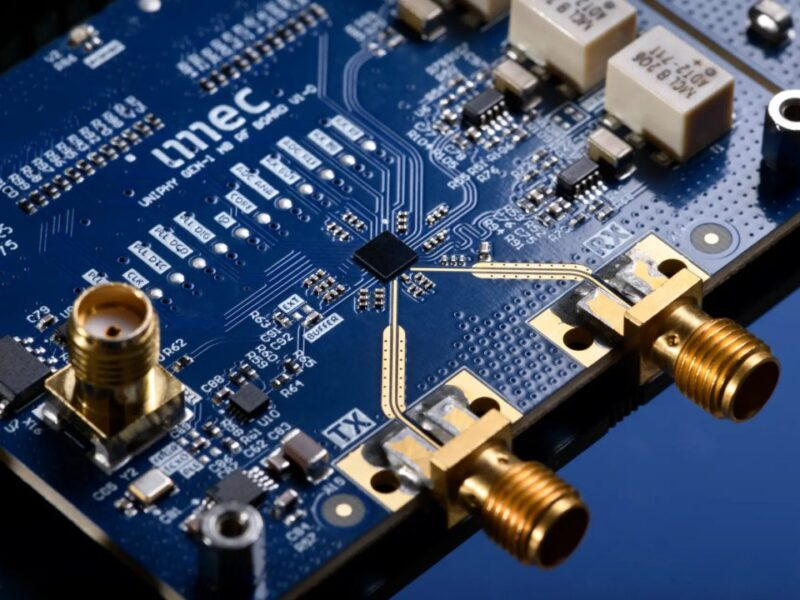
Imec has developed and validated a narrowband receiver chip for the upcoming IEEE 802.15.4ab ultra-wideband standard, targeting longer-range and more robust positioning in dense wireless environments.
Built in 22nm CMOS, the receiver implements the narrowband assistance mechanism being introduced with IEEE 802.15.4ab. The approach combines narrowband signalling in the 5–6GHz range for discovery, synchronisation, and coordination with UWB’s precise ranging and localisation capability.
Imec has reported a fourfold increase in UWB ranging distance through the receiver architecture. The wider transceiver work, combining receiver, transmitter, and standard-level changes, is designed to deliver up to a 32-times improvement in ranging performance.
At circuit level, the receiver uses a second-order transimpedance amplifier with controlled filtering to suppress strong out-of-band interferers early in the signal chain while preserving sensitivity to weak wanted signals. In practical deployments, that balance determines whether UWB remains useful around Wi-Fi, dense radio traffic, metallic environments, and varying installation conditions.
A high dynamic-range clip detector monitors the receiver’s operating conditions and changes the system state when strong interference is present. Under difficult radio conditions, the device can shift into a more robust mode with additional filtering and gain control, while quieter environments allow a lower-power mode to preserve energy efficiency.
Anoop Bhat, senior researcher at imec, said: “Our low-power design — consuming less than 6mW — achieves a 9dB improvement in dynamic range over state-of-the-art implementations, maintains a low noise figure of 3.2dB, and tolerates Wi-Fi blockers around –32dBm.”
UWB has already moved beyond secure access and smartphone features into asset tracking, industrial positioning, automotive systems, wearables, and robotics. As deployments become denser, the design challenge shifts from laboratory ranging accuracy to coexistence, synchronisation, power budget, and predictable operation across many devices.
Narrowband assistance gives system designers a route to handle discovery and coordination more efficiently before the UWB link performs precise ranging. That can reduce wasted energy, improve range, and make positioning more resilient where infrastructure cannot be tightly controlled.
The development sits alongside a broader shift toward sensing systems that process more information at the edge. ST’s in-sensor AI vibration monitoring reflects the same engineering direction, with local processing used to reduce system load and make sensor nodes more autonomous.
For robotics, AR glasses, automotive access, smart buildings, and industrial IoT, location data increasingly has to be accurate, low-latency, and energy efficient without relying on ideal wireless conditions. UWB remains attractive because of its precision, but wider deployment depends on radio architectures that tolerate the crowded spectrum around real products.
Imec is also exploring how the narrowband-assisted architecture could apply to other low-power wireless systems, including future Bluetooth evolutions. If that work progresses, the receiver design could influence more than UWB ranging alone, feeding into the next generation of short-range wireless systems that combine communication, positioning, and sensing in the same device architecture.