IN Brief:
- ESCATEC’s Lutterworth facility has achieved ISO 13485:2016 certification.
- The certification supports medical device manufacturing, traceability, compliance, and international production transfer.
- Further UK investment includes a new SMT line and a dedicated medical-grade cleanroom.
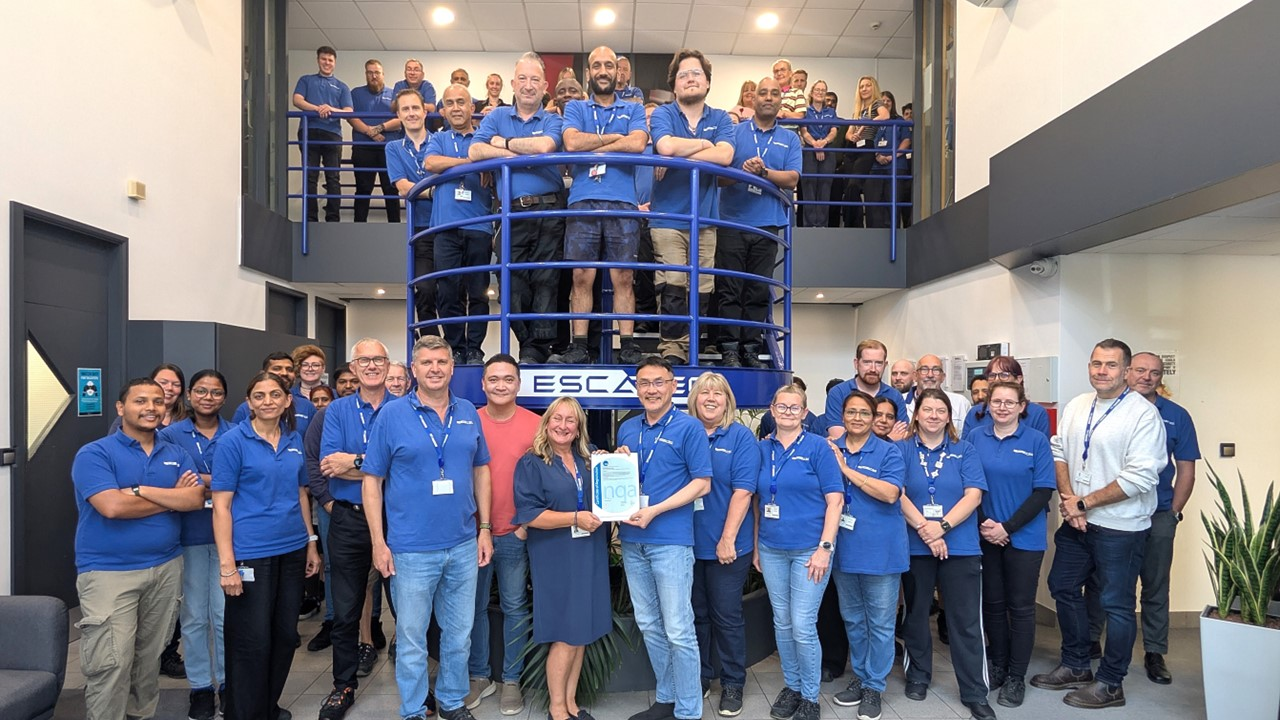
ESCATEC has achieved ISO 13485:2016 certification at its UK manufacturing facility in Lutterworth, expanding its certified production capability for medical device and healthcare OEMs.
The certification applies to ESCATEC’s UK manufacturing operation and confirms compliance with the quality management requirements used across medical device production. ISO 13485 covers quality systems, operational controls, traceability, process discipline, and regulatory expectations across the product lifecycle.
Lutterworth gives customers a route to transfer and scale medical device production between ESCATEC sites in Europe and Asia while maintaining consistent quality systems and documentation. The UK site specialises in complex electronic, electrical, and electromechanical assemblies, including PCB assembly, box build, cabinet and panel wiring, mechatronics, and test solutions.
Further investment is planned at the site this year, including a new SMT line to increase manufacturing capacity and a dedicated medical-grade cleanroom to support regulated product build requirements.
ESCATEC operates across Malaysia and Europe, with facilities in Penang, Johor Bahru, Heerbrugg, Lutterworth, Chomutov, and Plovdiv, alongside a partner site in Wisconsin. Its service model covers design and development, DfX, industrialisation, PCBA, box build, microelectronics, mechatronics, machining, injection moulding, test, and lifecycle support.
Medical electronics manufacturing places pressure on process control as much as assembly capability. Device OEMs need partners that can manage traceability, repeatability, process-change control, long lifecycle support, documentation, and regulatory evidence across products that may remain in service for many years.
Those requirements are becoming harder to separate from the electronics architecture itself. Connected diagnostics, patient monitoring systems, surgical equipment, wearable sensors, laboratory instruments, and therapy platforms increasingly combine electronics, software, electromechanics, sensors, wireless interfaces, and data-security requirements. Manufacturing partners have to handle the full product discipline rather than only populate boards.
Supply-chain resilience is also reshaping EMS decisions. OEMs still need access to competitive manufacturing routes, but regional capacity, controlled product transfer, contingency planning, and regulatory continuity have become harder to ignore. A certified UK site gives ESCATEC a stronger European base for customers that cannot treat medical electronics manufacturing as a simple offshore volume decision.
The UK’s electronics infrastructure is being strengthened at several points in the chain, including semiconductor support through the Semiconductor Catapult. ESCATEC’s certification sits downstream from chip development, but it addresses the same industrial requirement: design, validation, manufacturing, and scale-up capacity have to connect if regulated electronics products are to move reliably from concept to production.
In medical electronics, production capacity only becomes useful when backed by the process evidence needed to keep devices compliant. The Lutterworth certification gives ESCATEC a stronger position in regulated manufacturing at a point when medtech OEMs are scrutinising geography, quality systems, lifecycle risk, and production transfer more closely.