
IN Brief:
- TDK’s B25696H MKP DC-link capacitors are designed for SiC-based power-electronics systems.
- The series spans 47µF to 1280µF and 900V to 2000V DC ratings, with ultra-low ESL and low ESR.
- Target applications include energy storage systems, solid-state transformers, renewable inverters, traction drives, and industrial motor drives.
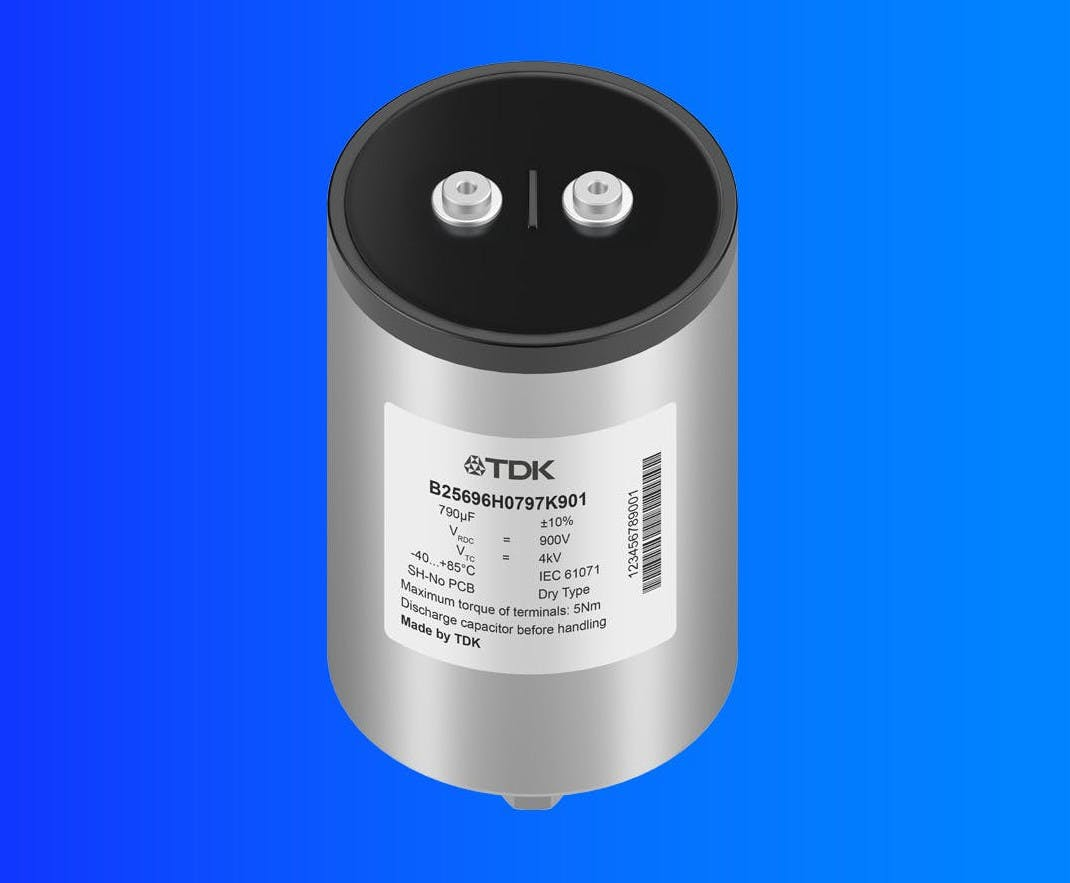
TDK has introduced the B25696H series of MKP DC high-frequency film capacitors for SiC-based power-electronics systems in energy storage, solid-state transformers, renewable inverters, traction drives, and industrial motor drives.
The series covers capacitance values from 47µF to 1280µF and rated DC voltages from 900V to 2000V. TDK has designed the capacitors around ultra-low self-inductance and low equivalent series resistance, matching the requirements of converter topologies that operate at higher switching frequencies and tighter transient margins than earlier silicon-based systems.
An internal busbar configuration distributes current more evenly between capacitor windings, helping reduce parasitic effects inside the component. Self-inductance can be as low as 30nH, while ESR falls to 0.8mΩ at 10kHz and remains stable up to 100kHz. Ripple-current capability reaches 91A at +60°C ambient and 10kHz, depending on configuration.
The capacitors use a metallised polypropylene dielectric in an aluminium case with a resin top. Two case diameters are available, 85mm and 100mm, with screw female M6 terminals and a threaded M12 mounting bolt. Operating temperature spans −40°C to +85°C hotspot, with lifetime specified at 100,000 hours at +75°C hotspot and rated voltage. With derating, lifetime can extend to 200,000 hours.
SiC power stages place different demands on the DC link from slower-switching silicon designs. Faster switching reduces losses and supports smaller magnetics, but it also increases sensitivity to parasitic inductance, voltage overshoot, ringing, current imbalance, and thermal stress. The capacitor therefore becomes part of the switching-loop design rather than a bulk-energy component selected after the semiconductor stage is fixed.
Low ESL reduces voltage spikes and electrical stress on SiC devices during fast current transitions, while low ESR limits thermal losses inside the capacitor under ripple current. Stable behaviour at higher frequencies allows converter designers to work with switching regimes that would expose weaknesses in older DC-link parts. Thermal margins and lifetime remain closely connected, since capacitor ageing can become a system-level reliability constraint in high-power converters.
TDK’s CapThermal tool is available to support thermal modelling and lifetime estimation during design. That kind of software support is becoming increasingly important as capacitors are selected not only by capacitance and voltage, but by ripple current, hotspot temperature, mounting, cooling, duty cycle, and long-term reliability targets across storage, traction, and renewable-energy systems.
The B25696H series extends TDK’s wider activity around high-power conversion hardware. TDK’s PCIM focus on AI data-centre power placed MKP DC-link capacitors, power capacitors, and magnetic components around high-density conversion and SiC stages. The new series narrows that focus onto the DC-link capacitor itself, where package geometry, internal current distribution, and parasitic behaviour can influence how aggressively SiC devices can be switched.
SiC is also spreading into protection and infrastructure hardware beyond conventional inverter designs. Infineon’s SiC module supply for Siemens solid-state circuit breakers has shown wide-bandgap devices moving into faster protection architectures for rail and transport power systems. As switching speeds rise in both conversion and protection, surrounding passives have to absorb more of the system-performance burden.
Energy storage systems and solid-state transformers are particularly demanding environments for DC-link design, combining high power density, repeated transient handling, thermal cycling, and long operating life. Renewable inverters add outdoor operating conditions, variable power flow, and lifetime expectations that can exceed the pace of component refresh cycles. A DC-link capacitor designed for low inductance and long operating life therefore affects both electrical performance and maintenance planning.
Traction and industrial motor-drive systems add vibration, cabinet temperature, regenerative operation, rapid load changes, and extended service intervals. Low-inductance film capacitors can support cleaner switching behaviour, but the surrounding busbar, module placement, cooling path, enclosure layout, and mechanical mounting still define the final electrical and thermal result.
Wide-bandgap adoption is exposing the limits of surrounding components and layouts. SiC MOSFETs and modules can enable faster, smaller, and more efficient converters, but the DC-link capacitor has to keep pace with the switching loop. As more systems move toward higher frequency and higher voltage operation, capacitor design is becoming a visible part of SiC system performance rather than a commodity selection at the edge of the bill of materials.

