IN Brief:
- e-peas is highlighting energy harvesting and Ambient IoT technology at VivaTech 2026 in Paris.
- The company’s AEM portfolio includes PMICs for photovoltaic, RF, vibration, thermal, hybrid, and dual-source harvesting.
- Battery-light and batteryless devices are becoming more important as IoT fleets grow in scale and service life.
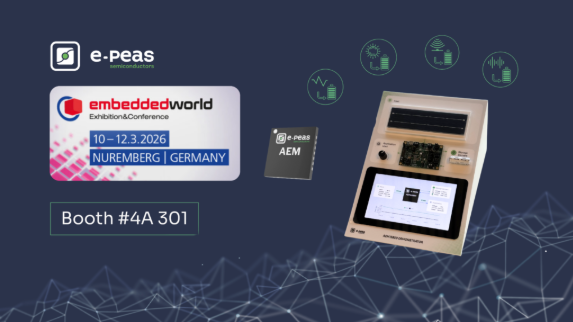
e-peas is using VivaTech 2026 in Paris to demonstrate energy harvesting technology for Ambient IoT, including work showing how ambient light can carry both power and data for connected devices.
The Belgian company’s activity centres on its Ambient Energy Manager portfolio, a family of power management ICs designed to collect energy from sources including light, thermal gradients, vibration, and RF. The range includes devices for hybrid harvesting, dual-source harvesting, photovoltaic operation, RF energy, vibration, and thermal sources.
Among the products being highlighted is the AEM13921, a high-efficiency dual-source constant-voltage and MPPT boost PMIC with DC-DC output. The device harvests from two independent sources, allowing designers to combine energy inputs where one source may be intermittent, seasonal, or location-dependent.
The VivaTech demonstration also includes e-peas’ collaboration with Luxwave, focused on using visible light as both an energy source and a data path. That convergence points toward Ambient IoT systems in which power, sensing, identity, communications, and ultra-low-power compute are designed together from the start.
Energy harvesting has long promised lower-maintenance connected devices, although practical adoption depends on closing the full system power budget. Sensors, microcontrollers, radios, storage elements, firmware, security functions, and duty cycles all have to fit the harvested energy profile. The PMIC governs cold start, conversion efficiency, storage management, source selection, and operating availability, so its influence extends well beyond the power input stage.
Industrial IoT, logistics, smart buildings, asset tracking, retail infrastructure, and environmental monitoring are all pushing toward larger fleets of low-power devices. Battery replacement can dominate lifetime cost, especially when sensors are installed in ceilings, enclosures, machinery, transport assets, or remote infrastructure. Maintenance visits create operational disruption, while discarded batteries add waste and compliance overhead.
The same design pressure is visible in embedded energy-harvesting work shown around Embedded World 2026, where Ambient IoT was tied to the practical problem of powering devices over long service lives. VivaTech extends that discussion into ecosystem integration, where harvesting has to work alongside connectivity, sensing, provisioning, and data management.
Connectivity remains part of the power equation. Remote provisioning and lifecycle management, including work such as Wireless Logic’s SGP.32 activity for IoT hardware, affect how long connected products can remain useful after installation. Power autonomy and connectivity flexibility are different engineering domains, but both shape the service life of distributed devices.
Ambient IoT will not eliminate batteries from every deployment. Some systems require guaranteed availability, high peak power, long-range transmission, or operating conditions that make harvesting unreliable. The near-term opportunity lies in reducing battery size, extending replacement intervals, supporting self-powered sensor nodes, and enabling equipment in locations where wiring or routine servicing is uneconomic.
The design challenge is increasingly architectural. Harvested energy has to be modelled against realistic light levels, vibration patterns, thermal gradients, RF exposure, operating duty cycles, and storage ageing. Firmware may need to schedule work around available power, radios may operate in bursts, and sensing intervals may adapt to the energy state of the device.
e-peas is addressing that problem through a portfolio rather than a single harvesting component. By matching PMICs to different sources and system profiles, it is giving developers more options for balancing conversion efficiency, storage, cold start, and operating duty cycle. As Ambient IoT deployments scale, power management is moving from a peripheral component decision into a core system design constraint.