
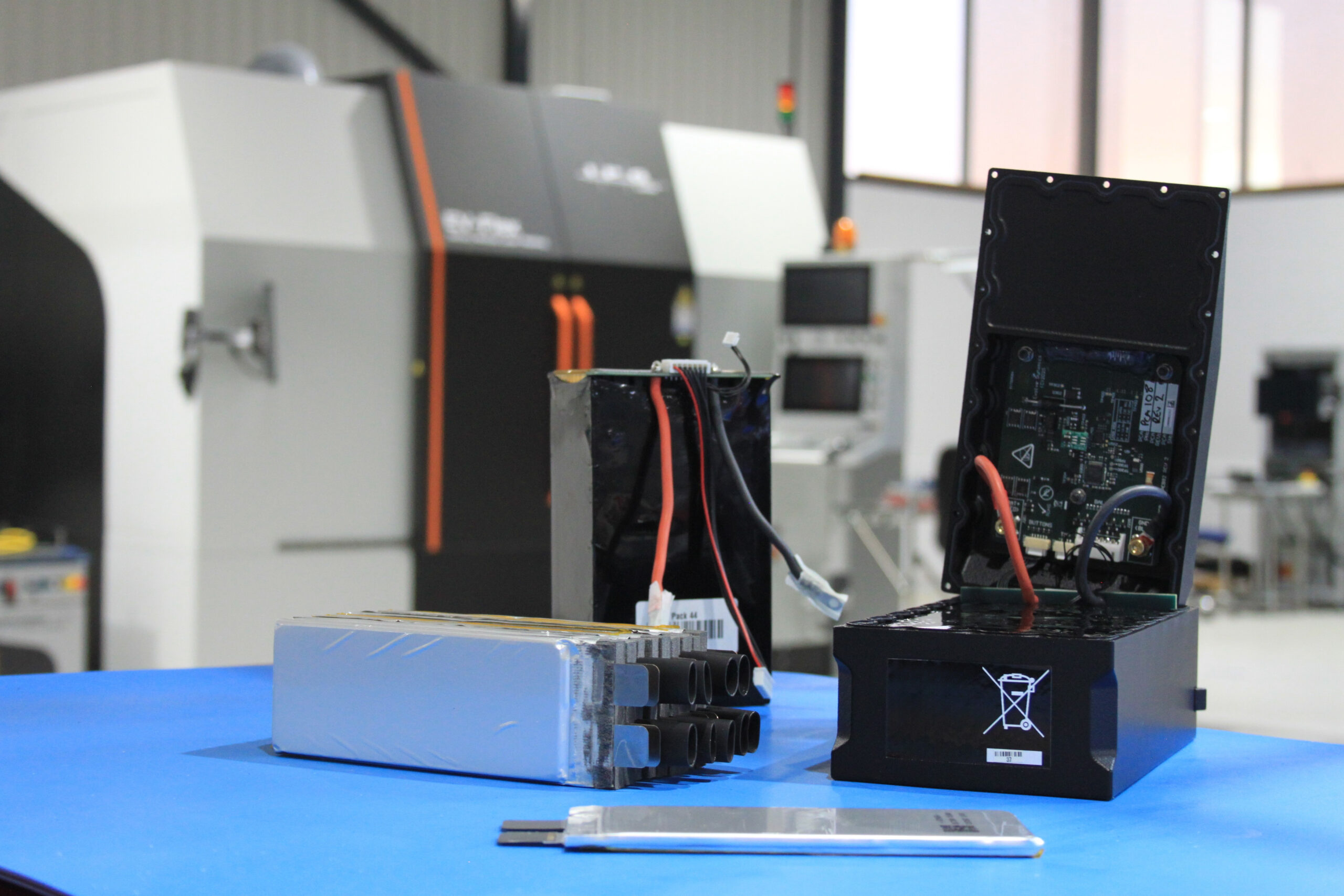
IN Brief:
- Growing demand for commercial UAVs is pushing manufacturers to rethink battery development as production volumes increase.
- Battery packs must be designed for manufacturability, testing, traceability, certification, and supply chain resilience alongside technical performance.
- As UAV programmes mature, specialist battery manufacturing expertise is becoming an increasingly important factor in scaling production successfully.
In a growing market sector, UAV manufacturers are facing a common challenge as they mature.
The nature of the UAV application is such that even between very similar looking products, the actual performance and features can vary greatly. The battery is a key factor that determines how the product performs against the application requirements, and many UAV manufacturers choose to design and develop battery systems in-house during early-stage development.
In recent years, the commercial UAV market has rapidly developed both in terms of technology and demand. This presents a double-edged challenge for UAV manufacturers as they reach commercial maturity.
At the point where repeat production in high quantities is needed, UAV manufacturers need the battery pack to do more than work technically; it must be manufacturable, testable, repeatable, traceable and supported by a reliable supply chain.
When in-house design reaches its limits
One UK-based UAV manufacturer had strong expertise within its engineering team, so had always treated battery packs as a part of the aircraft design process. The in-house approach allowed the team to make changes as each platform developed and ensured the battery design met the specific requirements of their UAV platforms. In the early days, the manufacturer worked with electronics manufacturing companies to build the battery cell packs which were then assembled elsewhere.
As the company expanded its portfolio of uncrewed aerial systems for infrastructure inspection and public safety, it began looking for external partners to further support product development and help prepare key parts for volume manufacture.
A senior project manager at the British UAV/UAS manufacturer said: “We needed feedback from a battery manufacturer on how the packs would translate into production at higher quantities. Manufacturability became an important topic.”
Designing for manufacture
It is common within new product development, to find designs that had been suited to lower quantities are difficult to commercialise. Problems can include high labour utilisation, complex assembly processes, poor repeatability, unsuitable production testing, or hard-to-source components. This is particularly true within battery pack production which relies on multiple electronic and mechanical processes as well as a complicated supply chain.
Managing several battery-related suppliers can also add complexity for UAV manufacturers already managing the wider aircraft supply chain. A specialist battery manufacturer can help assess availability, alternatives and sourcing risk earlier in the design process.
To support the next phase of their development, the UAV manufacturer looked for a UK battery partner with experience in volume manufacturing.
The senior project manager said: “From our first introductions with Alexander Battery Technologies, we could tell the team knew what they were talking about. For example, we were talking directly with engineers from the outset, and they didn’t just take our design choices at face value. They wanted to make sure that what we had specified was used correctly, efficiently and safely as we moved forward.”
Mark Rutherford, CEO at Alexander Battery Technologies (ABT) said the project reflected a common challenge for manufacturers moving from development to higher-volume production.
He said: “The customer came to us with a clear understanding of what its aircraft needed from the battery packs. The next stage was about looking at those designs from a manufacturing, testing and certification point of view.
“That is where a specialist battery manufacturer can add value. We focus on working with OEMs to test the assumptions in their design, identifying what needs to change before production and making sure the final pack can be built and tested consistently.”
Testing, traceability and production control
The scope of the UAV battery project with ABT also included meeting the global UN38.3 safety standard required to transport lithium-ion batteries.
Testing to the standard is rigorous and proves that cells and battery packs can withstand extreme environmental, mechanical and electrical stresses, and therefore are safe to ship.
The senior project manager for the UAV manufacturer said: “The test lab is timely and expensive, so we don’t want to go into that testing without a high level of confidence beforehand.
“We understood the electronic safety requirements but needed more support around mechanical shock and vibration testing. Understanding it from a design perspective means that what we submit has a very good chance of passing the requirements.”
Aside from testing for UN38.3 requirements, production line testing can also become a bottleneck as quantities increase. For most UAV manufacturers, testing small numbers of packs on a benchtop is sufficient in the early days. However, improved traceability and speed of testing become critical at industrial volumes.
Mr Rutherford said: “Testing and validation is a critical stage in the battery pack production line. Here, we are validating that our control plans and assembly processes have worked as expected. Testing verifies that the finished packs are safe and operating within specification, and it becomes part of the traceable product history record.”
A maturity milestone for UAV manufacturers
The British UAV manufacturer and ABT are now working on three battery projects together. The project manager said: “We are getting technical feedback that we trust. The first project showed us that Alexander Battery Technologies was the right company to work with, which is why the relationship has grown from there.”
The trend for continued growth and sudden increases in demand within the UAV sector mean it’s likely that UAV manufacturers will reach the point of maturity where battery development progresses from being a design problem into a manufacturing, testing and supply problem. At this point, the manufacturers best placed to scale will be those that address supply, design, validation and production together from an earlier stage. A specialist battery pack manufacturer can draw on years of experience covering technical, safety and supply disciplines that are specific to battery pack manufacturing at commercial volumes.
For UAV manufacturers moving from low-volume development to repeat production, the battery pack cannot be treated as a finished design simply because it works in the aircraft. It must also be ready to manufacture, test, trace and supply consistently as demand grows. Addressing these issues earlier can reduce avoidable redesign, protect lead times and give manufacturers more control over cost and product availability as demand increases.
Alexander Battery Technologies is a UK-based battery pack manufacturer supporting custom design development, and build-to-print programmes. For more information visit www.alexandertechnologies.com

