IN Brief:
- u-blox has introduced MAYA-W5 and NORA-W5 wireless modules for industrial-grade connected equipment.
- The families combine Wi-Fi 6 and Bluetooth Low Energy, with host-based and stand-alone options.
- European design and manufacturing add supply-chain reassurance for long-lifecycle connected devices.
u-blox has introduced two wireless module families for industrial IoT, healthcare, asset tracking, smart building, and connected equipment designs, combining Wi-Fi 6 and Bluetooth Low Energy in compact, pre-integrated form factors.
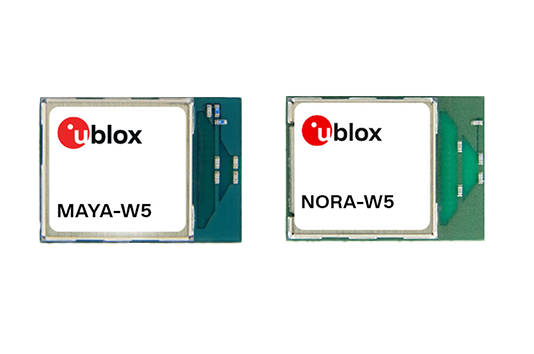
The MAYA-W5 and NORA-W5 series are built around Texas Instruments chipsets and are designed and manufactured in Europe. Both families are intended to reduce the engineering load associated with chip-level RF design, antenna validation, regional certification, and wireless software integration, while giving developers a clearer path to connectivity in products with long operating lives.
MAYA-W5 is a host-based, dual-band module based on the Texas Instruments CC3351 chipset. It connects Wi-Fi through SDIO and Bluetooth through UART, making it suitable for equipment that already has a host processor and requires a qualified short-range wireless subsystem rather than an additional application controller.
NORA-W5 takes a different route, using the Texas Instruments CC35x1E series with an onboard Arm Cortex-M33 MCU and memory options. That makes the module suitable for smaller or more distributed connected products where the wireless module can also carry a greater share of the control workload. The NORA family also supports u-connectXpress software, giving developers a faster path into wireless communication without building the full protocol and command layer from scratch.
Both module families are available with internal and external antenna options. Mechanical compatibility within the existing MAYA and NORA portfolios supports migration planning, which is particularly valuable where products are expected to remain in production for several years and where redesigns are constrained by approvals, enclosure geometry, or installed-base support.
Industrial wireless integration has become less about adding a radio and more about managing coexistence, certification, security, and lifecycle control. Factories, healthcare facilities, logistics environments, and commercial buildings all contain dense radio environments, metal structures, changing obstructions, and multiple generations of installed equipment. A wireless module that behaves predictably across those conditions can remove a disproportionate amount of programme risk from the main product design.
The same pressure is reshaping adjacent areas of edge electronics. As local systems take on more data filtering, sensing, and decision-making, connectivity and memory choices start to become linked design decisions rather than isolated component selections. That was also visible in Longsys’ edge AI memory module work, where local processing requirements pushed memory closer to the application boundary.
European manufacturing adds another useful layer to the launch. Wireless modules may not dominate the bill of materials, but they can become difficult to replace once certification, antenna layout, firmware behaviour, and regulatory paperwork are tied to a finished product. Sourcing continuity and technical support therefore carry more weight than the unit price alone, especially in industrial, medical-adjacent, and infrastructure equipment.
Samples of the MAYA-W5 and NORA-W5 modules are scheduled to become available shortly. The combination of Wi-Fi 6, Bluetooth LE, module-level integration, and European manufacturing gives developers a practical route to connected designs without reopening the RF design problem at board level.