
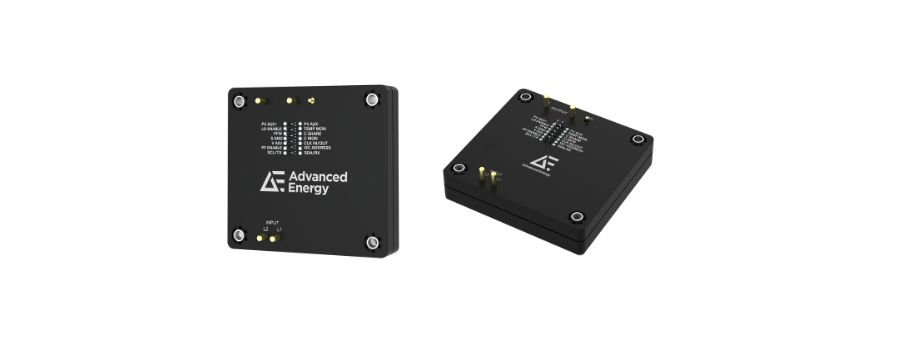
IN Brief:
- The AIH03ZPFC provides a regulated 390VDC output from an 85–264VAC input.
- Peak efficiency reaches 97.3%, with power density specified at 380W/in³.
- Integrated inrush control and PMBus reduce the supporting circuitry required in compact power systems.
Advanced Energy has introduced a 1.1kW board mounted power factor correction module in the half brick format for industrial, medical, defence, telecommunications, and dense computing equipment. The AIH03ZPFC accepts an 85–264VAC input and supplies a regulated, non isolated 390VDC output to a downstream conversion stage.
Peak efficiency is specified at 97.3%, while power density reaches 380W/in³. Compared with the preceding generation, Advanced Energy reports an efficiency improvement of 2.3 percentage points, a 44% rise in power density, and a 46% reduction in power loss.
At kilowatt scale, modest efficiency gains alter the thermal load imposed on an enclosure, the amount of air that must be moved, and the input power distributed through a rack or instrument. The reduction in losses can also lower the temperature experienced by nearby capacitors, connectors, magnetic components, and control electronics.
Inrush current limiting is integrated within the module, reducing the external circuitry needed to control the initial charging of bulk capacitance. Auxiliary power support and PMBus communication provide interfaces for sequencing, status monitoring, fault reporting, and coordination with equipment management software.
The regulated 390VDC bus is intended to feed isolated DC to DC converters or other downstream regulators. Separating the PFC and isolation stages allows the output architecture to be adapted for multiple rails, redundant supplies, battery interfaces, or tightly regulated low voltage loads without changing the mains input section.
A standard half brick footprint can shorten development where a qualified front end is required but mains conversion offers little product differentiation. Mechanical familiarity also simplifies the comparison of alternative modules, although pin arrangements, cooling methods, control functions, and transient behaviour still require detailed review.
Density concentrates the thermal problem
Compressing the PFC stage does not remove its losses; instead, the heat is produced across a smaller area. Baseplate coupling, airflow, PCB copper, connector resistance, and the temperature of adjacent components therefore become more influential, while efficiency across the complete line and load range is more useful than a single peak figure.
Power architecture is already being reconsidered around the current density of AI systems. Liquid cooling integrated with high current rack busbars shows how electrical distribution and thermal management are converging at cabinet level, and the same interaction is present within compact instruments and embedded computers.
A smaller PFC stage can release useful volume, but downstream converters, energy storage, EMI filters, hold up capacitance, protective devices, and service clearances remain. A design gains little from a dense module if the surrounding parts create inaccessible hot spots, excessive airflow resistance, or a layout that cannot meet conducted and radiated emissions limits.
PMBus adds visibility into the front end, provided the equipment software turns telemetry into useful control. Input conditions, temperature, operating state, and fault history can support power capping or condition based maintenance, while coordinated start up can prevent several supplies from presenting their maximum load to the mains simultaneously.
Because PMBus becomes part of the control architecture, the management path itself requires disciplined design. Communications must fail safely, remote commands need appropriate access controls, and a software or network fault must not leave the converter in an uncontrolled state. Fault thresholds and recovery behaviour should also be validated against the complete load rather than accepted from module defaults.
Medical and defence equipment introduces further constraints around leakage current, isolation in the downstream stage, electromagnetic compatibility, acoustic noise, environmental limits, and component lifecycle. Certification applies to the finished system, so a compact PFC module simplifies one section of the chain without substituting for equipment level testing.
Industrial installations bring line disturbances, long service periods, and limited maintenance access, making wide range input and controlled inrush useful beyond laboratory conditions. The AIH03ZPFC offers a compact route from universal mains to a managed high voltage bus, although its full advantage will appear only where cooling, EMC, protection, and downstream conversion are designed with equal attention.

