IN Brief:
- Chroma’s ATS 8000 automated power-test platform now supports Rohde & Schwarz MXO Series oscilloscopes.
- MXO instruments offer acquisition rates up to 4.5 million waveforms per second and up to 24 synchronised channels through ScopeSync.
- The integration extends automated measurement options for increasingly dense, high-power conversion architectures.
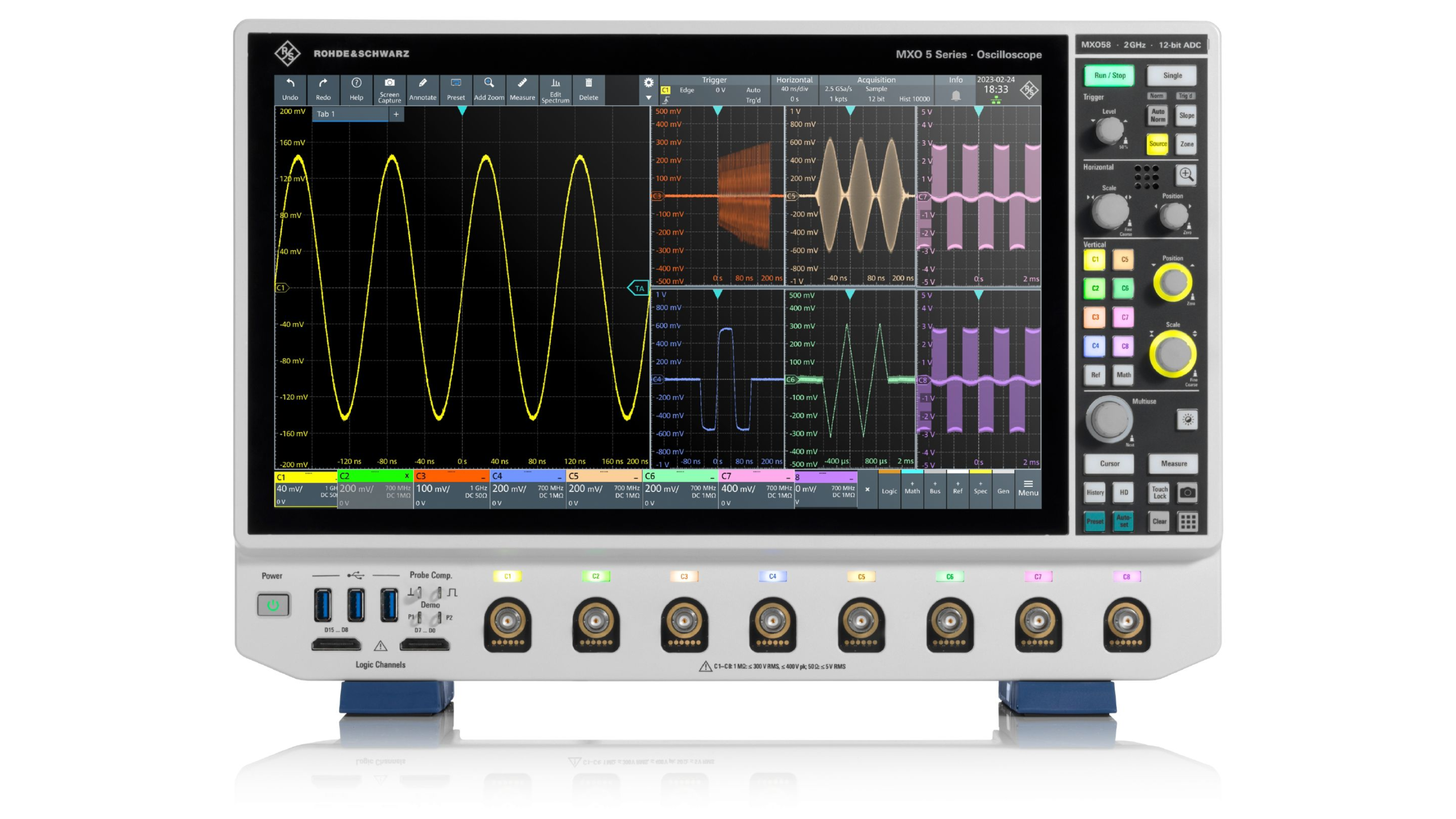
Chroma ATE has added support for Rohde & Schwarz MXO Series oscilloscopes to its Power Conversion Device Automated Test System Model 8000, extending the platform’s measurement options for automated power electronics testing.
The ATS 8000 is used to automate development and production checks on power conversion devices and power supplies, including waveform capture, debugging, and calibration. Integrating the MXO Series gives users access to Rohde & Schwarz’s current oscilloscope architecture without moving measurements outside the established ATS workflow.
The addition is aimed partly at increasingly dense power systems used in AI data centres, where power supply designers are working with higher power levels and newer high-voltage DC architectures. Such systems can combine multiple power modules, battery backup units, and capacitor backup units, increasing both the number of signals that must be observed and the value of capturing short-duration events across several channels at once.
Rohde & Schwarz says the MXO Series, based on its MXO-EP processing ASIC, can acquire up to 4.5 million waveforms per second. HD mode supports up to 18-bit resolution, while input sensitivity extends down to 0.5mV/div. Adjustable trigger sensitivity, digital triggering, and low trigger jitter are intended to improve visibility of small or infrequent signal anomalies.
Channel count becomes equally important once a test moves beyond a single power stage. MXO models are available with up to eight channels, while the company’s ScopeSync architecture can synchronise multiple instruments in a primary-secondary arrangement, taking the available channel count to as many as 24. That allows automated test developers to correlate behaviour across converters, backup modules, control lines, and other nodes without splitting the investigation into unrelated captures.
Jithu Abraham, Director Product Management Oscilloscopes at Rohde & Schwarz, said: “Power electronics engineers developing complex power systems used in AI data center infrastructure need measurement tools that can capture fast signal behavior and support complex multi-channel setups. By adding our MXO Series to Chroma’s well-established ATS 8000 platform, these users can now access next-generation oscilloscope technology within their existing automated test workflows.”
Chroma’s PowerPro 5 control software also allows external C# or Python programs to run inside the test flow. Application-specific analysis can therefore sit alongside standard automated routines, including serial-bus decoding, product-specific calibration, and calculations that would otherwise require a separate engineering environment.
That software integration is useful where the same test platform has to serve development, validation, and production. A design team may need to capture an intermittent transient during debugging, reproduce it under controlled conditions, then convert the measurement into a repeatable validation or production check. Keeping the oscilloscope inside the automated platform makes those transitions easier to manage and preserves measurement consistency between manual investigation and machine-run sequences.
The instrumentation problem also changes as power architectures become more modular. A fast oscilloscope is of limited value if engineers cannot observe enough nodes coherently to understand the interaction between converters, storage elements, and control signals. Multi-instrument synchronisation therefore becomes as relevant as acquisition speed when a power system has to be assessed as one electrical system rather than as a series of isolated stages.
Chroma positions the ATS 8000 as a configurable automated test platform with several supported hardware options, rather than a system tied to a single instrument family. Adding MXO support broadens that choice while bringing higher-resolution acquisition, fast waveform capture, and multi-instrument measurements into an existing power-test environment.
As data-centre and high-power conversion architectures add channels, backup elements, and tighter transient requirements, the measurement burden is shifting towards capturing more signals at the same instant without sacrificing detail. The ATS 8000 integration gives users another route to build that capability into automated testing rather than treating oscilloscope work as a separate bench activity.