IN Brief:
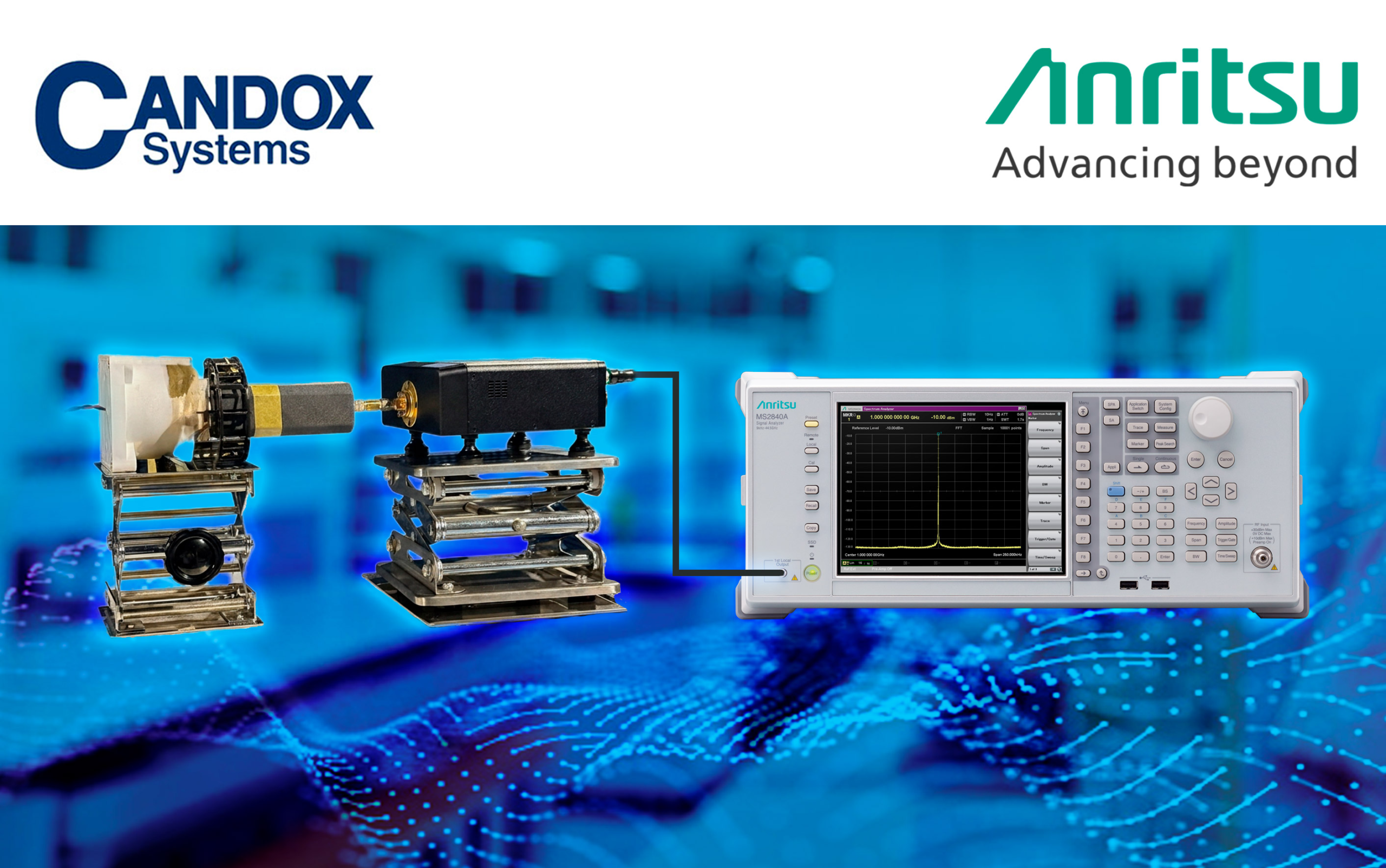
- The setup combines an Anritsu millimetre wave measurement system with a CANDOX 60 GHz near-field probe for production inspection.
- Measurements made at TÜV Rheinland Japan were compared with far-field results from the Japan Radio Act certification method.
- The approach is intended to reduce production test footprint and capital cost while maintaining a characterised relationship with certification measurements.
Anritsu and CANDOX Systems have evaluated a chamberless production test method for 60 GHz radar and sensor products, establishing a measurable correlation between near-field probe results and the far-field method used for certification under Japan’s Radio Act.
The system combines Anritsu millimetre wave measurement equipment based around a signal analyser with a CANDOX 60 GHz near-field probe. Instead of reproducing the large anechoic environment used for regulatory measurements, the production setup places the probe much closer to the device and uses measured difference data to relate its results to the established certification method.
Near-field and far-field measurements cannot normally be treated as interchangeable. Close to an antenna, the electric and magnetic fields retain a more complicated spatial relationship and the measured result depends strongly on distance, position and the geometry of the radiating structure. Further away, the wave behaves more predictably and measurement methods can characterise radiated performance using the assumptions required by the relevant test standard.
Anritsu and CANDOX therefore compared the two methods rather than assuming that a compact probe would reproduce the certification result directly. Measurements used to calculate the differences were performed at the laboratory of TÜV Rheinland Japan, a third-party certification body. Anritsu says it then used those results to establish correlation between the far-field certification measurements and the measurements obtained with the CANDOX probe.
TÜV Rheinland Japan’s involvement should not be confused with certification of the chamberless method itself. Its laboratory provided measurements using the regulatory test approach against which the compact system could be compared. Anritsu is the party stating that the resulting data demonstrates correlation suitable for production testing.
The distinction also separates regulatory approval from manufacturing inspection. A 60 GHz product still has to meet the applicable radio requirements through the prescribed certification process. The proposed chamberless setup is intended for repeated testing once manufacturing begins, where putting every device through a large anechoic chamber would consume considerable floor space, equipment investment and test time.
Those constraints become more significant as radar and sensing devices move into larger production volumes. An anechoic chamber controls reflections from surrounding surfaces and provides the physical distance required for the chosen radiated measurement. Reproducing that environment beside several production lines is difficult, particularly where factory space is already occupied by assembly, calibration and end test equipment.
A compact near-field fixture changes the physical arrangement but does not remove the need for measurement discipline. Probe position, device orientation and the distance between the probe and antenna can all alter the measured field. Enclosure materials and antenna layout can also change the relationship between the local field and the far-field radiation pattern, so the difference data has to be established for the product and test arrangement rather than treated as a universal correction for all 60 GHz devices.
Anritsu identifies applications including vital sign detection, motion sensing, security systems and industrial equipment. These products increasingly integrate antennas directly into compact modules or complete assemblies, which can make conducted RF testing impossible once the antenna and transmitter form one integrated design. Radiated production measurement then becomes necessary if manufacturers want to detect assembly or RF faults before shipment.
The chamberless method provides a smaller measurement environment for that task. Its usefulness depends on whether the relationship established during validation remains sufficiently repeatable across production fixtures, operators and device lots. A compact test that drifts with mechanical positioning would simply replace the chamber footprint with another source of uncertainty, so fixture control remains part of the production engineering problem.
Anritsu began offering the solution in October 2026. The validation establishes a route between the CANDOX near-field measurement and the Japan Radio Act reference method, giving manufacturers a basis for developing a production screen without duplicating the complete certification environment on the factory floor.