IN Brief:
- Navitas completed the Claros transaction on 6 October after agreeing the acquisition in August.
- Claros integrates power transistors, digital control, inductors and capacitors into voltage regulation technology for vertical and embedded power delivery.
- The acquisition extends Navitas from higher voltage GaN and SiC conversion stages into the final low voltage conversion close to AI processors.
Navitas Semiconductor has completed its acquisition of Claros, adding integrated voltage regulator technology intended to move the final power conversion stage closer to high current AI processors.
The transaction closed on 6 October following the acquisition agreement reached in August. Claros now forms part of a power portfolio that already includes gallium nitride and silicon carbide devices used at higher voltage conversion stages, giving Navitas technology spanning a larger portion of the electrical path between the incoming supply and the processor core.
That electrical path becomes difficult near an AI accelerator because processor voltage is low while required power continues to rise. Delivering several kilowatts at around one volt requires very large currents, and those currents produce resistive losses as they travel through PCB copper, connectors and power planes. The inductance of the path also limits how rapidly current can change when processor demand shifts between workloads.
Conventional voltage regulator modules are normally positioned beside the processor and move current laterally across the board. As current increases, the distance between the regulator and the silicon becomes more expensive electrically because both resistance and inductance sit in the path. Moving the final conversion closer to the processor reduces that distance and can lower distribution losses while improving the regulator’s response to rapid load changes.
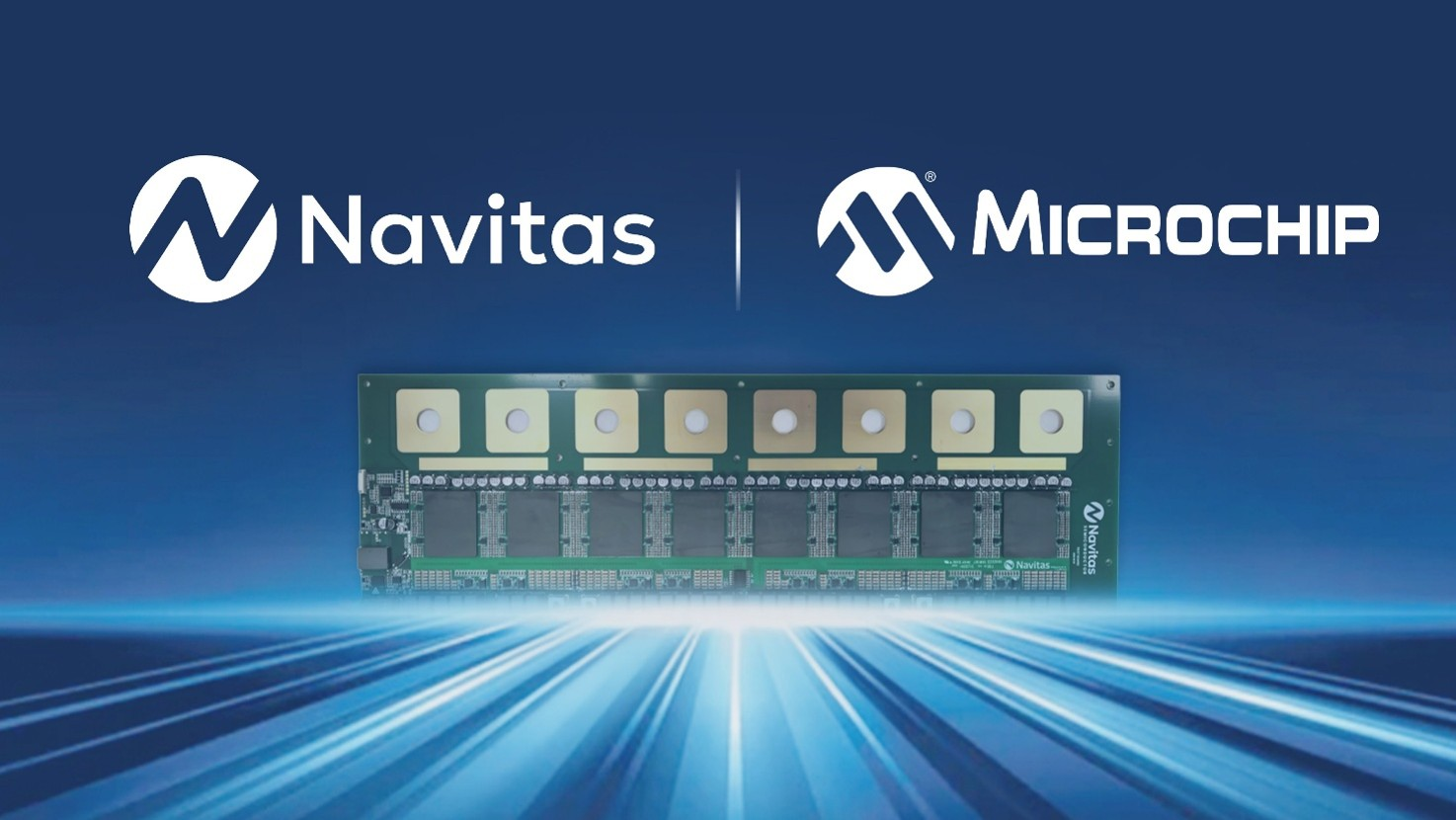
Claros addresses that stage with an integrated voltage regulator technology stack combining power transistors, digital control, inductors and capacitors. Navitas says the same underlying technology supports packaged and embedded regulator products for vertical and embedded power delivery architectures. Its PowerArray approach is intended to combine regulator elements as processor current requirements increase.
Vertical power delivery changes the physical direction of the final connection. Instead of carrying all of the low voltage current across the motherboard from regulators positioned around the processor, parts of the conversion system can sit beneath or immediately adjacent to the package. Embedded designs move power circuitry still closer to the processor structure. Both approaches shorten the high current path, although they place additional demands on packaging, heat removal and manufacturing.
Navitas’ existing portfolio operates further upstream. Its GaN and high voltage SiC devices address conversion stages where voltage is much higher and current is correspondingly lower than at the processor core. The company has been aligning those devices with emerging 800VDC infrastructure for AI data centres, where power can be distributed through racks at higher voltage before being converted down through subsequent stages.
Raising the distribution voltage reduces current for a given amount of transmitted power, which can reduce conductor losses before the supply reaches the server board. It does not remove the final conversion problem. The processor still requires a low core voltage, so the electrical architecture has to move from hundreds of volts to fractions of a volt while preserving efficiency and responding to rapid changes in compute load.
The Claros acquisition gives Navitas technology at that final stage rather than requiring the company to stop at the intermediate bus. It also introduces digital control and integrated passive components alongside the power semiconductor technologies already in the portfolio. Designing those stages together could allow optimisation across the interfaces between converters, but the company has not yet disclosed a production system combining every part of the architecture.
Completion of the transaction is distinct from a product launch. Claros already has packaged and embedded regulator concepts, but no new customer deployment or production volume has been disclosed for the acquired technology. Navitas plans to provide further technical detail on 20 October during a webinar covering its AI infrastructure power strategy.
The acquisition changes the range of electrical problems Navitas is equipped to address. Higher voltage conversion is governed by switching loss, isolation and power density at one end of the chain, while the final processor stage is dominated by extremely high current, transient response and short electrical paths. Claros brings that second set of constraints inside the company as AI processor power continues to rise.