IN Brief:
- ASMPT's SIPLACE V L increases feeder capacity from 90 to 120 slots, supporting more component types within one machine configuration.
- An interchangeable tray unit and multiple placement heads accommodate miniature devices and larger components up to 55mm high.
- Compatibility with existing SIPLACE feeders, software, and factory interfaces supports integration into established SMT operations.
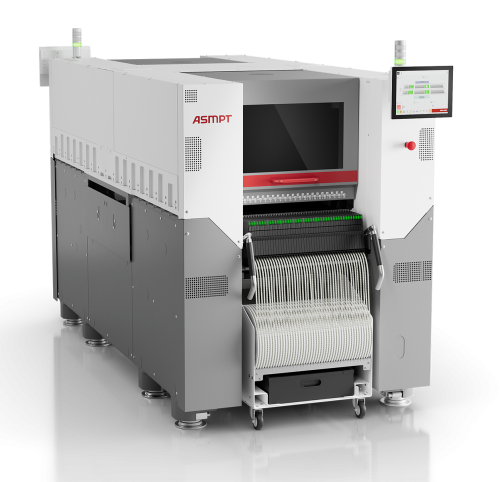
ASMPT has expanded its SIPLACE V placement platform with a second machine variant, increasing feeder capacity and extending the range of components that can be handled on a common electronics assembly architecture.
The SIPLACE V L provides 120 feeder slots, compared with 90 on the standard SIPLACE V, and accommodates components up to 55mm high. ASMPT has also introduced a narrower, interchangeable tray unit that allows tray-fed components to be supplied alongside conventional feeders.
The expansion, announced on 18 November, builds on a placement platform designed to accommodate different product mixes and production requirements without introducing a separate machine architecture for each application.
Feeder capacity is an important constraint in surface mount assembly, particularly where manufacturers produce numerous PCB variants on the same line. Each additional component type can require another feeder position, while differences in packaging may also affect the equipment needed to present parts to the placement head.
When the required component mix exceeds the available feeder capacity, operators must change materials or divide production between configurations. Increasing the number of positions allows more component types to remain loaded, potentially reducing the frequency of those changes.
The scale of any productivity improvement depends on the products, feeder allocation, material availability, and production schedule. ASMPT has not provided a separately quantified changeover improvement attributable to the additional 30 slots.
The new variant also provides greater flexibility in the supply of components from trays. Its compact SIPLACE V Tray Unit can be combined with a feeder table on either side of the machine, allowing different packaging formats to be handled within the same placement configuration.
Tray handling is commonly required for components that are unsuitable for tape-and-reel packaging, including certain large or specialised packages. The ability to use feeders and trays together reduces the need to separate these components into different handling arrangements solely because of their packaging.
A broad component range also requires placement heads with different mechanical characteristics. Rapidly placing miniature components imposes different demands from picking up and accurately positioning large packages with greater mass.
Across the SIPLACE V platform, ASMPT offers several placement heads. The CP20 collect-and-place head has a specified maximum placement rate of 52,500 components per hour, with accuracy of ±25µm at three standard deviations under the manufacturer’s stated conditions.
That figure describes the head’s rated capability, not the guaranteed output of a complete assembly line. Actual throughput depends on component mix, PCB layout, material supply, machine configuration, and the time required by other production operations.
The CPP head supports different operating modes for mixed component placement, switching between collect-and-place, pick-and-place, and combined operation through software commands.
For larger components, the TWIN VHF head accommodates packages measuring up to 200 × 150 × 55mm, with available placement force reaching 100N. Its handling characteristics extend the platform beyond the miniature surface mount devices typically associated with high-speed placement equipment.
The requirements for positioning a large component also differ from those for miniature passives. Package dimensions, centre of gravity, nozzle selection, and placement force can influence whether the part can be handled reliably without damage or positional error.
ASMPT attributes performance improvements of up to 30% under specified production conditions to the wider SIPLACE V architecture, which incorporates a rigid machine frame, shortened travel paths, and main-axis acceleration reaching 6G.
The company has not established that the V L variant independently delivers a further 30% improvement over the standard machine. Its principal additions concern material capacity and the component spectrum rather than a separately announced increase in placement speed.
Compatibility has been retained with existing SIPLACE X-Feeders and SIPLACE SX changeover tables. The platform also supports ASMPT’s WORKS Software Suite and Factory Solutions, allowing manufacturers to retain compatible material handling and production software investments.
Communication facilities include Gigabit Ethernet and free-space optical links, alongside IPC-HERMES-9852 and IPC-CFX interfaces used for exchanging information between production equipment and higher-level software.
These interfaces allow machine operation and material information to be incorporated into wider factory systems, although the available functions depend on the software and equipment deployed.
The SIPLACE V L expands the range of production configurations available on the existing platform. ASMPT has not disclosed customer orders, delivery volumes, or a machine-specific throughput comparison for the new variant, leaving individual manufacturers to assess its additional feeder and component handling capacity against their assembly requirements.