IN Brief:
- Arrow is set to become a licensed reseller of SECO's Clea software platform.
- The partnership encompasses embedded computing modules based on Qualcomm Dragonwing processors.
- Joint demonstrations at European technology centres will support customer development and design opportunities.
Arrow Electronics and Italian embedded computing specialist SECO have signed a memorandum of understanding covering industrial edge artificial intelligence, extending their commercial and engineering relationship across Europe, the Middle East, Africa, and North America.
Under the proposed arrangement, Arrow will become a licensed reseller of SECO’s Clea software platform, which supports the deployment and management of applications, AI models, and connected devices. The partnership will combine these capabilities with embedded computing hardware, including systems on modules based on Qualcomm Dragonwing processors.
Arrow and SECO intend to develop joint customer demonstrations at European technology centres, providing opportunities to evaluate Qualcomm’s processing technology alongside the software and engineering resources required to integrate it into electronic products.
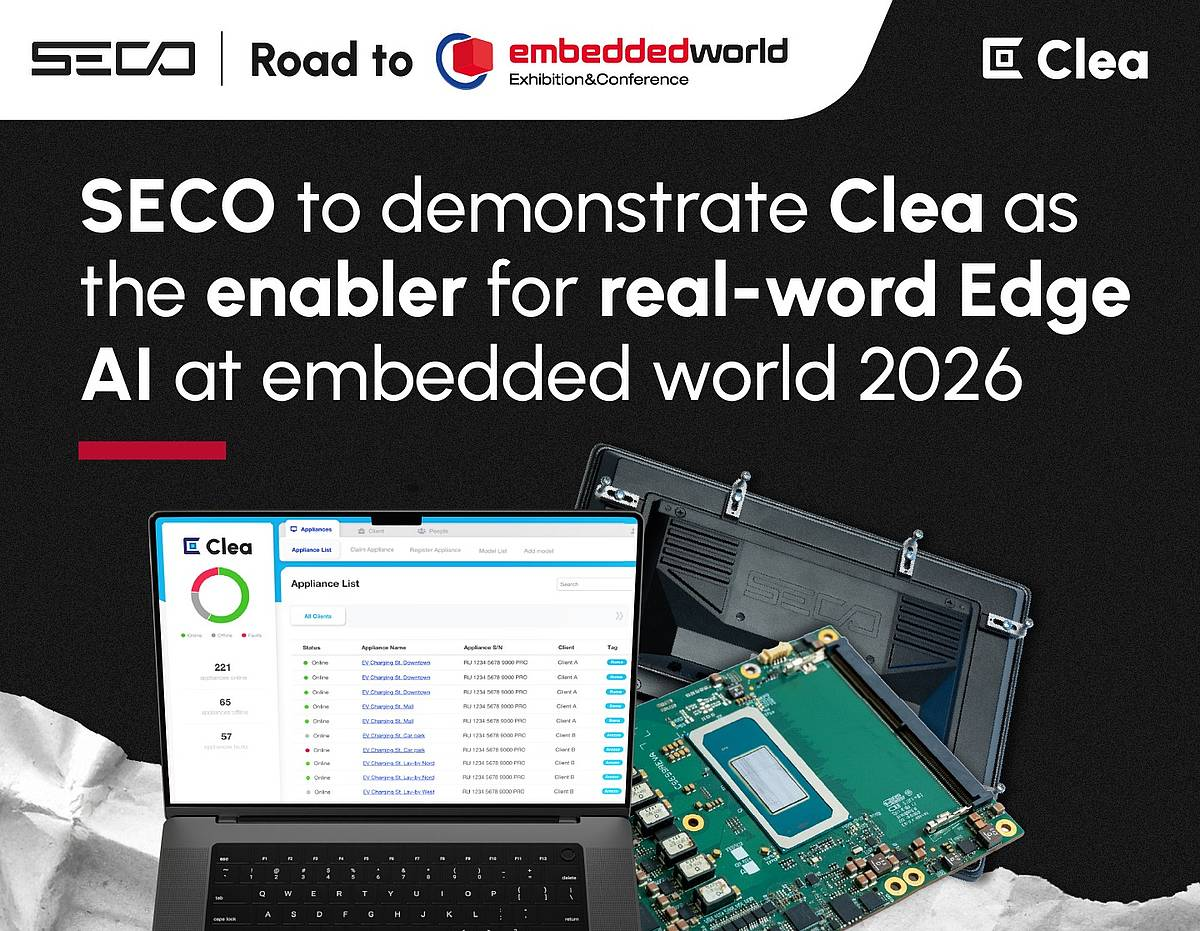
SECO has already demonstrated elements of this combined approach. At Electronica in Munich earlier this month, the company presented a development workflow covering application selection through its App Hub, configuration using Clea Studio AI, and deployment onto embedded computing hardware. Its SOM-SMARC-Dragonwing-IQ8 module also formed part of its exhibition programme.
The expanded relationship with Arrow extends beyond conventional hardware distribution by incorporating the software environment through which applications can be configured, deployed, and maintained. An equipment manufacturer sourcing an embedded computing module must establish compatibility between the processor architecture, operating system, application software, and the interfaces connecting the module to external circuitry.
Using a system on module allows some of those requirements to be addressed through a pre-integrated hardware assembly. Processing resources, memory, and supporting circuitry can be incorporated into an application-specific design through a carrier board, reducing the amount of custom engineering required around the processor itself.
SECO’s Dragonwing-based portfolio includes modules using the SMARC and COM Express specifications. These formats establish mechanical and electrical interfaces through which computing modules connect to carrier boards, although the processor capabilities, interface configurations, and software support available on individual modules continue to determine their suitability for particular products. SMARC and COM Express also differ in connector layouts and carrier board requirements, so migration between formats generally involves hardware redesign.
AI processing introduces additional considerations during module selection. The execution performance of a neural network depends on the operations supported by the accelerator, the numerical precision of the model, and the movement of information between processing resources and memory. Published peak performance figures cannot establish the execution speed or power consumption of every application.
Developing a machine vision application also requires the integration of image acquisition and preprocessing functions. Camera interfaces must accommodate the required image resolution and frame rate, while the software pipeline must deliver information to the inference engine within the timing constraints of the equipment in which it operates.
Local inference can reduce the amount of information transmitted to external computing infrastructure. In an industrial inspection system, for example, identifying defects within the embedded device can allow inspection results to be communicated without transferring every unprocessed image across a network. The corresponding computational and thermal requirements remain within the electronic product itself.
Managing deployed applications introduces a separate set of requirements after the initial hardware and software integration. Industrial equipment can remain operational across several generations of application software, requiring manufacturers to maintain compatible configurations and establish controlled procedures for updating the functionality available on individual devices.
SECO introduced its updated Clea 2.0 deployment framework in October, expanding its capabilities for managing applications across embedded installations. The proposed reseller arrangement would give customers an additional commercial route into that environment alongside Arrow’s existing component supply and engineering services.
The memorandum does not identify committed customer projects or sales volumes. Its immediate commercial development is the planned addition of Clea to Arrow’s software offering, with the European customer demonstrations providing a route towards specific embedded computing design programmes.