IN Brief:
- UL Solutions has evaluated the AVR SD microcontroller family against UL/CSA/IEC 60730-2-5 Class C requirements.
- Integrated safety mechanisms include dual-core lockstep processing, error-correcting memory, redundant peripherals, and autonomous fault monitoring.
- Microchip's Safety Framework coordinates hardware diagnostics, watchdog supervision, fault responses, and transitions into safe operating states.
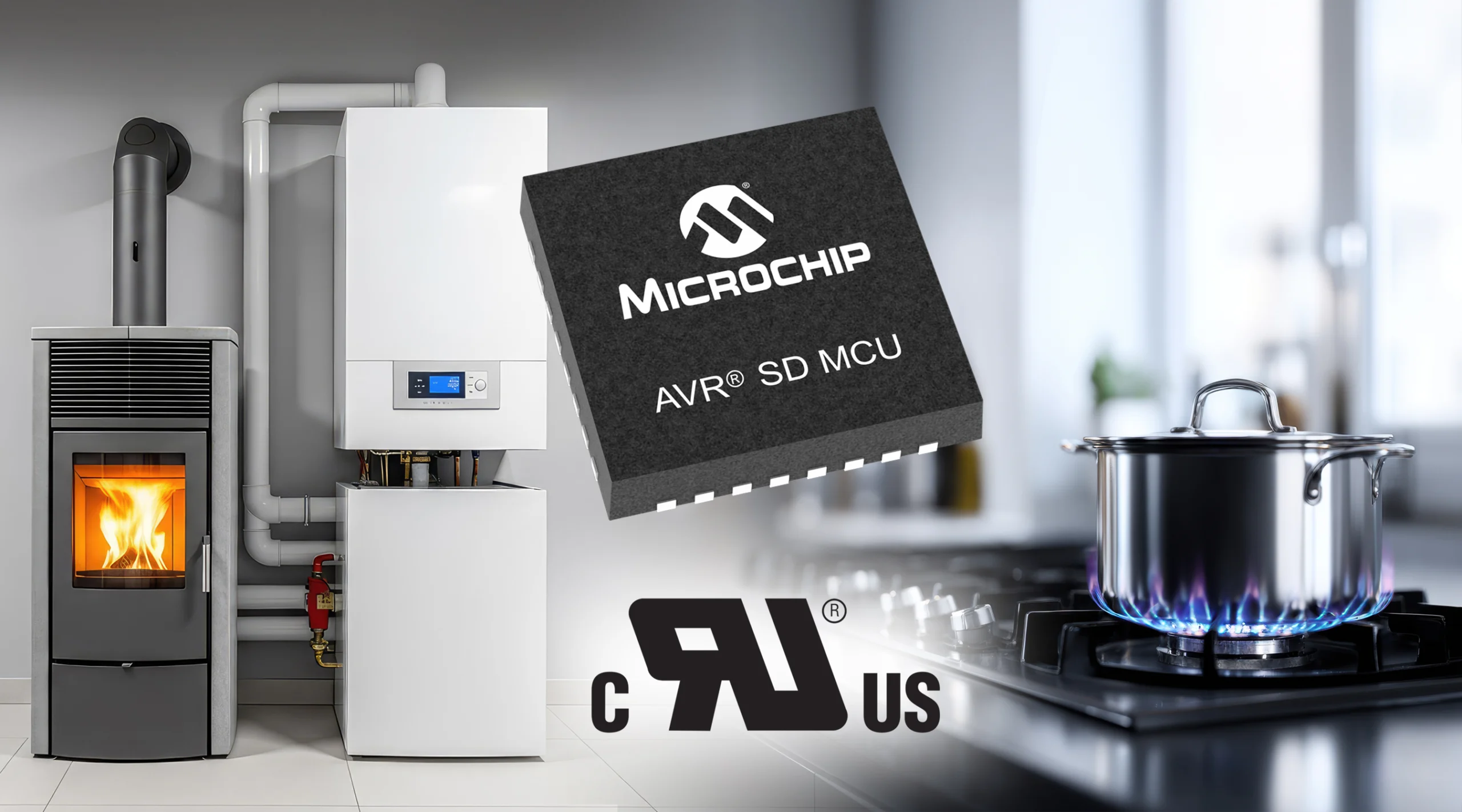
Microchip Technology has secured UL Recognition for Components for its AVR SD microcontroller family against UL/CSA/IEC 60730-2-5 Class C requirements, providing an independently evaluated hardware architecture for the development of automatic electrical burner controls used in appliances and associated equipment.
The recognition follows an assessment by UL Solutions of the microcontrollers’ safety architecture, diagnostic capabilities, and fault management mechanisms. Microchip has incorporated more than 20 dedicated hardware safety features into the devices, supported by a software framework that coordinates their operation within safety-related embedded applications.
IEC 60730 establishes safety requirements for automatic electrical controls, with Part 2-5 specifically addressing automatic burner control systems. Applications include furnaces, boilers, and gas-fired appliances, where failures affecting the operation of electronic controls could compromise the safety of the equipment.
Microchip’s AVR SD architecture incorporates dual-core lockstep processing, in which redundant processing resources execute corresponding operations and their behaviour is compared to detect discrepancies. Implementing this comparison in hardware allows certain processor faults to be identified during execution rather than relying exclusively on diagnostic software running at predetermined intervals.
Greg Robinson, corporate vice president of Microchip’s MCU, development tools and wireless business units, said: “The AVR SD family was purpose-built for functional safety applications, integrating key safety mechanisms directly into hardware so engineers can focus more on application development and less on implementing and maintaining safety functions through software.”
Protected memories incorporate single-error correction and double-error detection (SECDED) error-correcting codes. Redundant information stored alongside the memory contents allows the hardware to correct individual bit errors and detect double-bit errors, which cannot be corrected through the same mechanism. The detection of an uncorrectable error can then form part of the wider system’s fault response.
Peripheral redundancy extends the diagnostic architecture beyond the processor and memory. The AVR SD family incorporates two analogue-to-digital converters, providing resources for measurement comparison and plausibility checking. Their effectiveness in detecting particular faults depends on the design of the associated analogue signal paths, reference sources, and external sensing circuitry.
A centralised error controller receives fault information from the integrated diagnostic mechanisms and can initiate an automatic transition into a safe state. Bringing these functions together allows faults detected across different parts of the microcontroller to be handled through a coordinated response, rather than requiring each application routine to implement its own fault management procedure.
Vladimir Ivetic, senior staff engineer of Functional Safety in the Appliances, HVAC and Lighting group at UL Solutions, said: “The AVR SD MCUs integrate hardware-based solutions that were evaluated as safeguards against microelectronic faults and errors for IEC/UL/CSA 60730 Function Class B and C applications.”
Microchip’s accompanying AVR SD Safety Framework coordinates the operation of these mechanisms through configurable source code. Its responsibilities include initialisation, fault-injection diagnostics, watchdog supervision, error responses, safe-state transitions, and recovery following a reset. Supporting safety and verification documentation addresses the integration of those functions into individual product designs.
Moving diagnostics into dedicated hardware can reduce the program memory and processing time required by equivalent software implementations. It also allows certain monitoring functions to operate independently of the normal application execution sequence, providing diagnostic resources that do not depend entirely on the continued correct operation of application software.
The appropriate safe-state response remains an application-specific design decision. The microcontroller can initiate a response to a detected fault, but the resulting condition of the controlled equipment depends on the external circuitry, actuator interfaces, and safety architecture through which that response is implemented.
Microchip developed the AVR SD devices and Safety Framework under a functional safety management system certified by TÜV Rheinland, using processes aligned with ISO 26262 and IEC 61508. The platform is also designed to support applications targeting Automotive Safety Integrity Level C (ASIL C) and Safety Integrity Level 2 (SIL 2).
The UL component recognition establishes an evaluated foundation for developing controls under IEC 60730-2-5. Manufacturers must still establish the compliance of their complete products, including the integration of the microcontroller, external safety mechanisms, diagnostic coverage, and application-specific fault responses. Microchip’s integrated architecture and supporting documentation provide resources through which those requirements can be addressed without independently developing every processor-level diagnostic function.