IN Brief:
- The 76–81GHz radar MMIC supports modulation bandwidths of up to 4GHz and frequency ramp slopes reaching 200MHz/µs.
- Its CSI-2 interface supports data transmission to external processing equipment at up to 1.2Gbps per lane.
- The device is qualified to AEC-Q100 Grade 1 and supports functional safety requirements up to ASIL B.
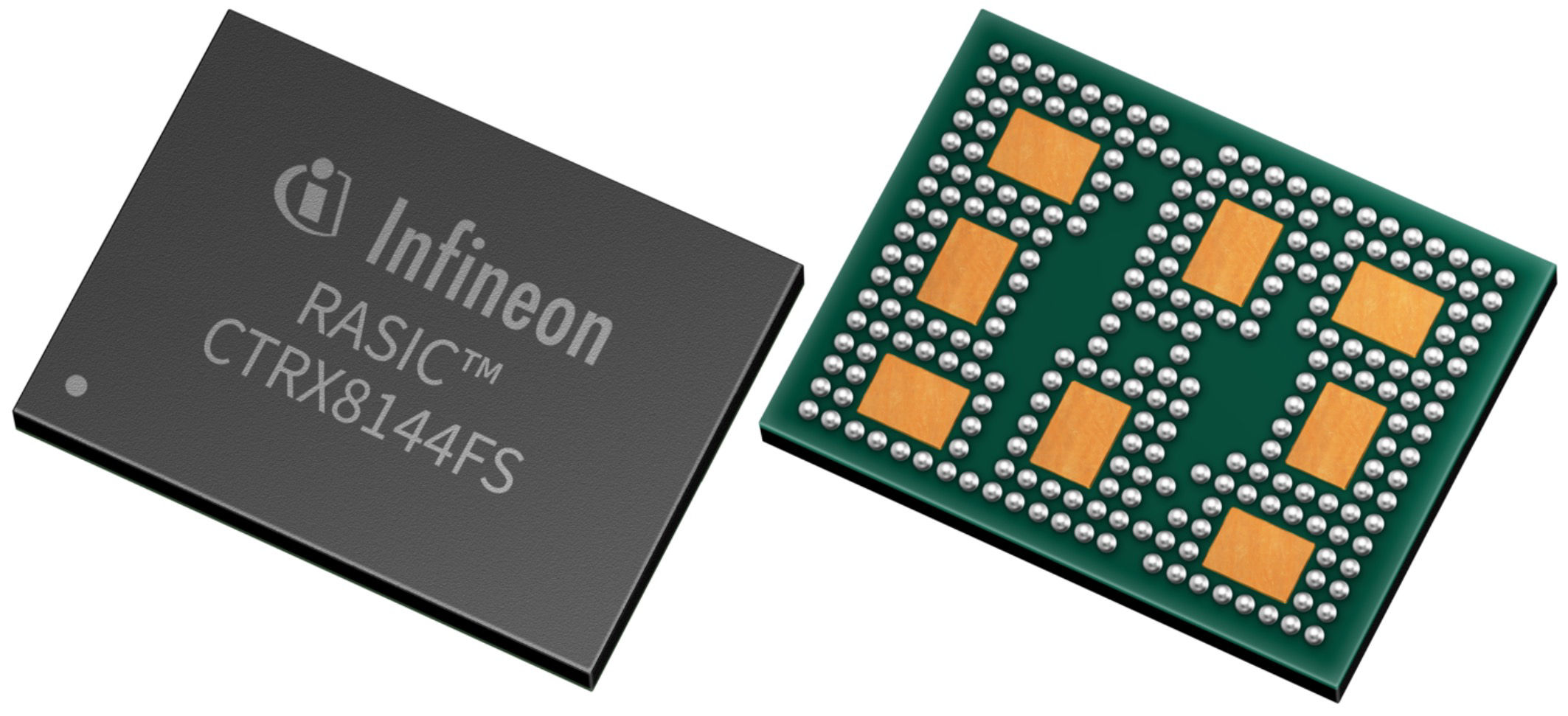
Infineon Technologies has expanded its automotive radar portfolio with the RASIC CTRX8144FS, a monolithic microwave integrated circuit designed to transfer radar data directly to central processing hardware within advanced driver assistance systems (ADAS).
Manufactured using a 28nm semiconductor process, the device operates across the 76–81GHz frequency range and incorporates four transmit and four receive channels. It extends Infineon’s existing CTRX radar family, which includes the CTRX8191F/FS and CTRX8188F, with a configuration intended for front and corner radar applications.
The transceiver supports modulation bandwidths of up to 4GHz and frequency ramp slopes reaching 200MHz/µs. Infineon specifies a transmit output power of 14.5dBm and a receiver noise figure of 10.2dB, with a CSI-2 interface providing data transmission rates of up to 1.2Gbps per lane.
Corner radar systems monitor areas adjacent to the vehicle, complementing forward-facing sensors in applications including cross-traffic detection, lane merging, and environmental sensing at intersections. Their positioning allows approaching vehicles and other objects to be detected across angles that may fall outside the coverage of forward-facing equipment.
Frequency-modulated continuous-wave radar determines an object’s distance and relative movement by analysing the relationship between transmitted signals and their reflections. As the transmitted frequency changes, the time taken for the reflected signal to return produces a corresponding difference in frequency from which distance can be estimated.
The available modulation bandwidth influences the ability to distinguish objects separated in range. A 4GHz sweep corresponds to a theoretical range resolution of approximately 3.75cm under ideal conditions, although the practical performance of the radar also depends on its waveform configuration, antenna characteristics, signal processing, and operating environment.
Multiple transmit and receive channels provide additional spatial information. Suitable multiple-input multiple-output configurations allow differences in received signal phase to be used for angular estimation, with the physical arrangement of the antennas determining the properties of the resulting virtual antenna array.
The CTRX8144FS incorporates a digital phase-locked loop and a configurable sequencing system for generating radar waveforms. Integrated power management and low-dropout regulators reduce the requirement for external supporting circuitry, while diagnostic functions monitor RF performance and internal temperature.
“Centralized processing shifts signal processing from the radar sensor to a central ADAS compute unit,” said Andreas Kopetz, Head of the Radar Product Line at Infineon. “By removing memory and computing constraints at sensor level, the architecture enables larger radar data sets and more advanced algorithms. This can support improvements in detection range, sensitivity and target separation.”
Transferring radar processing into a shared computing platform changes the distribution of electronics throughout the vehicle. Conventional radar modules typically incorporate local processing hardware and memory, allowing them to send information about detected objects to other vehicle systems instead of transmitting the underlying measurement data.
A centralised architecture can allocate more processing resources to the analysis of radar measurements, alongside information acquired through cameras and other sensors. Processing those inputs within a common computational environment also allows vehicle manufacturers greater flexibility over the algorithms used to combine them.
Transmitting less processed radar data increases the communications bandwidth required between the sensor and the central computing unit. Synchronisation, data integrity, and processing latency must also remain compatible with the timing requirements of the associated ADAS functions.
The CSI-2 interface provides the CTRX8144FS with a high-speed connection at sensor level, although the complete vehicle architecture must incorporate suitable mechanisms for transporting and synchronising the information generated by multiple devices.
Infineon has also integrated RF waveguide ports into the transceiver. At millimetre-wave frequencies, discontinuities and losses within PCB transmission structures can reduce the power reaching an antenna and affect the sensitivity of the receive path. Waveguide integration reduces reliance on complex high-frequency PCB transitions, while the device’s thermal characteristics support operation across automotive temperature conditions.
The CTRX8144FS has been developed as a Safety Element out of Context under ISO 26262 and supports requirements up to Automotive Safety Integrity Level B. Its AEC-Q100 Grade 1 qualification addresses semiconductor reliability across the corresponding automotive operating temperature range, with system manufacturers responsible for establishing the functional safety of the completed radar application.
The device is now available, extending Infineon’s component options for automotive platforms in which radar acquisition and signal processing are implemented on separate electronic assemblies.