
IN Brief:
- Advantech is preparing three embedded platforms based on AMD Ryzen AI Embedded P100 processors.
- The portfolio includes the MIO-5380 SBC, SOM-6874 COM Express module, and AIMB-2211 Mini-ITX motherboard.
- The platforms combine heterogeneous AI acceleration, industrial I/O, and remote management for edge deployments.
Advantech has announced an embedded edge AI portfolio based on AMD Ryzen AI Embedded P100 Series processors, covering a 3.5in single-board computer, a COM Express computer-on-module, and a Mini-ITX motherboard.
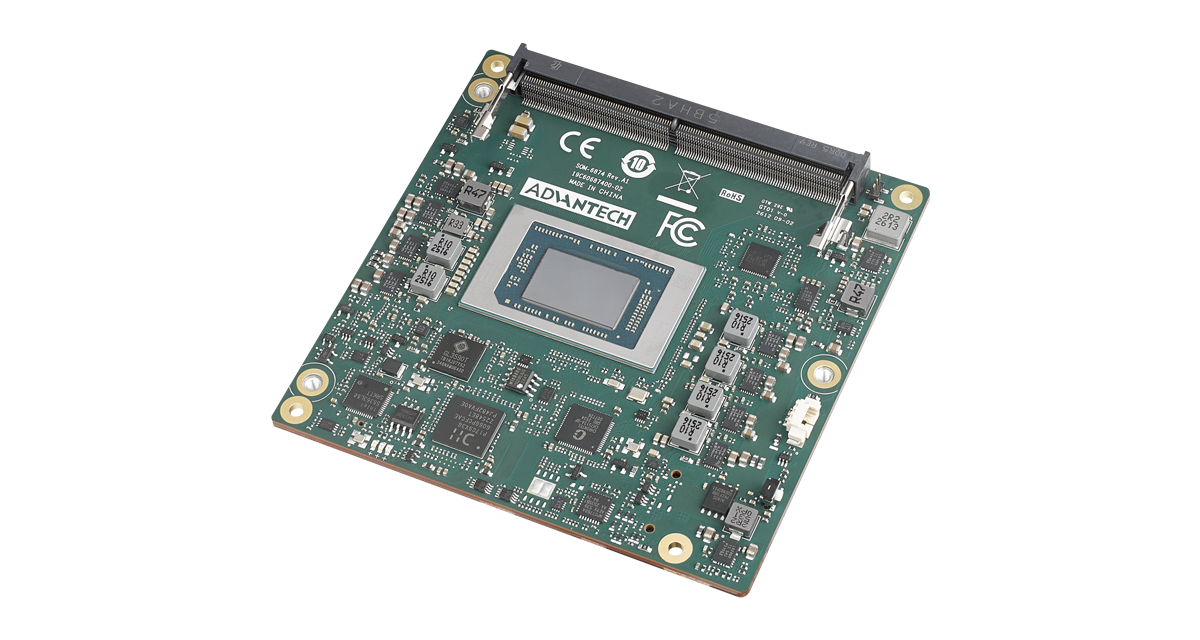
The new platforms include the MIO-5380 3.5in SBC, SOM-6874 COM Express Compact Type 6 module, and AIMB-2211 Mini-ITX motherboard. The portfolio is designed for edge AI systems in industrial automation, medical imaging, transportation, and outdoor interactive urban systems.
The AMD Ryzen AI Embedded P100 Series scales from four to 12 cores and is built around a heterogeneous architecture combining CPU, GPU, and NPU resources. The processors deliver up to 80 total system TOPS for AI acceleration, with variants supporting extended-temperature operation for demanding deployment environments.
The processing platform includes Zen 5 CPU architecture, AMD RDNA graphics, and XDNA 2 NPU acceleration. It also supports AVX-512, including VNNI and BFLOAT16, for compute-heavy edge workloads. Integrated graphics support up to four 4K displays at 120Hz, with hardware codec acceleration for machine vision, imaging, and HMI applications.
The MIO-5380 single-board computer is designed for compact edge systems requiring expansion flexibility. It supports MIOe extension, external GPU support through MXM, additional LAN ports with PoE, and PCIe expansion through an MCIO connector. EdgeBMC support adds out-of-band remote management, allowing maintenance and recovery even when the operating system is not responding.
The SOM-6874 COM Express module supports up to 18 PCIe lanes, 2.5GbE, USB 3.2, and DDR5-5600 memory. Its thermal design is intended to prevent throttling up to 60°C, while reference carrier boards are available for application development. The AIMB-2211 Mini-ITX motherboard adds broader system integration options, including four independent 4K displays, multiple USB ports, PCIe 4.0 x8 expansion, M.2 storage, and 12–24V DC input.
The portfolio is supported by Advantech’s Edge AI SDK, WISE-Edge Developer Architecture, DeviceOn remote management, SUSI APIs, and design-in services covering carrier-board references, thermal design, and compliance support.
Edge AI deployments are moving beyond demonstration systems into industrial equipment, clinical imaging, transport infrastructure, robotics, and field monitoring. Many of those applications cannot rely on cloud processing because of latency, bandwidth, data ownership, or uptime requirements. Inference has to run close to the sensor while remaining inside strict power, thermal, and lifecycle constraints.
That changes the embedded-computing design brief. A board is no longer judged only on CPU performance, I/O count, or mechanical format. AI throughput, graphics capability, software support, remote management, thermal stability, and long-term availability all sit in the same design decision. The NPU becomes one element in a wider system architecture that also depends on memory bandwidth, PCIe expansion, display capability, and field-serviceability.
Offering the P100 platform across SBC, COM Express, and Mini-ITX formats gives engineering teams a way to standardise processor and software capability while adapting the hardware envelope to each product. A compact embedded system, a custom carrier-board design, and a motherboard-based industrial build can use the same processor family without forcing a single mechanical approach.
The platforms are scheduled for ordering from the second quarter of 2026. Their performance in deployment will rest on more than peak TOPS figures, with thermals, I/O, software tooling, and lifecycle support deciding how far edge AI can move from prototype systems into long-service industrial equipment.

