IN Brief:
- Additive manufacturing market growth is diverging globally, with UK share under pressure.
- AMUK is prioritising supply chain readiness, skills development, and standards as adoption blockers.
- UK ambitions for sovereign capability are being linked to qualification and scalability, not prototypes.
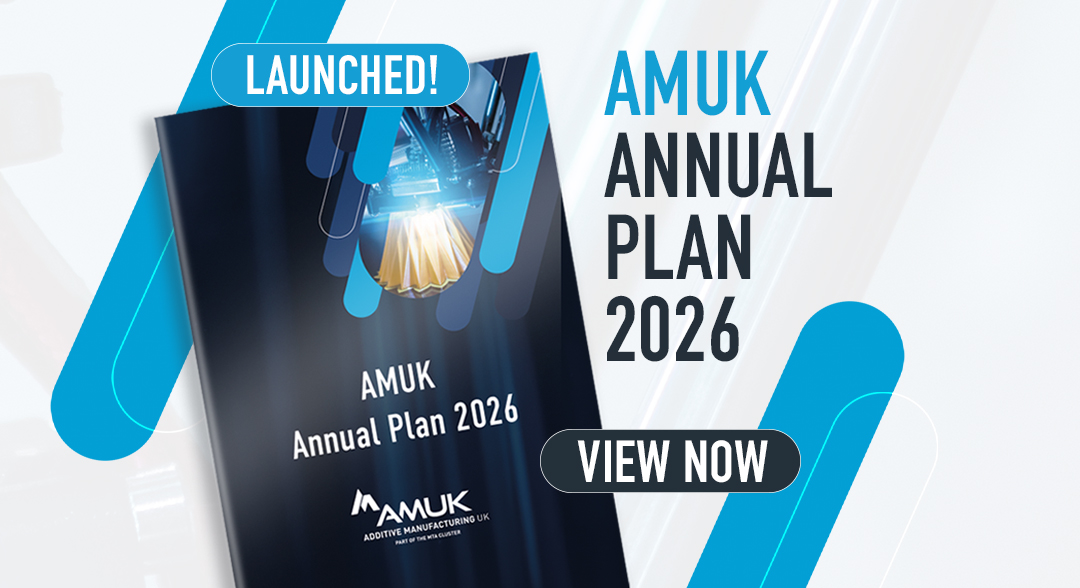
Additive Manufacturing UK (AMUK) has published its third Annual Action Plan, setting out a 12-month roadmap for the UK additive manufacturing sector built around member-led initiatives and a focus on converting research strength into economic growth and sovereign capability. The plan lands as global additive manufacturing activity continues to expand, while UK market performance has remained more fragile.
AMUK puts the global additive manufacturing market at $21.9 billion in 2024, but reports that the UK market contracted despite that growth, with the UK’s global share falling by approximately 4%. With the most recent full-year figures not yet available, AMUK members have reported difficult trading conditions, although the organisation points to early signs of recovery at the start of 2026.
The plan frames the next phase less around technical feasibility and more around the industrial basics needed to scale production use, with supply chain, skills, and standards identified as the top three constraints on adoption. That emphasis aligns with where electronics-adjacent applications tend to stall, particularly when additive processes are expected to produce repeatable thermal hardware, qualified enclosures, production tooling, or high-reliability assemblies that still have to live inside conventional certification and inspection regimes.
“Our plan highlights challenges that we must address in order to accelerate the adoption of additive manufacturing technologies,” said Joshua Dugdale, head of AMUK. “Together with our members, we have identified supply chain, skills and standards as the top three challenges, which we will tackle during this year, as these are crucial areas impacting the AM industry.”
AMUK is also setting out a longer-range objective for UK market position by 2030, pointing to a potential 7% global share valued at nearly $5 billion, contingent on stronger adoption and a more scalable domestic ecosystem. The linkage to sovereign capability is particularly notable in high-value manufacturing segments where additive methods are used to reduce lead times, consolidate parts, and unlock geometries that are not viable through subtractive routes, but where qualification remains a commercial gatekeeper.
For electronics manufacturing and system integration, the pressure points AMUK highlights map onto familiar failure modes: parts that are technically printable but not consistently inspectable, supply chains that cannot guarantee material pedigree or repeatable post-processing, and a shortage of engineers and technicians who can carry additive processes from development into controlled production. In those contexts, standards and skills become less of a policy debate and more of a throughput constraint.
AMUK will also use its affiliation with the Manufacturing Technologies Association to broaden visibility through the MACH exhibition at the NEC Birmingham from 20–24 April, where it will host an Additive Manufacturing and 3D Printing Knowledge Hub intended to connect potential users with suppliers across the value chain.
To download the report, click here.