
IN Brief:
- Analog Devices has released A²B 2.0 devices to production for automotive audio and data connectivity.
- The update delivers 98.3Mbps full-duplex bandwidth and supports up to 119 upstream and downstream audio channels.
- Vehicle audio networks are carrying more sensing, communications, and cabin interaction functions.
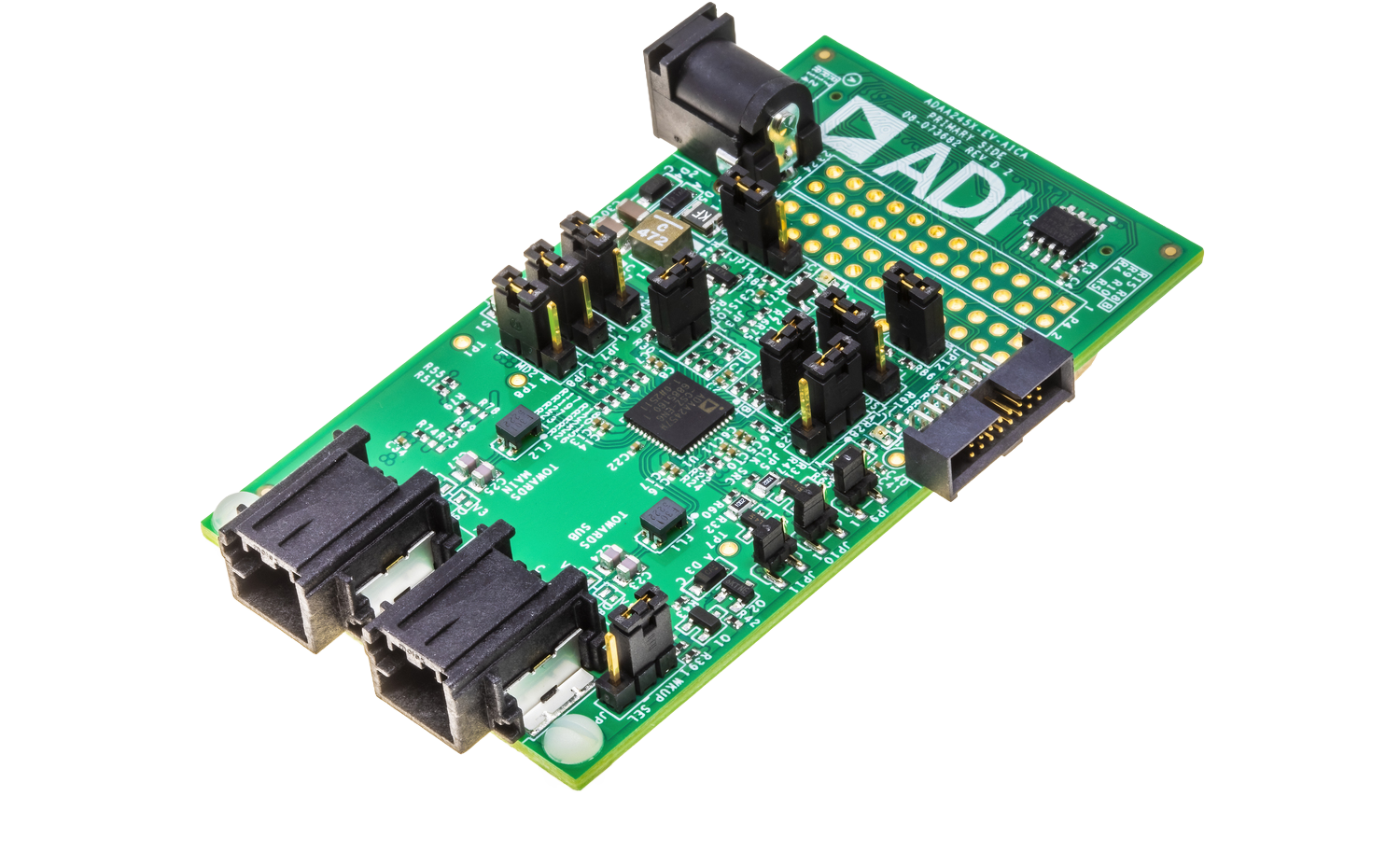
Analog Devices has released A²B 2.0 devices to production, expanding its automotive audio bus technology for higher-bandwidth in-vehicle audio and connectivity architectures.
The ADAA245x family increases bus bandwidth by a factor of four compared with existing A²B 1.0 devices, supporting up to 98.3Mbps full duplex. The architecture supports up to 119 upstream and 119 downstream audio channels, giving system designers more headroom for high-definition audio, personal sound zones, rear-seat entertainment, road-noise cancellation, in-car communications, and distributed microphone or speaker networks.
A²B 2.0 adds Ethernet data tunnelling through the Open Alliance SPI interface. The devices preserve deterministic, low-latency behaviour, including a cited 62µs latency figure, while supporting compatibility with existing A²B 1.0 cabling and connector infrastructure. A²B 2.0 devices can also branch to A²B 1.0 networks, allowing existing modules to remain in use where the system architecture permits.
The ADAA2456 product information describes a single main node with up to 11 subordinate nodes, up to 15m between nodes, and up to 80m total cable length. The transceiver supports clock-synchronous multichannel I²S and TDM data over distance, phase-aligned sampling at all nodes, asynchronous data transport, SPI-to-SPI, SPI-to-I²C, I²C-to-I²C communication, mailbox messages, GPIO transport, and wake-on-A²B activity.
At device level, the ADAA2456 can operate as a main or subordinate node and includes node descriptor and one-time programmable memory, auto-discovery, line diagnostics, configurable serial I/O, I²C and SPI interfaces, PWM outputs, ADC inputs, and multiplexed GPIOs. It can connect to DSPs, microprocessors, FPGAs, ASICs, microphones, accelerometers, ADCs, DACs, and codecs through multichannel digital audio interfaces.
Vehicle audio networks now support more than infotainment. Microphones feed active noise cancellation, hands-free calling, emergency call systems, occupant sensing, voice control, and diagnostics. Speakers support alerts, personalised cabin zones, and entertainment. As software-defined vehicle architectures consolidate ECUs and move towards zonal wiring, the audio bus is being asked to carry more channels while remaining predictable and low latency.
Ethernet provides scale and a broad ecosystem, but audio networks require clock alignment, low latency, simple wiring, and deterministic timing across distributed nodes. A²B 2.0 increases channel capacity while retaining a specialised physical and timing architecture for audio, with Ethernet tunnelling added for mixed data requirements.
Reuse of A²B 1.0 cabling and connectors reduces the burden on platform redesign. Wiring changes affect cost, weight, manufacturability, service procedures, and validation, making backwards-compatible migration valuable in automotive programmes that span multiple model years.
The release gives vehicle electronics teams more capacity for distributed audio and related sensing functions without abandoning an established bus architecture. As cabin electronics become more distributed, network choices will shape audio quality, active noise cancellation, occupant interaction, and safety-related signalling.

