IN Brief:
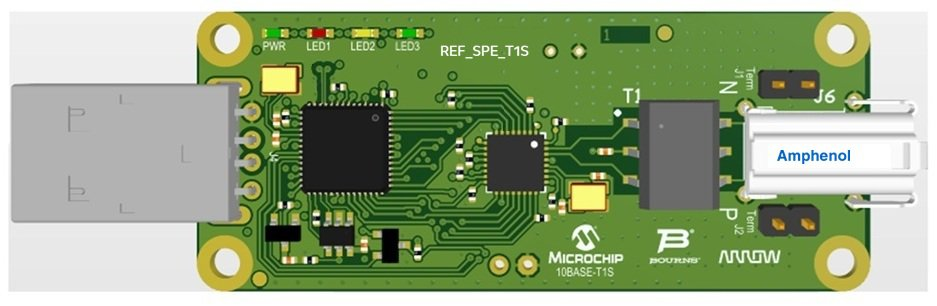
- REF_SPE_T1S combines a Microchip LAN8670 PHY, Bourns magnetics, and Amphenol SPE connectivity in a USB-powered evaluation board.
- The platform is built to compare isolation approaches, noise rejection, and EMC behaviour in electrically noisy environments.
- Arrow is positioning the design at factory automation, HVAC, building controls, and other edge-networking upgrades.
Arrow Electronics has introduced the REF_SPE_T1S reference platform, a new evaluation design intended to support the transition to 10BASE-T1S Single-Pair Ethernet in industrial and building-control applications.
The board has been developed with Microchip, Bourns, and Amphenol, bringing together Microchip’s LAN8670 10BASE-T1S PHY, Bourns integrated isolation transformer and common-mode choke magnetics, and an IEC 63171-6 compatible SPE connector from Amphenol. Arrow is presenting the platform as a practical way to examine what happens at the physical layer when designers move from capacitor-only isolation to transformer-based galvanic isolation.
That focus is squarely on network robustness. The company said the board is intended to let engineers assess signal integrity, EMC behaviour, emissions performance, and common-mode noise suppression before committing to a final product design. The reference platform supports both point-to-point and multidrop 10BASE-T1S configurations, giving development teams a way to validate channel performance in the kinds of electrically noisy settings that still make edge connectivity difficult.
Arrow is targeting applications including factory automation sensors and actuators, HVAC systems, building controls, and other embedded nodes moving away from CAN or RS-485. The board is USB powered and positioned as a hands-on development tool rather than a finished product, giving design teams a faster route to benchmark isolation choices, noise immunity, and compliance margins as SPE adoption moves further into edge networks.