IN Brief:
- Astute Group has stocked ATS thermal management products for NVIDIA Jetson modules in the UK.
- The range includes active heatsinks, passive cooling options, and thermal transfer plates.
- Edge AI and robotics designs are increasing demand for ready-to-integrate thermal hardware.
Astute Group has added UK stock availability for Advanced Thermal Solutions thermal management products designed for NVIDIA Jetson modules.
The stock is held at Astute’s UK warehouse and is available for dispatch across EMEA, India, Turkey, Australia, and New Zealand. The range supports evaluation, testing, and production deployment for robotics, edge computing, smart monitoring, embedded vision, and physical AI platforms.
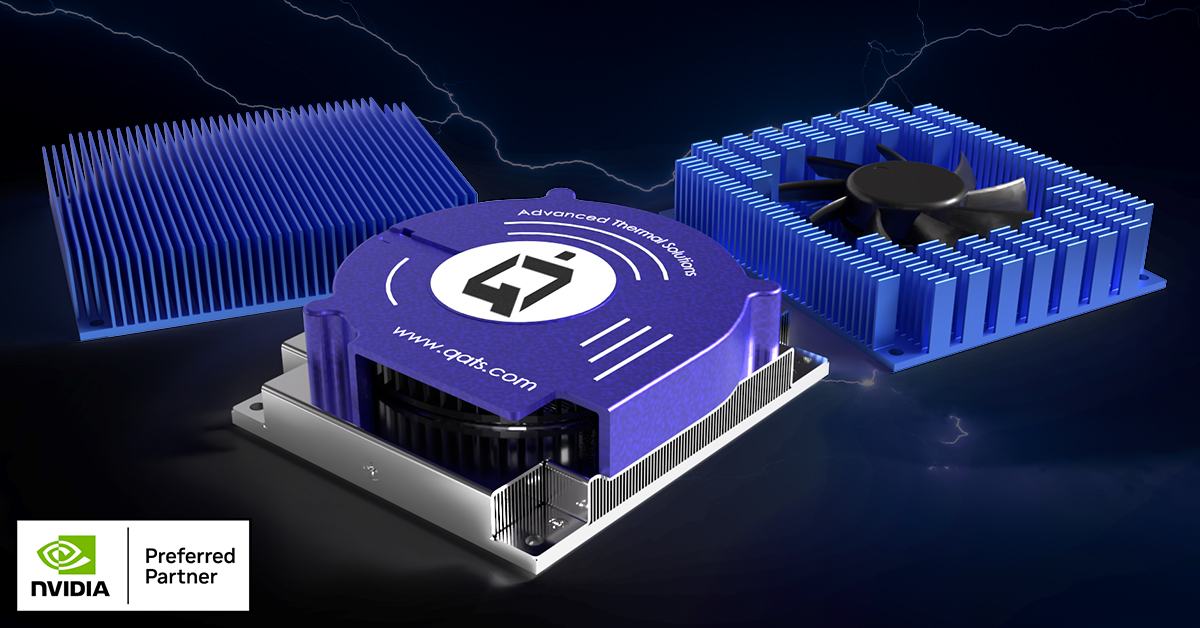
Available products include an active heatsink for NVIDIA Jetson Orin NX in Super Mode, with cooling capacity up to 40W and thermal resistance of 0.94°C/W. Units include pre-applied low-impedance thermal interface material, mounting hardware, and fan attachment hardware.
For Jetson Thor modules, Astute is stocking active heatsink assemblies for higher compute-density platforms, including models with frameless embedded fans for 95W TDP and top-mounted blowers for up to 175W TDP. Passive cooling options are also available. The range includes thermal transfer plates for Jetson Orin Nano, Orin NX, Nano, and Xavier NX modules, using black anodised aluminium to conduct heat into the walls of sealed or airflow-free enclosures.
Jetson-based systems are increasingly being deployed in equipment where conventional airflow assumptions do not hold. Industrial gateways, mobile robots, inspection systems, outdoor monitoring hardware, and embedded AI appliances are often enclosed, ruggedised, space-constrained, or exposed to variable ambient conditions. Thermal design therefore becomes part of the system architecture from the start of the mechanical layout.
Local inference workloads can create sustained processor, memory, and accelerator activity rather than short compute bursts. Without a sufficient heat path, a module may remain functional while throttling under load, reducing the performance margin that justified the design. Cooling hardware has a direct bearing on latency, frame rate, model complexity, enclosure strategy, and service life.
UK stock availability also addresses a practical engineering constraint. Teams working on embedded AI hardware often need samples quickly for mechanical fit checks, thermal validation, and pre-production trials. Long lead times can delay enclosure design, certification work, and customer pilots, particularly when the cooling hardware determines board orientation, mounting stack-up, and enclosure material choices.
The same pressure is visible across the edge AI supply chain. Longsys’ AIDIMM and AILPBGA memory products for local inference highlighted how memory bandwidth, capacity, and thermals influence system performance. Processor modules, memory, storage, and cooling now have to be selected together, because bottlenecks emerge wherever power density, bandwidth, or enclosure constraints are weakest.
For robotics and physical AI systems, cooling also affects reliability and maintainability. Machines operating in factories, warehouses, transport environments, and remote monitoring installations need predictable operation across long duty cycles. A cooling solution that fits the module, enclosure, and deployment environment reduces the risk of field performance diverging from lab validation.
The ATS inventory gives designers a faster route to test and production hardware for Jetson-based systems. As edge AI modules become more powerful, thermal management is becoming a core component of embedded system design rather than a mechanical afterthought.