IN Brief:
- Battery manufacturers face rising expectations from regulators, OEM customers, insurers, and auditors as programmes scale across critical applications.
- ERP, MES, and SPC systems are becoming central to battery traceability, supplier control, and production evidence.
- Structured process control can support Battery Passport readiness while improving consistency, efficiency, and long-term customer confidence.
By Mark Rutherford, CEO at Alexander Battery Technologies
Battery manufacturing is a well-established discipline but the operating environment has changed significantly in recent years. Battery manufacturing programmes are larger, applications are more diverse, and the level of scrutiny applied to OEMs and their supply chain partners has increased, not only from regulators but from customers, insurers, and auditors who want greater confidence in how products are designed, built, and controlled over time.
In practice, this has shifted the conversation away from whether a battery meets its functional requirements and towards how consistently those requirements are delivered across projects, production batches, and product life cycles. Traceability, evidence, and repeatable process control have become central to that discussion, particularly as batteries move into more critical and regulated applications.
Regulatory initiatives such as the EU Battery Passport reflect this wider change in expectations but they are not the sole driver. Although many battery manufacturers and their customers are not yet directly in scope, similar requirements are already being applied through contractual and quality frameworks. Serialised packs, auditable production records, and verified material data are increasingly treated as standard expectations rather than future obligations.
The challenge for manufacturers is rarely a lack of technical capability. More often, risk emerges as projects evolve. Battery programmes almost always change between early builds and production, whether through component substitutions, process improvements identified on the line, or adjustments driven by customer feedback.
Without structured control, those changes can introduce disconnects between approved designs, authorised component lists, and the build taking place on the line.
At Alexander Battery Technologies, managing that reality means accepting that change is inevitable while ensuring it remains visible and controlled. Projects are structured with defined stage gates and budget release points, while engineering change is reviewed and approved within a single system so that updates are reflected accurately across production and quality records. The objective is not to constrain development but to ensure that design intent and manufacturing reality remain aligned as programmes progress.
For manufacturers without structured systems in place, informal tools become harder to sustain as volumes increase and programmes scale. Spreadsheets and local workarounds tend to proliferate, creating fragmented records across engineering, procurement, production, and quality. The solution is an ERP system that provides a single, authoritative source of information across those functions, supporting consistency without removing the judgement and experience that sit on the shop floor.
This becomes particularly important when managing materials and suppliers. Battery performance and safety depend on tight control of components, from cells through to mechanical structures and electronics. Approved materials, qualified suppliers, and traceability back to batch and lot level reduce exposure to unplanned substitutions and provide a clearer response when supply constraints arise. Where alternatives are required, they can be assessed and approved in a controlled way, with a full understanding of impact.
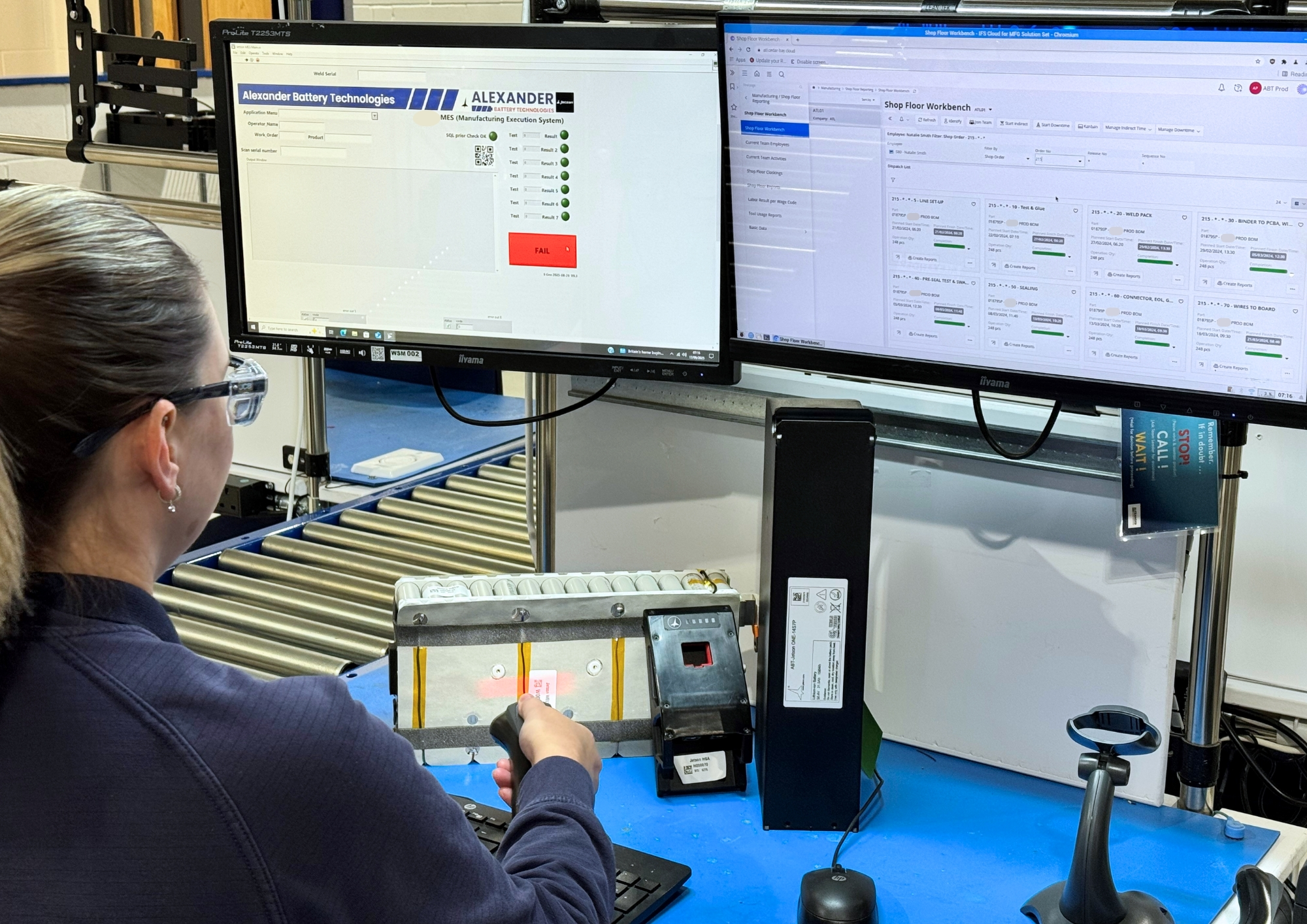
On the production side, manufacturing execution systems (MES) capture how each pack is built and link that activity to a unique serial number. Process data can then be monitored using established techniques such as statistical process control (SPC), while measurement systems are validated where appropriate through Gauge R&R studies to ensure consistency.
These are long-standing manufacturing practices, but their importance has increased as expectations around evidence and auditability have risen.
Quality management benefits from the same integration. When inspections, non-conformances, and corrective actions sit within the core production record, issues are identified earlier and addressed with less disruption. End-of-line testing still has a role, but it functions as confirmation rather than first detection, reducing rework and uncertainty later in the process.
There is sometimes a perception that tighter process discipline adds overhead but experience tends to show the opposite. Clear planning, accurate inventory control, and consistent records reduce wasted effort and the time spent reconstructing events after issues arise. Those efficiencies support lean manufacturing and make delivery more predictable for both manufacturer and customer.
For OEMs selecting a battery partner, these disciplines are increasingly part of the assessment. ERP-led process control supports smoother qualification, greater confidence during scale-up, and clearer answers when questions arise months or years into a programme. It also means that readiness for initiatives such as the Battery Passport follows naturally, rather than being treated as a separate compliance exercise.
The industry is not being asked to rethink how batteries are made. It is being asked to demonstrate control, consistency, and transparency at a higher level than before. Manufacturers that have invested in structured, ERP-led foundations are better placed to meet those expectations while supporting efficiency, scale, and long-term trust.
This article originally appeared in the January/February 2026 edition of IN Electronics. Read the full issue here.