IN Brief:
- The DP12IP measures isolated AC and DC currents up to 18A with maximum linearity error of 10ppm.
- A 32mm PCB mounted package targets precision supplies, battery test equipment, drives, and power analysers.
- Higher converter density is increasing demand for accurate current data close to the power stage.
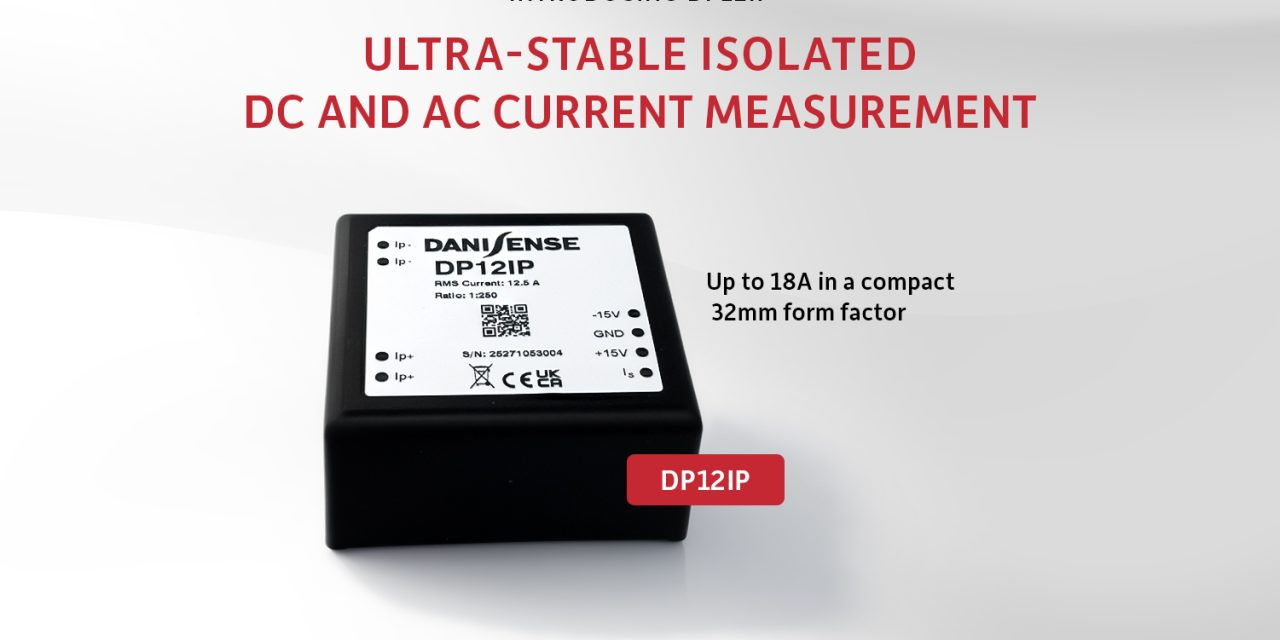
Danisense has introduced the DP12IP, a compact PCB mounted current transducer designed to measure isolated AC and DC currents up to 18A with a maximum linearity error of 10 parts per million.
The device uses closed loop compensated fluxgate technology, maintaining a zero flux condition in the magnetic core through fixed excitation and second harmonic detection. That architecture supports the accuracy, offset stability, and isolation required in precision power electronics, while reducing the mechanical volume associated with larger panel mounted transducers.
At 32mm high, the DP12IP fits within 1U equipment and other assemblies where vertical clearance is restricted. It mounts directly onto the printed circuit board, weighs approximately 250g, and supports a measurement resistor of up to 100Ω at full scale current, allowing the output stage to be adapted around the wider measurement chain.
Danisense is targeting stable power supplies, battery test benches, precision servo drives, power analysers, and magnet power supplies used in particle accelerators. Although the operating conditions differ considerably, each application depends on current data that remains consistent across load, temperature, time, and repeated calibration cycles.
Within a battery cycler, small measurement errors accumulate over thousands of charge and discharge operations, influencing calculated capacity, energy efficiency, and degradation. Servo systems use current feedback to regulate torque and dynamic response, while laboratory power equipment must preserve stability even when the output moves across a wide operating range.
Bringing the transducer onto the PCB can shorten analogue paths and simplify assembly, although the surrounding electromagnetic environment becomes more difficult. High di/dt conductors, switching nodes, transformers, inductors, and thermal gradients may sit only millimetres away from the measurement device, placing greater emphasis on conductor routing, shielding, filtering, and board construction.
A compact package does not automatically preserve metrology grade performance. Magnetic fields from adjacent conductors can introduce offset, while heat from power semiconductors may create temperature differences across the transducer and its supporting electronics. The mounting position therefore becomes part of the uncertainty budget rather than a purely mechanical decision.
Yokogawa’s recently introduced 2000V direct input power analyser reflects the same pressure elsewhere in the measurement chain. Battery systems, traction inverters, data centre supplies, and industrial converters are moving to higher voltages and faster switching, yet the instruments used to characterise them must retain accuracy across wider dynamic ranges.
Current measurements also feed a growing number of control and diagnostic functions. Converter firmware can use high resolution data for efficiency optimisation, state estimation, load profiling, fault detection, and predictive maintenance, turning drift and non linearity into system level errors rather than isolated imperfections in a protection circuit.
Fluxgate technology offers strong DC accuracy and galvanic isolation, but it requires dedicated excitation and signal processing, with cost and power demands above those of a basic shunt or open loop Hall sensor. The selection therefore depends on whether the application needs low offset and long term stability, or can recover sufficient accuracy through calibration and compensation.
At 18A, the DP12IP occupies a useful range between low current shunt measurements and the larger transducers used in high power industrial equipment. Precision supplies, modular test platforms, and actuator systems often need isolated measurement without the mechanical burden of a high current sensor designed for hundreds of amperes.
The final performance will depend on how closely the assembled equipment reproduces the conditions under which the transducer was characterised. Once thermal gradients, stray fields, converter noise, analogue conversion, and calibration are combined, the measurement chain must still remain more accurate than the system it is intended to regulate or verify.