IN Brief:
- HV power conversion is pushing test and protection hardware into higher isolation classes.
- Danisense has added a closed-loop fluxgate transducer variant with extended creepage and clearance.
- The specification targets precision current measurement as EV and storage system voltages rise.
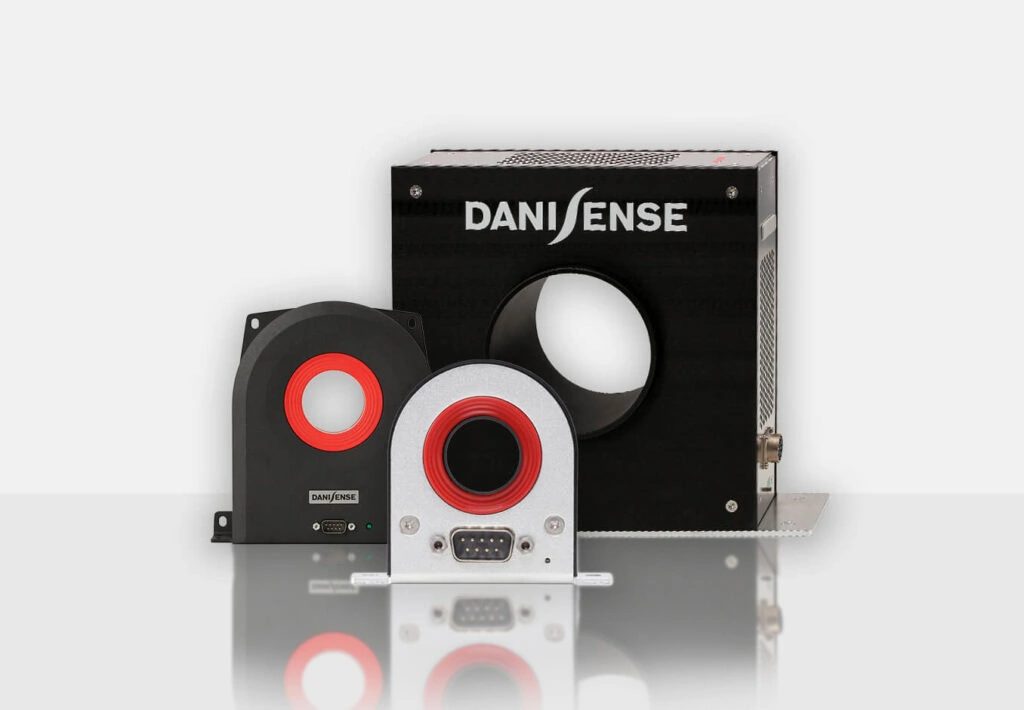
Danisense has expanded its DN1000ID current transducer family with the DN1000ID-CP02, a closed-loop fluxgate AC/DC current transducer built for high-current measurement with extended creepage and clearance.
At the mechanical and safety level, the headline change is a 38 mm creepage and clearance distance, paired with extended isolation specified up to 3200 V (non-mains). In application terms, Danisense is positioning the device for power measurement and analysis in higher-voltage systems, including EV chargers, power inverters, and battery energy storage systems, alongside test benches, calibration, and medical imaging platforms.
The electrical spec is aimed squarely at precision. The DN1000ID-CP02 is rated for 1000 A RMS nominal current, with a measurement range up to 1500 A, and a 1500:1 primary-to-secondary current ratio. Linearity error is specified to 1 ppm, with 5 ppm offset, and total accuracy listed at 7 ppm. For transient headroom, the transducer supports short-term overrange at 1200 A RMS for up to 30 minutes, and an overload capacity specified at 5000 A for 100 ms (non-measured).
On dynamic performance, the datasheet gives a small-signal bandwidth of 400 kHz and a response time of 1 µs to 90% of a step current, with noise characterised as sub-ppm RMS up to 10 kHz. Those figures, combined with fluxgate stability, put the device in a different class to simpler Hall-based sensing when drift, linearity, and repeatability are the priorities, particularly across temperature and long test runs.
Integration details are tuned for lab and field use. The unit provides a current output, includes a status signal and LED, and uses a Ø40 mm aperture with a removable isolation insert intended to accommodate wider cable terminals while maintaining isolation requirements. The electrical specifications are referenced at 23 °C with ±15 V supply, aligning with common instrumentation setups in power analysis racks and automated test systems.
The move towards higher-voltage architectures in electrified transport and grid-connected storage is also shifting the measurement problem. A current transducer that can hold ppm-class linearity at four-figure amperes is as much about confidence in efficiency maps and thermal design margins as it is about catching faults. As switching speeds rise, and converter topologies become more aggressive, the measurement chain has to keep pace without becoming the weak link in isolation design.
Danisense’s DN1000ID-CP02 is a straightforward response to that, offering more clearance, higher isolation, and the kind of stability that lets a test engineer stop compensating for their sensor and get back to measuring the system.