IN Brief:
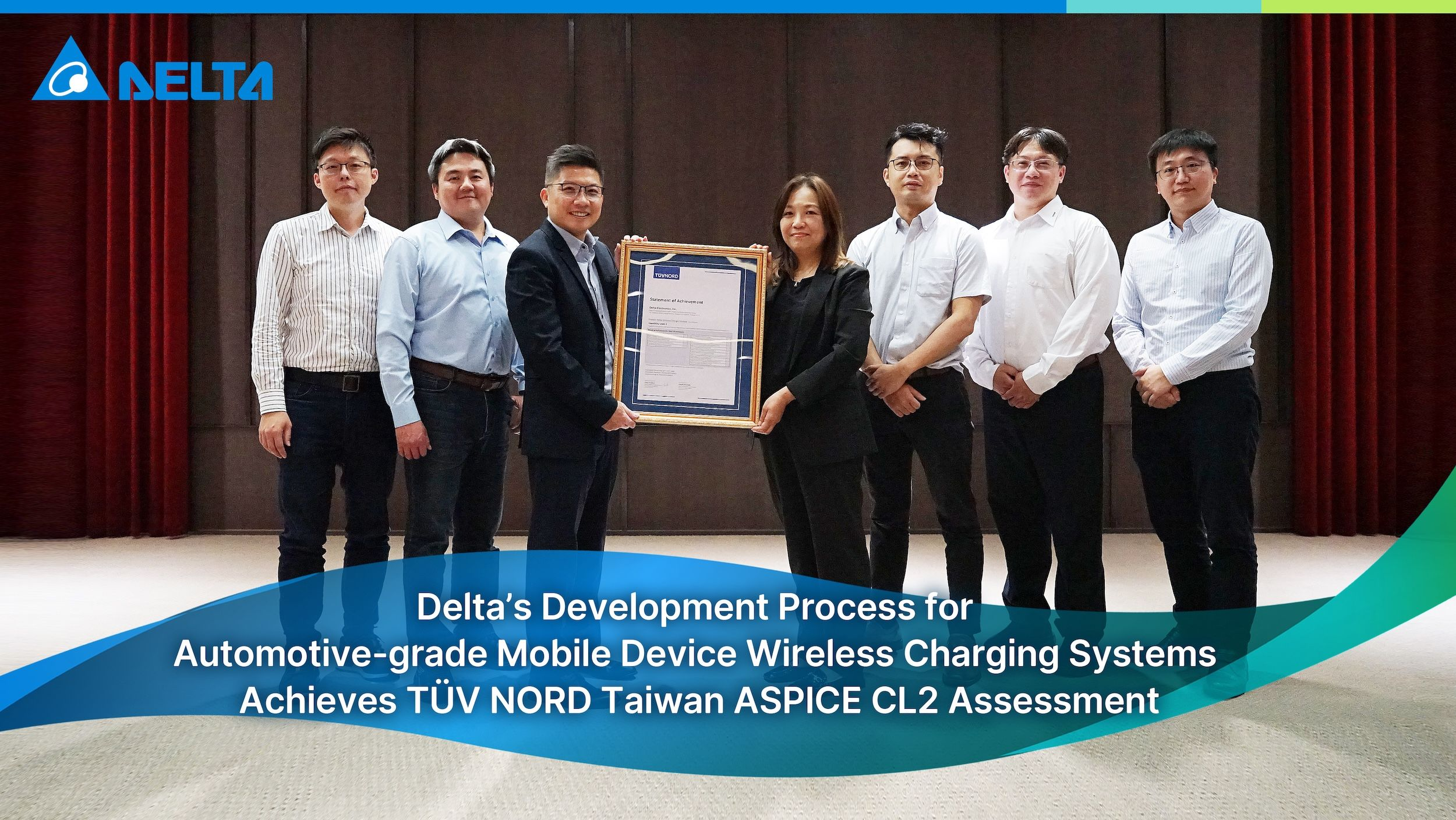
- TÜV NORD Taiwan assessed Delta's automotive wireless charging development process at ASPICE Capability Level 2.
- Delta's latest Qi 2.2 MPP module delivers up to 25W with magnetic alignment and NFC.
- Process maturity is becoming central as charging, digital keys, safety functions, and vehicle software converge.
Delta Electronics has achieved Automotive SPICE Capability Level 2 assessment for the development process used to create its automotive smartphone wireless charging systems. TÜV NORD Taiwan conducted the assessment across engineering activities extending from research and development through testing and final validation.
Automotive SPICE examines the processes used to develop software intensive vehicle systems. Capability Level 2 requires the assessed activities to be planned, monitored, controlled, and supported by managed work products, moving beyond the basic performance of the engineering process itself.
The assessment aligns Delta’s development controls with a framework widely used by vehicle manufacturers and tier suppliers when selecting and overseeing electronic systems. Requirements, implementation, tests, changes, and release evidence can consequently be managed through a defined process rather than assembled retrospectively at programme milestones.
Delta’s latest automotive charging module supports the Qi 2.2 Magnetic Power Profile and supplies up to 25W to compatible smartphones. Under its specified test conditions, the module can raise a suitable handset battery to 50% charge in 30 minutes.
Magnetic alignment maintains the relative position of the transmitting and receiving coils, reducing losses caused by device movement, imperfect placement, and vehicle vibration. Better coupling can preserve charging power while limiting the heat produced when energy crosses a poorly aligned air gap.
Near field communication is integrated to support digital car key applications, bringing charging and vehicle access functions into the same module. Foreign object detection identifies metallic items within the charging field, while card protection addresses the risk of heating or damaging contactless cards left between the phone and charging surface.
Thermal behaviour remains a central constraint because the transmitter sits inside a console exposed to cabin heating, direct sunlight, and restricted airflow. The phone may already be generating heat through navigation, cellular communications, display use, or background applications, forcing the charging system to reduce power as either device approaches its thermal limit.
Process control follows functional convergence
As vehicle functions converge, wireless charging is no longer an isolated inductive power stage. Power regulation, temperature sensing, alignment, object detection, NFC, diagnostics, communication with other control units, and software updates connect the module to the vehicle’s wider electrical and software architecture.
Automotive SPICE provides a common method for examining how that development is managed, although a Capability Level 2 result does not certify every resulting product as safe, secure, or free from defects. Individual programmes still require evidence for electrical safety, electromagnetic compatibility, thermal performance, vehicle transients, cybersecurity, environmental durability, and integration with the original equipment manufacturer’s platform.
Qi conformance likewise addresses interoperability with the charging standard rather than complete automotive qualification. A module may transfer power correctly under laboratory conditions while still needing extensive work around vibration, temperature cycling, contamination, ageing, nearby electronics, and the behaviour of different phones and cases.
Software defined vehicles increase the importance of traceability because operating parameters and functions may change during the vehicle’s service life. Requirements, source code, calibration data, tests, configurations, and release records need to remain connected after production begins, particularly when updates can alter charging power or access related behaviour.
An automotive inertial sensor designed to maintain positioning during satellite signal loss faces the same wider transition: components once treated as discrete devices now operate as configurable nodes within a networked vehicle. Their behaviour depends on software, diagnostics, security, and interactions elsewhere in the platform.
The expansion of UK automotive inverter production also shows how power electronics, embedded software, manufacturing controls, and qualification are advancing together. Greater electrical performance has to arrive with repeatable development and production evidence.
Combining Qi 2.2 charging and NFC digital key functions may simplify the centre console, but it also places more functions within a shared space, power budget, communications path, and software environment. Fault containment becomes essential so that a problem in charging cannot create uncontrolled behaviour in the access function, or vice versa.
Delta’s assessment establishes a defined level of maturity for the supporting process. Product programmes will provide the harder test through stable charging at real cabin temperatures, controlled behaviour around misplaced objects, dependable NFC operation, secure updates, and repeatable integration across the vehicle’s electrical and software architecture.