
IN Brief:
- The kit combines an Arduino UNO Q with an Adafruit BME280 environmental sensor.
- Machinechat’s JEDI One software provides local dashboards, storage, reporting, and automated alerts.
- Further application-specific rapid engineering kits are planned.
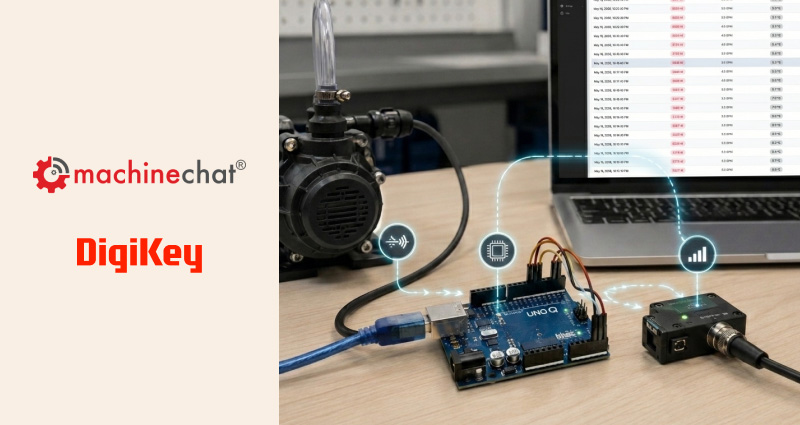
DigiKey and Machinechat have introduced a rapid engineering kit that combines embedded hardware, environmental sensing, connectivity, and locally hosted data software. The first package uses an Arduino UNO Q, an Adafruit BME280 temperature, humidity, and pressure sensor, supporting hardware, and a lifetime licence for Machinechat’s JEDI One platform.
JEDI One receives device data locally and provides dashboards, storage, visualisation, reports, and automated alerts without requiring a cloud service. It runs as a single executable on Windows, macOS, and Linux systems, including Arm-based platforms, without a separate database or runtime environment.
By combining sensing, acquisition, storage, and presentation, the initial configuration supplies a complete environmental-monitoring chain. Further kits are planned around different sensors and applications, using the same approach to package hardware and software into a working starting point.
Connected prototypes often begin with a development board and a breakout sensor, yet the integration burden appears as soon as measurements must be used operationally. Sampling intervals, timestamps, missing records, device identity, alarm thresholds, storage, and configuration all need to be handled before a demonstration resembles a field system.
Local processing removes the immediate need to establish cloud accounts, external databases, and internet connectivity. Factories, laboratories, buildings, and temporary test installations can collect and review data within the site, which may simplify initial deployment and reduce dependence on a remote service.
Although data remains local, security responsibilities continue across the host, network, software, and connected equipment. The host machine still needs controlled access, software updates, backup, account management, network segmentation, and recovery arrangements, especially once the prototype connects to operational machinery.
The BME280 is a practical development sensor, although its readings are strongly influenced by placement and enclosure design. Heat from processors, regulators, displays, or sunlight can bias temperature, while humidity responds to airflow, contamination, condensation, and recovery time after exposure.
Pressure measurement introduces another mechanical dependency because enclosure venting and local air movement can affect the observed value. A prototype mounted openly on a bench may therefore behave differently after installation in a sealed or filtered housing.
Because measurement uncertainty must suit the decision being made, calibration requirements change with the intended use. Trend monitoring can tolerate different uncertainty from a system controlling storage conditions, validating a process, or supplying evidence for maintenance and compliance.
Development platforms are becoming more complete as connected systems take on greater software and networking complexity. The Arduino Nesso N1 platform similarly combines sensing and connectivity, while edge-AI development kits add camera processing and local inference to the same progression from evaluation board towards an integrated prototype.
Once a prototype leaves the bench, its power architecture usually changes sharply to match field conditions. A USB-powered Wi-Fi demonstration may later require batteries, energy harvesting, low-power wide-area radio, deep sleep, and several years of unattended operation, forcing changes to sampling rate, buffering, and communication strategy.
As device numbers increase, fleet management creates another layer of complexity around identity, updates, and fault handling. One device can write directly to a dashboard, whereas dozens or hundreds require configuration control, time synchronisation, firmware updates, monitoring, and rules for equipment that disconnects or produces implausible values.
A local-first architecture supports a staged design process because sensing and data handling can be proven before the final communications model is fixed. The finished product may remain entirely on site, feed selected records to a supervisory system, or transfer summarised data to a remote platform.
Rapid kits are most effective when they expose configuration rather than hiding it behind a demonstration. Access to raw measurements, sampling parameters, communication behaviour, stored records, and alarm logic allows the prototype to become an engineering reference that can be measured and replaced systematically.
DigiKey and Machinechat have removed several early integration tasks by supplying the first working chain in one package. Production development will still require qualified hardware, enclosure design, calibration, cybersecurity, power planning, and lifecycle support, but those decisions can begin from functioning data rather than disconnected components.

