
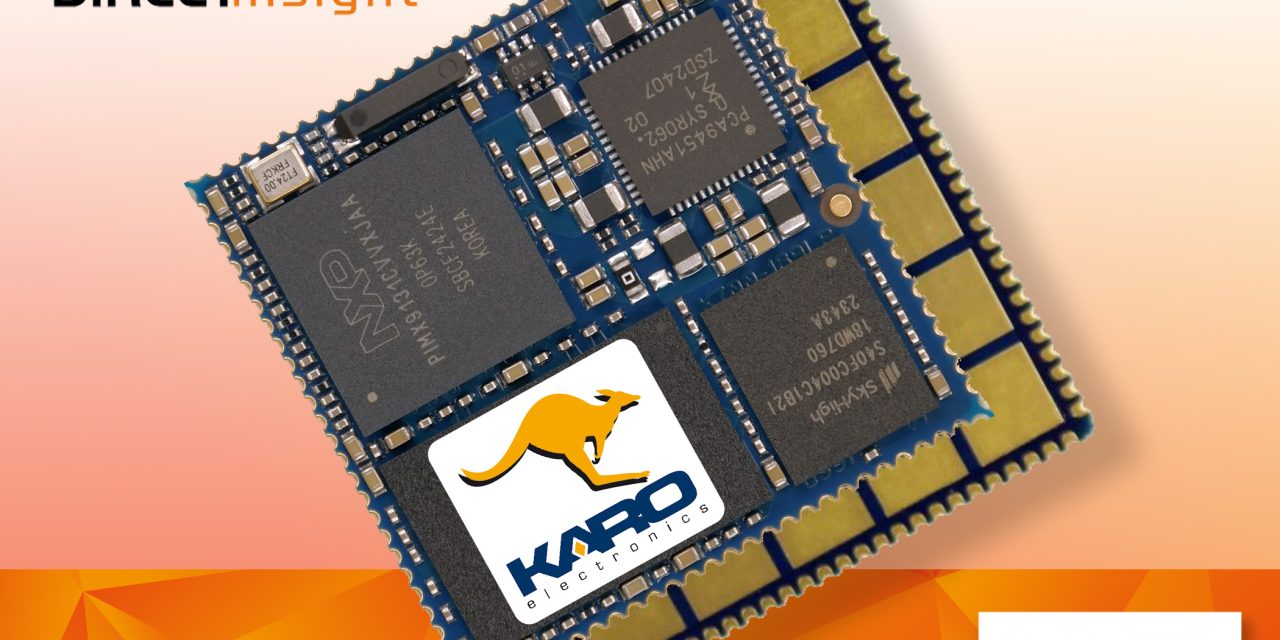
IN Brief:
- The QS91 uses NXP’s i.MX 91 processor with a single 1.4GHz Cortex-A55 core.
- The 27mm square solder-down module includes 512MB LPDDR4, 4GB eMMC, Gigabit Ethernet, CAN-FD, and dual USB.
- Secure embedded Linux modules are increasingly used to reduce design risk in industrial edge products.
Direct Insight is now delivering and supporting development for the QS91, a compact solder-down system-on-module built around NXP’s i.MX 91 applications processor.
The QS91 is manufactured by Ka-Ro Electronics and targets Linux-based IoT and industrial edge devices requiring secure operation, low power consumption, and reduced system cost. The module measures 27mm by 27mm, with a height of around 2.6mm, and uses a QFN-style solder-down format with 100 pads on a 1mm pitch.
The module integrates a single-core 64-bit Arm Cortex-A55 running at 1.4GHz, 512MB LPDDR4 memory, and 4GB eMMC flash. It provides dual USB, CAN-FD, Gigabit Ethernet, multiple serial interfaces, and RGB parallel display support. The design also includes NXP’s EdgeLock secure enclave, giving the module a silicon root of trust for connected edge applications.
The QFN-style format supports EMC-conscious signal routing, while the ground pad on the underside also functions as a thermal path. The module supports an extended industrial operating temperature range of -25°C to +85°C and requires a single 3.3V power supply. A QSBASE1 evaluation kit with Linux BSP is available, and a SODIMM version, the TX91, is also offered.
The QS91 sits in a practical part of the embedded Linux market. Many edge products need more capability than a microcontroller can provide, but do not require the cost, memory footprint, or power draw of a higher-end multicore application processor. The i.MX 91 provides an entry point into NXP’s i.MX 9 family for designs that need Linux, networking, security, and industrial I/O without excessive compute overhead.
Embedded hardware selection is being shaped by cost pressure, memory availability, power limits, and security requirements. AI-driven demand has tightened parts of the memory market, while industrial IoT systems are expected to support secure boot, network protection, update strategies, and long field lifetimes. A module based on a smaller application processor can reduce exposure to unnecessary bill-of-materials cost while retaining the software flexibility of Linux.
The single-core architecture also suits applications with defined workloads. Industrial gateways, metering devices, building controllers, small HMIs, and connected equipment interfaces often need reliable connectivity and a secure software environment more than raw multicore performance. For those designs, a lower-power Linux-capable module can keep system complexity under control while supporting modern software stacks.
Thermal design remains a major constraint in compact industrial electronics. Many edge devices operate in sealed enclosures, cabinets, or outdoor housings with limited airflow. The QS91’s solder-down construction and thermal path through the underside ground pad support designs where heatsinks, airflow, or larger board footprints may not be practical.
The module approach also reduces processor-subsystem development work. High-speed memory routing, power sequencing, boot support, EMC behaviour, and thermal validation can consume significant engineering effort when implemented from scratch. A production-ready system-on-module allows design teams to focus on the application hardware, enclosure, software, and field requirements that distinguish the final product.
Secure Linux capability in small industrial form factors is becoming a standard requirement rather than a premium feature. The QS91 gives designers a compact route into that space, with a processor and module format suited to connected edge devices where cost, security, and long-term support have to be balanced from the first hardware revision.

