
IN Brief:
- ESA is advancing the Sodankylä supersite with the Finnish Meteorological Institute and Finnish industrial partners.
- New systems include a tower-based multifrequency radiometer, greenhouse gas sensors, and airship-based regional survey capability.
- The site will support satellite calibration, validation, and environmental sensing technology development in Arctic and boreal conditions.
ESA is expanding an Earth observation calibration and validation supersite at Sodankylä in Finnish Lapland, adding new sensing systems and airborne survey capability to a high-latitude research infrastructure above the Arctic Circle.
The project is being developed with the Finnish Meteorological Institute and Finnish industrial partners, building on earlier work to turn FMI’s Arctic Space Centre into a reference site for Earth science, satellite calibration, and validation. ESA is progressing the procurement and installation of new instruments through its FutureEO programme.
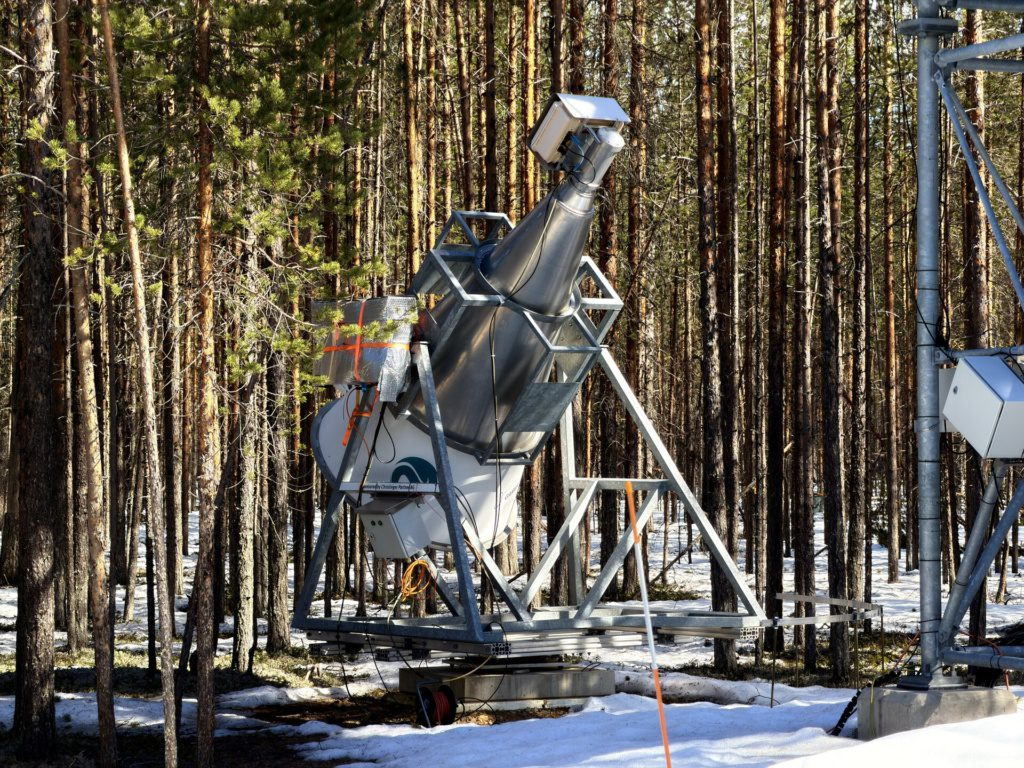
The planned equipment includes a tower-based multifrequency radiometer and greenhouse gas sensors. ESA also plans regional airborne sensing campaigns using a remotely controlled airship system capable of flights of up to 12 hours, supporting the production of a three-dimensional vegetation map around Sodankylä.
The site sits in a boreal forest environment representative of a wider northern biome spanning parts of Canada, Scandinavia, and Russia. That geography allows satellite observations to be checked against independent measurements taken from the ground, towers, and airborne platforms in an environment where field reference data is limited and difficult to obtain at scale.
Calibration and validation underpin the commercial and scientific value of satellite datasets. Climate monitoring, land classification, greenhouse gas measurement, snow mapping, atmospheric analysis, and forestry data all depend on a robust relationship between instruments in orbit and conditions measured on the ground. Arctic and boreal environments complicate that task through seasonal snow cover, low sun angles, long winters, rapidly changing vegetation, and restricted access for field teams.
Sodankylä already hosts satellite antennas, reference instruments, observation towers, data reception systems, and processing facilities. The latest phase adds capacity as Europe prepares a wider generation of Earth observation missions focused on carbon dioxide, radar imaging, microwave radiometry, polar ice and snow, vegetation fluorescence, and climate-system measurement.
The expanded site gives sensor developers a demanding reference environment for environmental instrumentation. Ground-based sensing, airborne platforms, ruggedised data acquisition, low-power field electronics, remote communications, and edge processing systems all have to operate reliably in conditions defined by cold weather, long service intervals, and variable atmospheric and surface conditions.
The development also reflects a shift in Earth observation from satellite deployment alone towards complete measurement ecosystems. Orbital data is only as dependable as the terrestrial infrastructure used to check, interpret, and improve it. Supersites such as Sodankylä provide a fixed reference point for mission teams, sensor companies, and data-service developers assessing instrument performance before satellite measurements are converted into operational services.
With new radiometry, greenhouse gas sensing, and airborne survey capability, the Finnish site is being built into a European testbed for Arctic monitoring. The hardware will be distributed across towers, airships, ground systems, and data infrastructure, but its value sits in the accuracy and repeatability of the measurements used to validate future satellite missions and environmental sensing technologies.

