IN Brief:
- The HFC150-W/G accepts 14.4V to 154VDC inputs, covering nominal 24V, 36V, 48V, 72V, and 110V railway supplies.
- The converter provides 150W output, efficiency up to 93%, and operation from −40°C to +85°C.
- A common converter can reduce qualified variants, spares holdings, documentation, and maintenance complexity across vehicle fleets.
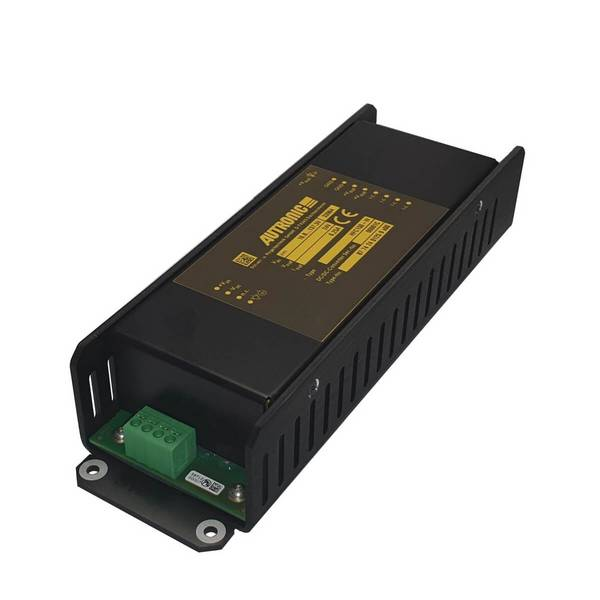
Fortec UK has introduced the AUTRONIC HFC150-W/G, a 150W isolated DC-DC converter designed to operate across five common railway supply-voltage classes without changing the core power module.
The chassis-mounted converter accepts inputs from 14.4V to 154VDC, covering equipment connected to nominal 24V, 36V, 48V, 72V, and 110V onboard supplies. Output versions include 24V, 48V, ±15V, and ±24V for communications, control, monitoring, passenger-information, and auxiliary electronic systems.
Efficiency reaches 93%, while operation is specified from −40°C to +85°C. Hold-up capability exceeds 10ms, allowing downstream electronics to ride through brief input interruptions, and supervisory connections provide remote enable, power-good, and thermal-warning signals.
Protection functions cover reverse polarity, overvoltage, overcurrent, overtemperature, and continuous short circuit. Galvanic isolation separates the output rail from the vehicle supply, while the design addresses EN 50155, EN 50121-3-2, and EN 45545-2 requirements for railway electronic equipment, electromagnetic compatibility, and fire behaviour.
Nominal voltage describes only part of a railway electrical environment because battery charging, switching, regenerative braking, load disconnection, long cable runs, and faults can create substantial steady-state variation and severe transients. A converter must remain stable through those conditions without passing damaging disturbances to processors, radios, displays, or sensors.
Covering several nominal rails within one design extends that challenge across both high-current and high-voltage operation. At the 14.4V lower limit, a 150W output requires more than ten amperes before conversion losses are included, placing heavy demands on connectors, PCB copper, filtering, switches, and thermal paths.
At the upper end of the input range, semiconductor voltage stress, insulation, spacing, and surge margin become more prominent. The converter therefore has to maintain regulation and protection across an input span greater than ten to one, rather than optimising the power stage around one tightly controlled source.
Common hardware can reduce the number of qualified variants carried across a rolling-stock programme. Passenger-information equipment, radios, CCTV, diagnostics, control units, and condition-monitoring systems are often adapted for several train classes, each with its own supply architecture and service history.
Using one converter family can simplify bills of material, drawings, test records, spares holdings, maintenance instructions, and obsolescence planning. Equipment may also be transferred between fleets more readily when the internal electronics already tolerate several nominal supplies.
Installation-specific qualification remains necessary because cable length, earthing, enclosure construction, cooling, surge exposure, conducted emissions, and load behaviour differ between vehicles. A compliant power module contributes to the evidence for the finished subsystem, but it does not establish compliance for the complete assembly on its own.
Hold-up performance has grown more important as onboard electronics become increasingly software dependent. A short interruption can reset an embedded computer, terminate a communications session, interrupt logging, or corrupt data, even when the mechanical and electrical system recovers almost immediately.
Additional capacitors can extend ride-through, although stored energy increases volume, inrush current, ageing exposure, and fire load. A converter with defined hold-up capability gives the system architect a known basis for allocating energy storage between the primary module and downstream rails.
Connectivity is adding further continuous loads to railway power systems. German production of industrial 5G modules now includes equipment aimed at future railway communications, bringing radio, processing, cybersecurity, thermal management, and lifecycle support into the onboard electrical architecture.
Power-good and thermal-warning outputs can feed vehicle diagnostics, allowing maintenance software to distinguish an upstream supply problem from a failed computing or communications unit. That visibility becomes more useful as fleets adopt condition-based maintenance and expect faults to be isolated before equipment is removed.
The HFC150-W/G provides a common conversion layer across several railway voltages, but standardisation will deliver its full benefit only when protection, connectors, mechanical integration, diagnostics, and service documentation are also kept consistent. Otherwise, one flexible converter simply becomes the centre of several newly created variants.