
IN Brief:
- Fraunhofer IAF has developed a 1200V-class GaN power module for 800V DC charging.
- The module is integrated in a 3kW bidirectional off-board EV charger demonstrator.
- Higher-voltage GaN research is moving closer to complete converter and charging-system hardware.
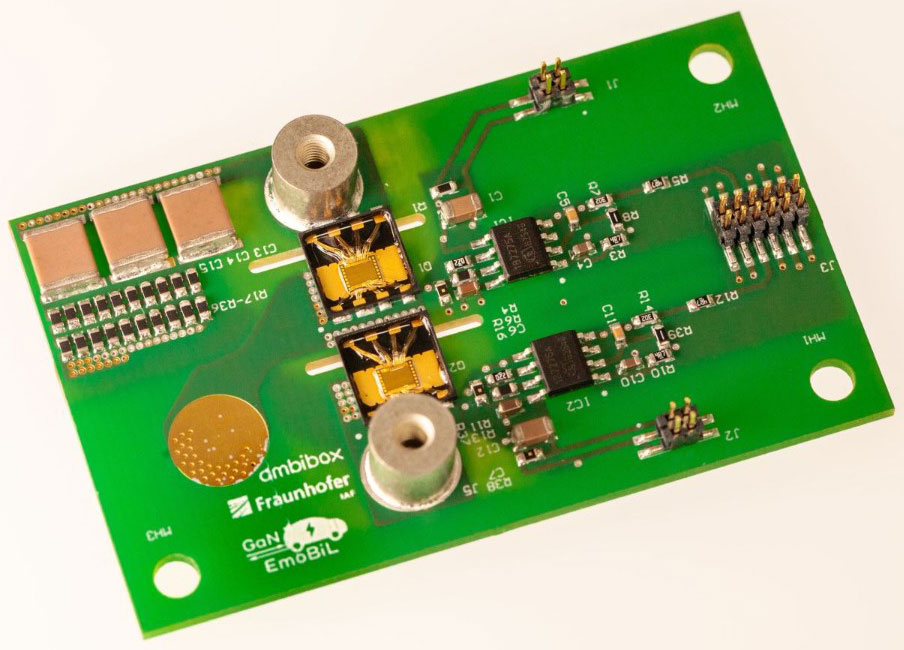
Fraunhofer IAF is presenting a 1200V-class gallium nitride power electronics module for bidirectional electric-vehicle charging at PCIM Europe 2026 in Nuremberg.
The module has been developed for 800V bidirectional direct-current charging systems and is integrated into a single-phase off-board EV charger demonstrator developed by Ambibox. The work forms part of the GaN4EmoBiL project, which is researching GaN power semiconductors for electric mobility and bidirectional charging.
The demonstrator supports bidirectional power of up to 3kW and operates with battery voltages from 150V to 920V. Including plugs, it has a total volume of 8.3 litres and weighs 5.7kg. With both CCS and Schuko connection options, the system has been built around a mobile off-board format rather than a fixed on-board charger architecture.
The 1200V GaN devices are fabricated on an insulating substrate, with the demonstrator used to evaluate device behaviour in high-voltage battery charging conditions. Fraunhofer IAF is using the work to advance GaN power electronics into voltage classes more commonly associated with silicon carbide.
Bidirectional charging changes the role of the vehicle in the electrical system. A vehicle can become a distributed storage asset as well as a load, drawing power when supply is abundant and feeding energy back during peak demand or local grid stress. That function depends on conversion hardware that can handle power flow in both directions while preserving efficiency, protection, and thermal stability.
Off-board charging at 3kW does not replace high-power fixed charging, but it addresses a different use case. A compact, mobile bidirectional unit can reduce the weight and cost burden on the vehicle while still supporting charging flexibility and future vehicle-to-home or grid-support services. Regulatory approval, grid connection rules, and vehicle compatibility will shape deployment, but the hardware direction is already taking form.
EV electronics development is spreading across conversion, test, sensing, and validation. The same wider engineering pressure can be seen in EV battery and ECU test systems being prepared for Stuttgart, where validation equipment is adapting to more complex electrified platforms.
GaN’s attraction is high-speed switching and compact system design, yet 1200V-class operation brings harder questions around reliability, packaging, dynamic on-resistance, isolation, and protection. The Fraunhofer demonstrator is therefore valuable because it places device development inside a working charger, where semiconductor performance has to meet converter-level constraints.
With GaN research now extending toward 1200V and beyond, the competition between wide-bandgap technologies will increasingly be settled at module and system level. Device figures remain important, but converter size, heat removal, control behaviour, manufacturability, and cost will determine how far high-voltage GaN can move into electric mobility.

