IN Brief:
- iDEAL Semiconductor will show its SuperQ silicon MOSFET technology at PCIM Europe.
- The architecture uses a RESURF approach to increase conduction area and reduce switching and conduction losses.
- Silicon power devices are being reworked as GaN and SiC raise expectations for efficiency, density, and thermal performance.
iDEAL Semiconductor will use PCIM Europe to highlight its SuperQ silicon MOSFET technology, bringing a revised silicon power-device architecture into a market increasingly shaped by wide-bandgap performance targets.
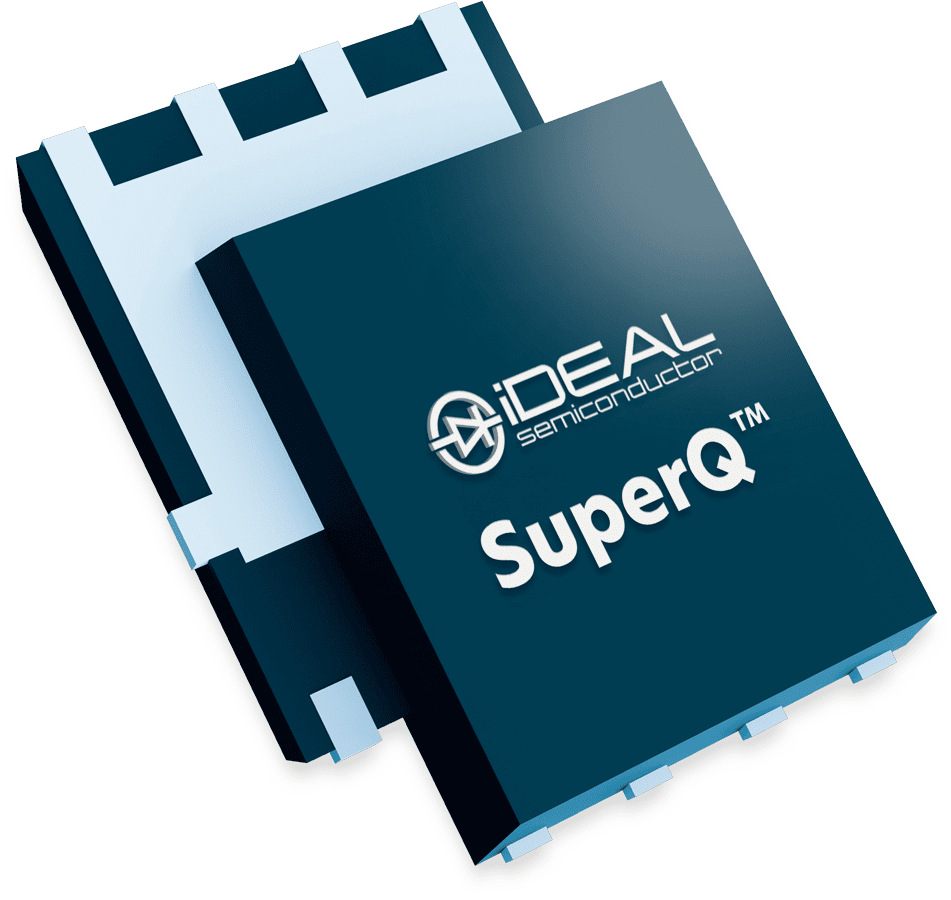
SuperQ is an advanced reduced surface field, or RESURF, silicon MOSFET architecture. The approach increases conduction area and reduces losses while retaining the reliability, manufacturability, and supply-chain stability associated with silicon power devices.
The technology is designed to reduce both conduction and switching losses. iDEAL says SuperQ can deliver up to 3.3 times lower resistance than leading silicon competitors, with lower heat generation and compatibility with existing silicon footprints.
The architecture targets voltages from 60V to 1200V across applications including data centres, USB Power Delivery fast charging, motor drives, electric vehicles, renewable power arrays, e-bikes, medical systems, and home appliances.
Inside the device, the charge-balance structure is altered so that less of the architecture is required for voltage blocking and more area can be used for conduction. That enables higher doping concentration, thinner epitaxy, lower resistance, and improved figures of merit.
Silicon MOSFET development remains active despite the rise of wide-bandgap devices. Nexperia’s US production route for next-generation power MOSFETs shows how established silicon devices continue to serve broad automotive, industrial, computing, and power-supply markets.
GaN and SiC have raised expectations for switching speed, thermal behaviour, and conversion efficiency, but the power-device market is not moving through a single replacement cycle. SiC is gaining ground in high-voltage and high-power conversion, GaN is expanding in compact high-frequency stages, and silicon continues to dominate applications where cost, availability, ruggedness, qualification history, and package familiarity carry substantial weight.
SuperQ is aimed at that competitive middle ground. By improving resistance, losses, and thermal performance within silicon, the architecture gives power designers another route before moving to unfamiliar materials, different gate-drive behaviour, or new supply-chain assumptions.
Converter performance still depends on the full system. Lower on-resistance can reduce conduction losses, but switching behaviour, layout, magnetics, control strategy, thermal impedance, avalanche performance, and package parasitics all shape the final result. Any new MOSFET architecture has to prove itself not only through headline figures, but through how predictably it behaves inside real circuit topologies.
PCIM Europe gives iDEAL a useful technical stage because power semiconductor roadmaps are being tested hardest in data-centre power, EV charging, renewable energy, industrial drives, and solid-state infrastructure. If SuperQ can deliver meaningful silicon gains without forcing major redesign penalties, it could extend the practical performance envelope of MOSFET-based power stages.