IN Brief:
- Edge and micro data centre platforms are running into DIMM-slot and motherboard layout limits.
- Innodisk’s CXL add-in card provides up to 256 GB of DDR5 expansion over PCIe Gen 5 x8 with CXL.mem and CXL.io support.
- The company is targeting low-latency, variable-load environments where memory pooling and flexible allocation are becoming practical.
Innodisk has launched a Compute Express Link (CXL) add-in card aimed at expanding DDR5 memory capacity in edge servers and compact on-premises AI systems, using a PCIe Gen 5 interface to add memory without consuming traditional DIMM slots.
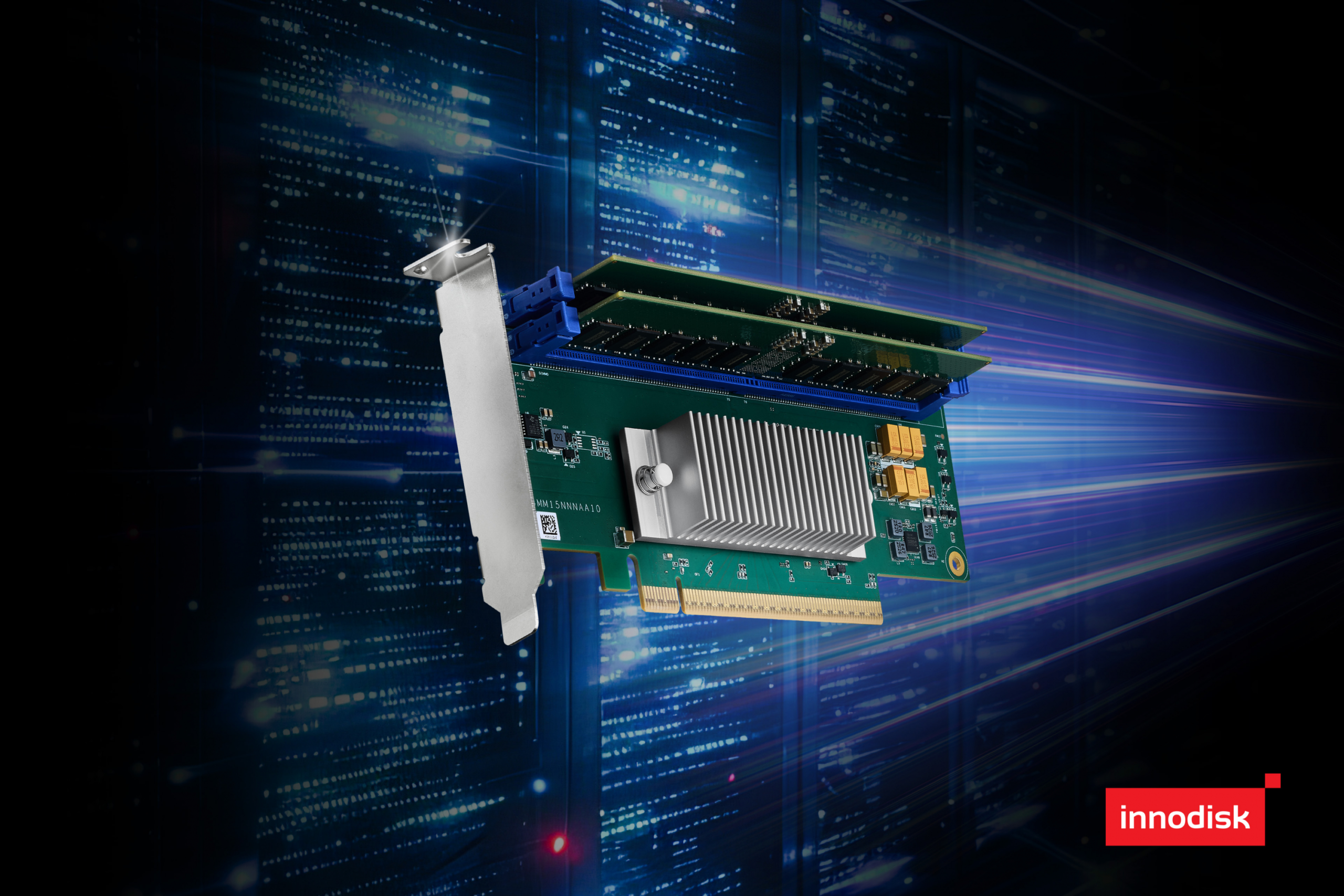
The CXL Add-in Card (AIC) is positioned as a CXL 2.0 Type 3 memory expansion device supporting CXL.mem and CXL.io. The company says the board uses a PCIe Gen 5 x8 link and provides up to 32 GB/s of additional bandwidth, with two onboard DDR5 RDIMM sockets supporting up to 256 GB of expansion capacity via 128 GB modules. In practice, the design is intended to give system architects an extra memory growth path when motherboard DIMM slots are already allocated, or where platform constraints limit the use of higher-density DIMMs.
Innodisk is also leaning on physical integration. The card is offered in a half-height, half-length (HHHL) form factor, with an additional full-height bracket included for chassis compatibility. When paired with the company’s compact DDR5 RDIMM VLP options, the aim is to keep the overall footprint workable in space-constrained enclosures typical of edge deployments and micro data centres.
CXL’s value proposition in this configuration is not only raw capacity. By exposing memory over the CXL fabric, the AIC is positioned to support more dynamic allocation and, where supported by host platforms, memory pooling across workloads. Innodisk is explicitly targeting environments where latency sensitivity and bursty memory demand are hard constraints, including 5G networking infrastructure, high-frequency trading systems, and medical imaging workloads, where the ability to scale memory without a platform redesign can be commercially significant.
The company’s product positioning is a direct response to practical motherboard design limits. As CPU core counts climb and inference pipelines become more memory-hungry, increasing capacity often forces a platform change rather than an incremental upgrade, particularly in embedded server form factors. A CXL card format provides a new upgrade vector: swap or scale RDIMMs on the expansion card as requirements change, while keeping the base system design stable.
Innodisk has said the CXL AIC is scheduled for release in Q1 2026. The launch adds to a wider portfolio push around CXL memory expansion, as CXL moves from standards work and early server enablement into product categories that fit the physical and operational realities of edge infrastructure.