IN Brief:
- Keysight has added an executable whiteboard capability to RF Circuit Simulation Professional.
- The software captures simulations, optimisations, decision trees, parameters, and editable Python code.
- RF design automation is becoming more important as semiconductor teams face skills gaps and rising system complexity.
Keysight Technologies has added an executable whiteboard capability to RF Circuit Simulation Professional, allowing engineers to capture design workflows, simulations, optimisation steps, decision trees, and parameters in a reusable visual environment.
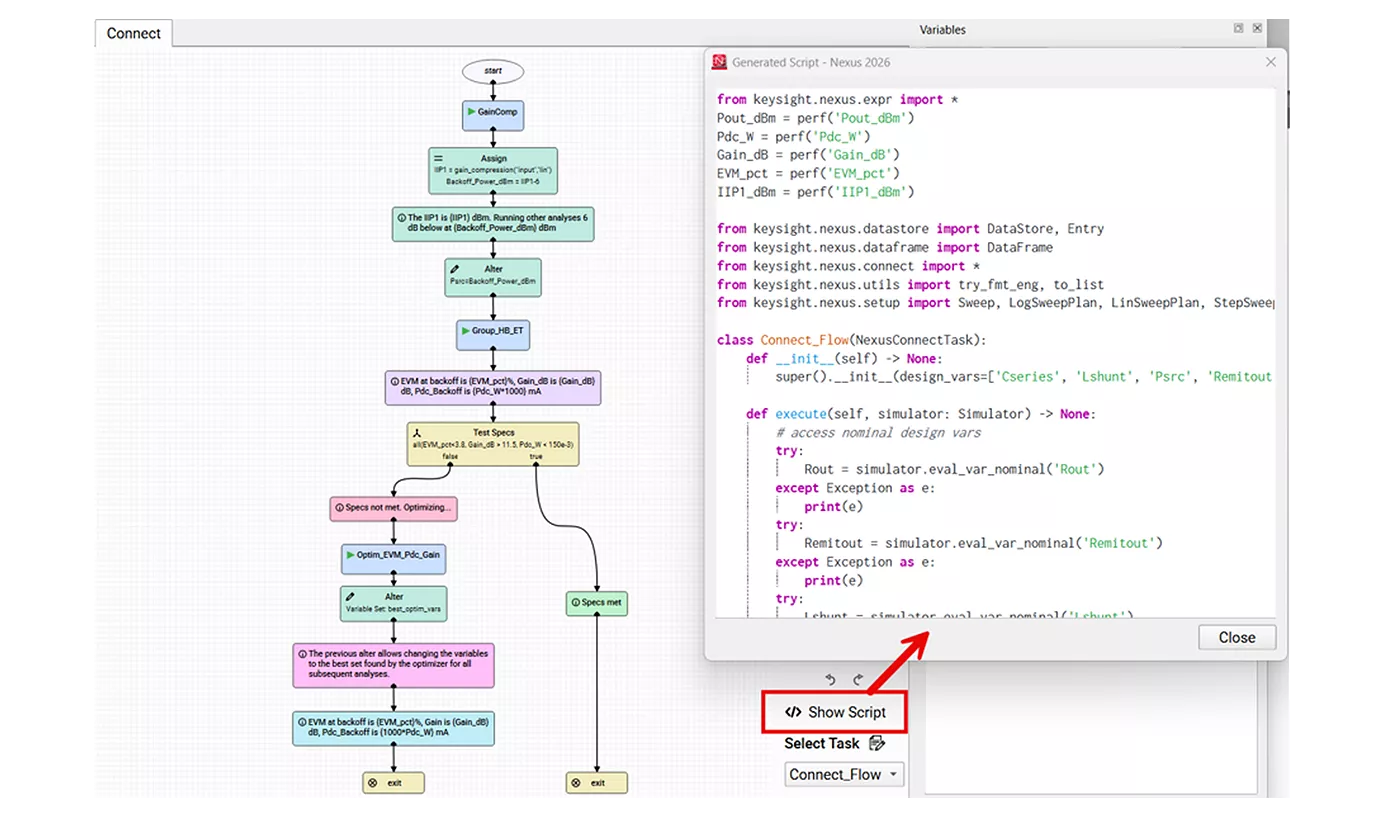
The capability is designed to replicate the engineer’s decision process during RF circuit development. Each step can generate editable Python code that can be saved, shared, and redeployed across Keysight Advanced Design System, Cadence Virtuoso, and Synopsys Custom Compiler environments.
Design teams can build workflows visually on the whiteboard or work through auto-generated Python scripts. Each step can execute simulations, optimisation routines, and design decisions in sequence, with support for decision-based loops and parameter settings. Workflows can then be reused by teams, reviewed, automated, and used as structured data for future AI and machine-learning design processes.
Nilesh Kamdar, EDA General Manager at Keysight, said: “RF design expertise is leaving the industry faster than it can be replaced. The simulation knowledge that senior engineers have accrued cannot be transferred through documentation alone. Design teams now have a way to capture that experience as a visual, executable, reusable workflow. The structured data this generates, and the underlying Python APIs, are the first step toward fully automated, AI/ML-driven RF design.”
Keysight will demonstrate RF Circuit Simulation Professional at IMS2026. The 2026 release also includes a workflow-based user interface, Nexus Connect visual language, workflow usability enhancements, ADS schematic import, multi-domain RF circuit simulation, small-signal and noise analysis, envelope simulation, and parallel optimisation algorithms.
Repeatable RF workflow capture links naturally with the growing use of software-defined test and simulation environments. Keysight and SRC UK’s work on electronic warfare test and simulation shows the same need for controlled, repeatable RF scenarios on the validation side. The new whiteboard addresses design capture, where complex engineering decisions often remain embedded in individual practice.
RF and microwave design is difficult to automate because it crosses electromagnetic effects, device behaviour, packaging, parasitics, temperature, manufacturing variation, and system-level performance. Experienced engineers often know which simulations to run, which trade-offs to test, and when a result is likely to be misleading. Much of that judgement does not transfer cleanly through static documentation.
An executable workflow changes how that experience can be preserved. A sequence of simulations, constraints, parameter sweeps, and decisions can become a reusable method rather than a memory. That supports design review, onboarding, IP reuse, and tapeout preparation in organisations where experienced RF engineers are limited and development schedules are compressed.
The Python layer strengthens that route. AI-assisted design depends on structured data and repeatable execution, not loose notes or isolated simulation files. Turning design steps into editable scripts creates a foundation for workflow mining, optimisation, and future AI agents that can operate inside controlled engineering procedures.
The immediate benefit is more disciplined reuse of RF workflows across projects and teams. Over time, design environments that capture expert reasoning as it happens could make that reasoning executable, auditable, and available to engineers facing similar circuit problems.